Your Perfect Portfolio by Cullen Roche: The 2026 Book That Says There's No Such Thing
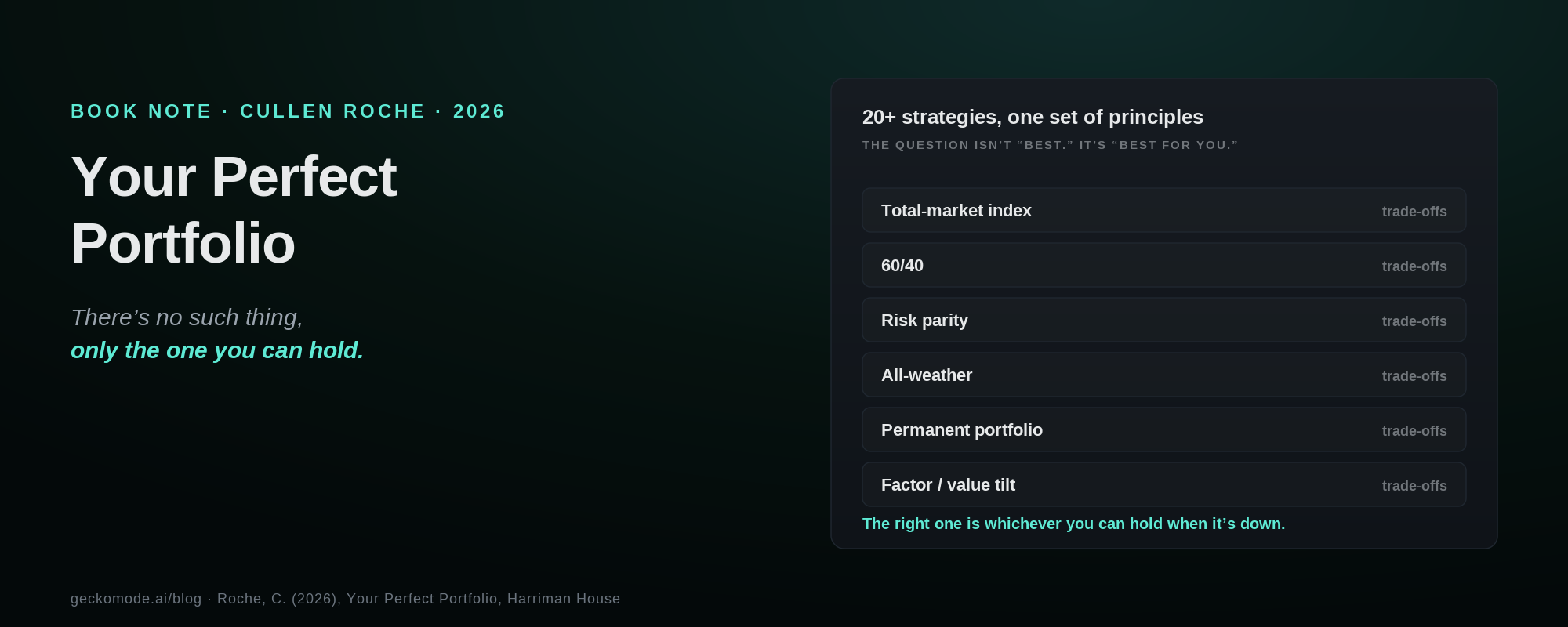
There is a peculiar paralysis that afflicts thoughtful investors: the more they learn, the harder it gets to commit. Index or factor-tilt? Classic 60/40 or risk parity? Permanent portfolio, all-weather, golden butterfly? Each has its evangelists, its backtests, its compelling case, and the result, for many, is an endless, anxious tinkering in search of the one allocation that is theoretically optimal. Cullen Roche’s Your Perfect Portfolio, published by Harriman House in early 2026, exists to cure that paralysis, and it does so with a thesis hidden in plain sight in its own title.
Key takeaways
- Cullen Roche’s 2026 book takes 20-plus well-known investing strategies and grades each against a consistent set of evidence-based principles.
- The verdict is in the title’s irony: there is no single perfect portfolio for everyone. The right one fits your circumstances and, crucially, your temperament.
- His honesty is refreshing: even the best illustrative portfolio delivers a sober long-run return, not a fantasy. This is a build-something-durable book, not a get-rich one.
- The unspoken punchline for traders: the best portfolio in the world is useless if you can’t stick to it, which makes it a behavioral problem, not an allocation one.
The structure: principles first, then the gauntlet
Roche, the founder of Discipline Funds and the long-running Pragmatic Capitalism blog, and one of the clearest myth-busters in finance, builds the book in two halves. The first lays out the fundamental building blocks of portfolio construction: how to think about risk, time horizon, costs, diversification, and the behavioral realities that wreck real portfolios. The second half is the fun part: he runs more than twenty famous strategies (simple total-market indexing, the 60/40, risk parity, Ray Dalio’s all-weather, the permanent portfolio, factor and value tilts, and more) through the gauntlet of those principles, showing honestly what each gets right, what it trades off, and who it actually suits.
What makes this more than a listicle is the consistency of the lens. Instead of cheerleading one approach, Roche holds them all to the same evidence-based standard, which lets you see that most reasonable strategies are, in fact, reasonable: they differ mainly in which risks they take and which investor temperament they fit. That reframes the whole exercise. The question stops being “which is the best portfolio?” and becomes “which is the best portfolio for me?”
The honesty that makes it trustworthy
The most valuable thing about the book is also the least marketable: Roche refuses to oversell. One reviewer grumbled that his highest-performing illustrative portfolio yields a sober long-run figure rather than a thrilling one, and that grumble is actually the book’s integrity showing. Roche is explicit that “this is not a get-rich-quick book,” that perfect is the enemy of the good, and that the realistic goal is a durable, disciplined approach you’ll stick with for decades, not the fantasy allocation that looks best in a cherry-picked backtest. In a genre drowning in overfitted strategies and performance porn, a writer who tells you the honest number and then explains why durability beats optimality is doing you a real service.
Endorsements from Morgan Housel, Josh Brown, and Morningstar’s Christine Benz (who praised its mix of rigorous data and readability) reflect that this is a serious, trusted book rather than a gimmick: the kind of evidence-first, hype-free writing that this blog’s Carlson and Housel reviews also celebrated.
Why it’s really a behavioral book (and where it stops)
Here’s the connection that earns it a place on a trading blog. Roche’s central move, insisting that the right portfolio is the one you can stick with, is a fundamentally behavioral claim disguised as an allocation one. The entire reason “the one you can hold through a drawdown” beats “the theoretically optimal one” is the behavior gap: a mediocre strategy you actually follow beats a brilliant one you abandon at the bottom. Roche is, in effect, telling you to allocate for your psychology, not just your spreadsheet, which is the same truth we drew from Peter Lynch’s investors, who owned the best fund of the era and still lost money by not sticking with it.
And that’s exactly where the book, like every good investing book, has to stop. Roche can help you choose a portfolio matched to your temperament, and he can tell you that sticking with it is the whole game. What he can’t do (what no book can) is tell you whether you actually stuck with it the last time your plan was underwater, or whether you quietly tinkered, chased and bailed. The book frames the behavioral problem beautifully. Your own record is the only thing that answers it.
From belief to behavior: did you stick with the plan?
| Roche’s principle | The fingerprint of breaking it in your record |
|---|---|
| Pick a portfolio you can hold | Repeated strategy changes and tinkering: chasing the “better” allocation instead of holding a good one. |
| Perfect is the enemy of good | Performance-chasing: switching into whatever’s recently worked; see recency bias. |
| Durability over optimality | Abandoning the plan during a drawdown, the exact moment discipline is tested and the behavior gap opens. |
| Allocate for your temperament | Risk sized for the backtest, not for what you can stomach; see size discipline. |
Roche can help you choose the plan; only your record shows whether you held it. Upload a broker statement and Gecko scores your tinkering, performance-chasing and drawdown behavior in dollars across twelve behavioral axes. No login or broker connection needed, first 100 trades free.
An educational tool, not financial advice.
Resources and further reading
- The book: Roche, C. (2026), Your Perfect Portfolio, Harriman House: principles of construction plus 20-plus strategies graded against them.
- The author: Cullen Roche’s Pragmatic Capitalism blog and Discipline Funds, for the fuller evidence-based, myth-busting worldview.
- Companion 2026 reads: Gecko on Ben Carlson’s Risk and Reward and Meb Faber’s Investing in America.
- The allocation classics: Bogle, J., The Little Book of Common Sense Investing, and Bernstein, W., The Four Pillars of Investing.
- The behavioral evidence: DALBAR’s QAIB and SPIVA: why the portfolio you stick with beats the one you abandon.
Frequently asked questions
What is Your Perfect Portfolio about?
Published by Harriman House in January 2026, it’s a practical, evidence-based guide to portfolio construction. Part one covers the building blocks; part two grades 20-plus strategies (indexing, risk parity, permanent portfolio, factor tilts, and more) against consistent principles. Its message: there’s no single perfect portfolio, so build one suited to your circumstances and temperament, and don’t let the hunt for perfection wreck a good-enough plan.
Who is Cullen Roche?
An investment manager and writer, founder of Discipline Funds and the Pragmatic Capitalism blog, known for clear, data-driven, myth-busting commentary on macro and portfolios. Your Perfect Portfolio (2026) drew endorsements from Morgan Housel, Josh Brown, and Morningstar’s Christine Benz.
What is the main lesson?
Perfect is the enemy of good. Many popular strategies are reasonable and none is optimal for everyone, so the right portfolio is the one that fits you and that you can hold through good times and bad. Roche is candid that even his best illustrative portfolio delivers a sober long-run return; the point is durability, not a get-rich number.
Is it worth reading?
Yes, especially if you feel paralyzed by competing strategies or keep tinkering for the optimal one. The 20-plus-strategy comparison against consistent principles is genuinely useful and readable. The caveat: it’s about allocation and construction, not day-to-day trading behavior, and some felt a few sample portfolios lean conservative for younger investors. It helps you choose a sensible portfolio; whether you stick to it is a behavioral question it can frame but not solve.
Book note in Gecko’s trading psychology series. Details about Your Perfect Portfolio are drawn from the publisher’s and author’s materials and published reviews as of 2026. Gecko has no commercial relationship with the author or publisher. Gecko is an educational and informational tool. Nothing here is financial, investment or trading advice, or a recommendation of any allocation or security. Investing carries substantial risk of loss.
Drop in a single statement. Gecko produces a one-page Behavioral Diagnosis ranking your costliest habits in actual dollars. Free to start. No card. No broker connection.
Twelve checks, one per behavioral habit, that show what your own trading costs you. Then one behavioral self-check from the research, every other Friday.
No account needed. We only use your email for the newsletter, and every email has a one-click unsubscribe.
More on the blog
- Most Trading Journals Ask What You Did. Gecko Tells You What It Cost You.A trading journal is a logbook: you type in trades and feelings, then audit yourself. Gecko reads your broker statement, tests twelve behavioral habits for real patterns, and prices each one in dollars. Here's why we built it that way.
- The Behavioral Investor by Daniel Crosby: The Four Tendencies Behind Almost Every Investing MistakePsychologist and asset manager Daniel Crosby compresses the long list of investing biases into four roots: ego, conservatism, attention and emotion. His defense is process over willpower. What the book can't tell you is which tendency is costing you money.
- Our Dollar, Your Problem by Kenneth Rogoff: Is Dollar Dominance Running Out of Road?Harvard economist and former IMF chief economist Kenneth Rogoff traces seven decades of dollar dominance and argues it is real but contingent, with the gravest threats internal: debt, dysfunction and the end of ultra-low rates. For traders, the lesson is time horizon: a slow tide is not a daily signal.