Most Trading Journals Ask What You Did. Gecko Tells You What It Cost You.
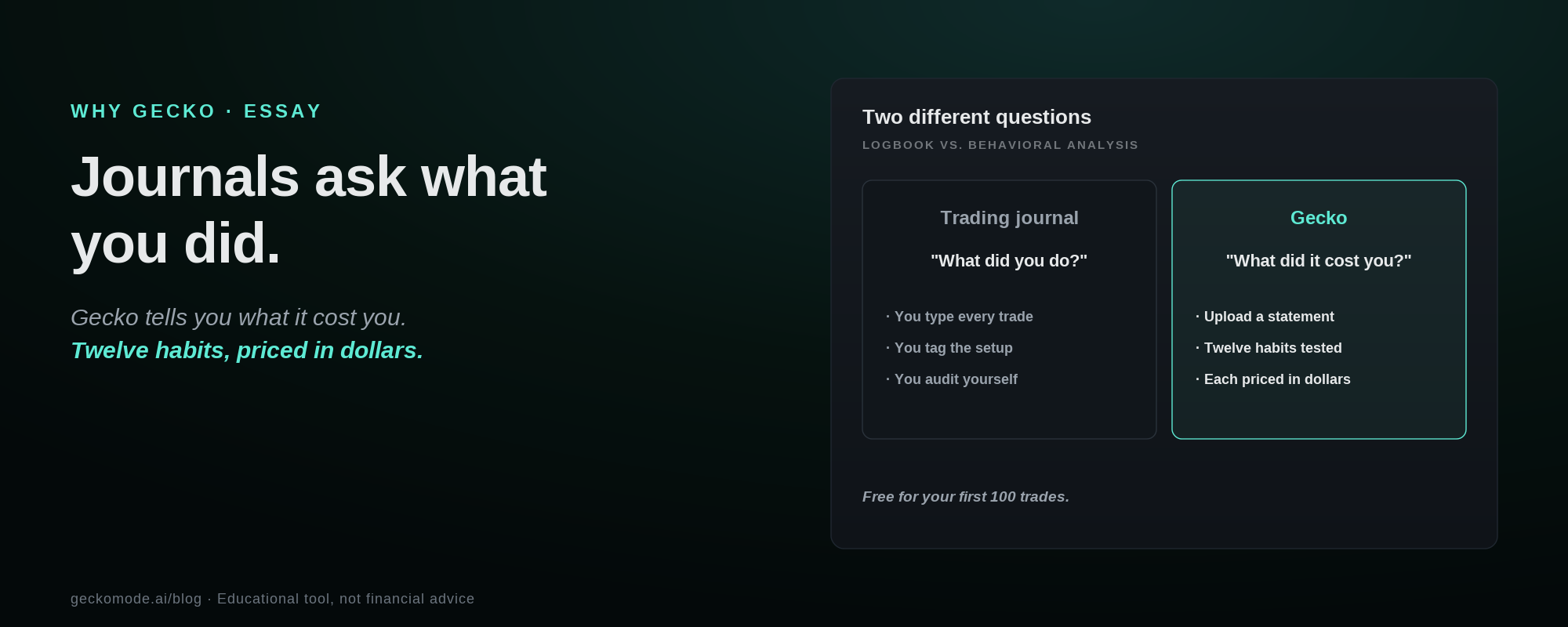
Almost every trading journal asks you the same question: what did you do? You type in the trade, the setup, maybe how you felt. Then you’re expected to read it all back and spot your own patterns. Gecko starts from a different question: what is that habit costing you? That one change is the whole product.
Key takeaways
- The typical journal is a logbook: you enter trades, reasons and feelings, and you do the analysis yourself.
- Gecko inverts that. Upload a broker statement and it grades your behavior across twelve habits and prices each pattern in dollars. No typing, no broker connection.
- The difference isn’t features, it’s the question. Other journals ask “what did you do?” Gecko answers “what is that habit costing you?”
- We built it this way because the gap between a decent strategy and a good year is mostly behavioral, and behavior is what a self-reported diary measures worst.
The problem with the diary model
Most trading journals are, underneath, a spreadsheet with better styling. You enter each trade by hand, tag the setup, note your mood, and then review it to find your patterns. The catch is that the same mind that produced the bad trades is the one doing the review. The trader who oversizes after a win is not the best auditor of whether they oversize after a win. Self-report is where behavioral errors hide, because we remember the disciplined trades and quietly edit out the flinches.
What Gecko does instead
You upload a broker statement: the actual record, not your recollection of it. Gecko reads the trades and scores your behavior across twelve habits, including size discipline, revenge trading, tilt after losses, cutting winners early and holding losers, overtrading, and when in the day or week you trade worst. It doesn’t just flag them; it estimates what each one cost, in dollars. “You tend to re-enter right after a loss” is easy to shrug off. “Re-entering within five minutes of a loss cost you about $2,100 over these trades” (an illustrative figure) is not.
Three things that make it different
It measures behavior, not trades. The unit of analysis isn’t the position, it’s the pattern. Any journal can show a red P&L number. Gecko isolates the repeated behavior underneath it and tests whether it’s a real pattern or just noise, separating losses from bad luck from losses from bad habits, a distinction Trading in the Zone spends a whole book insisting on.
It prices the habit in dollars. Behavioral finance has known for decades that the behavior gap, the cost of our own worst instincts, is large; studies such as DALBAR’s annual investor-behavior report put it at percentage points a year. Gecko makes it personal: not “investors underperform,” but “this pattern, in your account, cost this much.” An abstract bias becomes a line item.
There’s nothing to maintain. No daily data entry and no handing your brokerage password to anyone. You bring a statement and get an analysis of your first 100 trades free, with a free account. The friction that kills manual journals, logging every trade honestly every day, is exactly the discipline a struggling trader is short of. So we removed it.
What we’re not
Gecko won’t give you entries, signals or a strategy. It’s not a trade-idea service and it’s not financial advice. There are good tools for finding setups; this isn’t one of them. What Gecko does is the part almost nothing else does well: hold up an honest, dollar-priced mirror to how you actually behave once the position is on. Every book we review on this blog, from Douglas to Crosby to Peter Lynch’s own investors, lands on the same conclusion: the edge is behavioral. We built the tool that measures it.
Upload a broker statement and Gecko ranks the habits costing you money. No broker connection needed; your first 100 trades are free with a free account.
An educational tool, not financial advice.
Frequently asked questions
How is Gecko different from a trading journal?
A journal records what you did and leaves the analysis to you. Gecko reads your actual trades from a broker statement, tests twelve behavioral habits for real patterns, and prices each one in dollars.
Do I have to enter my trades by hand?
No. Upload a statement or trade export (CSV or PDF). Paid plans can also connect brokers read-only so new trades arrive automatically.
Does Gecko tell me what to trade?
No. It measures your past behavior and its cost. It never gives signals, picks or advice.
Gecko is our product; this post explains how it works. Dollar figures are illustrative. Gecko is an educational and informational tool. Nothing here is financial or trading advice. Trading carries substantial risk of loss.
Drop in a single statement. Gecko produces a one-page Behavioral Diagnosis ranking your costliest habits in actual dollars. Free to start. No card. No broker connection.
Twelve checks, one per behavioral habit, that show what your own trading costs you. Then one behavioral self-check from the research, every other Friday.
No account needed. We only use your email for the newsletter, and every email has a one-click unsubscribe.
More on the blog
- The Behavioral Investor by Daniel Crosby: The Four Tendencies Behind Almost Every Investing MistakePsychologist and asset manager Daniel Crosby compresses the long list of investing biases into four roots: ego, conservatism, attention and emotion. His defense is process over willpower. What the book can't tell you is which tendency is costing you money.
- Our Dollar, Your Problem by Kenneth Rogoff: Is Dollar Dominance Running Out of Road?Harvard economist and former IMF chief economist Kenneth Rogoff traces seven decades of dollar dominance and argues it is real but contingent, with the gravest threats internal: debt, dysfunction and the end of ultra-low rates. For traders, the lesson is time horizon: a slow tide is not a daily signal.
- Nvidia After the Air Came Out: A Behavioral Read on NVDARecord revenue, a stock near 52-week lows, a drift to Hold ratings and a sudden CEO change. Gecko has no view on whether NVDA is a buy. The useful question is how you behave around the market's most emotionally charged ticker.