Investing in America by Meb Faber: 250 Years, One Bull Market, and a Warning for Today
There’s a certain kind of market book you don’t read so much as fall into: the kind you leave on the coffee table, flip open at a random decade, and look up an hour later. Meb Faber’s Investing in America, published in 2026 to mark the United States’ 250th anniversary, is that book. It is part data project, part photo album, part argument, and underneath the lavish production is a single, deceptively simple thesis that every panicking investor needs tattooed somewhere visible: America has always come back. Whether that remains a safe assumption is the interesting question, and to his credit, Faber doesn’t dodge it.
Key takeaways
- Timed to America’s 250th birthday, Faber’s 2026 book is a lavish, chart-and-photo history of US markets with one message: the long-term investor in America has always, eventually, been rewarded.
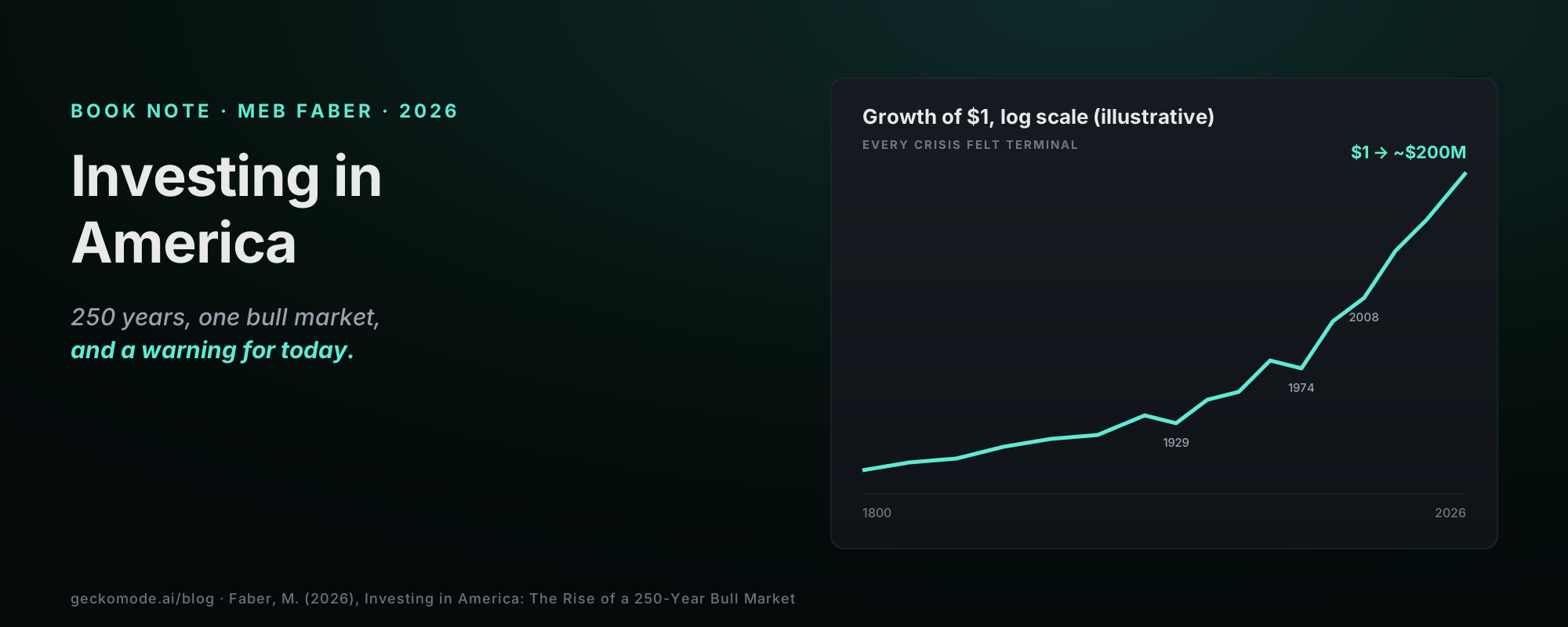
- The headline stat is a jaw-dropper: $1 invested in 1800 would be worth roughly $200 million today, through every war, crash and pandemic in between.
- But it’s not naïve cheerleading. Faber pairs the optimism with a warning that US valuations are near record highs, and argues for rebalancing globally rather than assuming America always wins.
- Its real power is behavioral: it’s an antidote to the recency bias and panic that make investors bail at exactly the wrong moments.
The thesis: resilience, rendered in charts
Faber, co-founder and chief investment officer of Cambria and a long-standing voice in quantitative, trend-following investing, set out to tell the entire financial story of the United States: from the joint-stock companies that financed the first colonies through the railroads, the 1929 crash, the Depression, the post-war boom, the inflation of the 1970s, the dot-com mania, 2008, and on to today’s AI-driven economy. He tells it decade by decade, and the cumulative effect is the book’s argument: every one of those eras contained a crisis that felt, at the time, like it might be the end, and in every one, the patient long-term investor who stayed invested was rewarded.
The number that anchors it is almost absurd: Faber calculates that $1 invested in America in 1800 would be worth something like $200 million today, dividends compounding across two and a quarter centuries of wars, panics, bubbles and pandemics. The point isn’t the specific figure; it’s the shape of the story. Catastrophe after catastrophe, each one survived, each one followed by new highs. It is the single most powerful visual argument for not selling in a panic that you can put in front of a nervous investor.
Why it’s really a behavioral book
We review a lot of investing books on this blog, and the best of them keep arriving at the same destination from different roads: the enemy is not the market, it’s the investor’s own behavior. Investing in America gets there through history. By forcing you to inhabit the past, to see that 1932, 1974, 2002 and 2009 all felt terminal and all turned out to be opportunities, Faber is really inoculating you against recency bias, the bug that makes whatever’s happening now feel permanent. It’s the same service Sorkin’s 1929 and Carlson’s Risk and Reward perform: history as a vaccine against present-tense panic. Faber just does it with the best charts in the business.
And this is the quiet link to the data on how people actually build wealth: the fortune in Faber’s $200-million dollar didn’t go to the clever or the brave. It went to whoever simply didn’t sell. The entire 250-year return is a reward for a behavior, staying invested, that is psychologically much harder than it sounds, precisely because every generation faced a moment when selling felt like the only sane choice.
The part that saves it from cheerleading
A book titled The Rise of a 250-Year Bull Market could easily have been a triumphalist victory lap for American exceptionalism, published at a market top. What rescues it, and what makes it useful right now, is that Faber refuses to end on blind optimism. He is explicit that US stocks sit at historically elevated valuations, with the Shiller CAPE near its second-highest reading ever, and that starting valuations matter enormously for future returns. His prescription is not “America always wins, so pile in.” It’s the opposite: precisely because the US is so expensive and so dominant right now, he argues for systematically rebalancing toward a global allocation rather than assuming the last decade’s leadership will continue forever.
That tension (deep long-run optimism about markets, real humility about today’s entry point) is the mature investor’s actual worldview, and it connects directly to our essays on concentration and how the AI boom is being financed. Faber manages to be a bull on human progress and a skeptic on current prices at the same time, which is a harder and more honest place to stand than either pure permabull or permabear.
The honest limitation
Two caveats, in fairness. First, survivorship hovers over any “America always comes back” story. The US is the single most successful market in history, and other great markets (Japan after 1989, or the markets that simply vanished in wars and revolutions) tell a bleaker tale. Faber’s own argument for global diversification is partly an acknowledgment of this, but a reader should hold the US-centric frame lightly.
Second, and more to our point: this is a book about grand history and asset allocation, operating at the altitude of decades. It will steady your nerves and widen your lens, but it can’t tell you whether you actually behaved the way it recommends the last time your portfolio was down 30%. That gap between the wisdom and your own conduct is the one Gecko exists to close, and it’s the one every great investing book, Faber’s included, leaves open.
From belief to behavior: did you stay invested?
| Faber’s lesson | The fingerprint of ignoring it in your record |
|---|---|
| Stay invested through the crisis | Exits concentrated on the worst days, then no re-entry before the recovery: the panic sale that forfeits the $200-million dollar. |
| Every “this time” felt terminal | Activity and fear spiking with volatility rather than opportunity; see recency bias. |
| Mind the starting valuation | Piling into the most expensive, most-loved names near highs; hidden concentration you didn’t choose. |
| Diversify beyond the recent winner | A “diversified” book that’s really one bet on the last decade’s leadership; see size discipline. |
Faber’s 250 years of charts are useless if you sold at the bottom of your own drawdown. Upload a broker statement and Gecko scores your drawdown behavior, concentration and tilt in dollars across twelve behavioral axes, so you can see whether you actually stayed the course. No login or broker connection needed, first 100 trades free.
An educational tool, not financial advice.
Resources and further reading
- The book: Faber, M. (2026), Investing in America: The Rise of a 250-Year Bull Market, Cambria: decade-by-decade US market history, charts, and the case for long-run resilience and global diversification.
- The author: the Meb Faber Research blog and The Meb Faber Show podcast, plus his earlier Global Asset Allocation and The Ivy Portfolio.
- Companion 2026 read: Ben Carlson, Risk and Reward: history as a stress test, reviewed in Gecko’s Book Notes.
- The valuation backdrop: Gecko on the AI debt machine and concentration: the “mind your entry point” case in numbers.
- The behavioral evidence: DALBAR’s Quantitative Analysis of Investor Behavior: the measured cost of not staying invested.
Frequently asked questions
What is Investing in America by Meb Faber about?
Published in 2026 for America’s 250th anniversary, it’s a lavishly illustrated, decade-by-decade history of US markets from colonial joint-stock companies to the AI economy. Its message: through wars, crashes, bubbles and pandemics, long-term investors in America have been rewarded; $1 invested in 1800 would be worth roughly $200 million today. Part chart-filled coffee-table book, part argument for long-run optimism and diversification.
Who is Meb Faber?
An investor, author, and co-founder and CIO of Cambria Investment Management, known for research on trend-following and tactical allocation, the Meb Faber Research blog and podcast, and earlier books like The Ivy Portfolio and Global Asset Allocation. Investing in America (2026) is his most ambitious, visual book.
What is the main lesson?
That America has consistently bounced back and the biggest mistake is bailing during the scary periods. But Faber isn’t blindly bullish: he flags that US valuations are historically elevated and argues for rebalancing globally rather than assuming US leadership continues. Long-run optimism paired with humility about the starting point.
Is it worth reading?
Yes, especially as an antidote to short-term panic and recency bias. The sweep of history reminds you that today’s crisis rarely looks special a century on, and the format makes it enjoyable. The limitation for an active trader: it works at the level of grand history and allocation, not day-to-day behavior, so it steadies nerves but won’t tell you whether you’re behaving as it recommends.
Book note in Gecko’s trading psychology series. Details about Investing in America are drawn from the publisher’s and author’s materials and public summaries as of 2026; the $1-to-$200-million and CAPE figures are approximate and as presented by the book and contemporaneous data. Gecko has no commercial relationship with the author or publisher. Gecko is an educational and informational tool. Nothing here is financial, investment or trading advice, or a recommendation of any allocation or security. Investing carries substantial risk of loss.
Drop in a single statement. Gecko produces a one-page Behavioral Diagnosis ranking your costliest habits in actual dollars. Free to start. No card. No broker connection.
Twelve checks, one per behavioral habit, that show what your own trading costs you. Then one behavioral self-check from the research, every other Friday.
No account needed. We only use your email for the newsletter, and every email has a one-click unsubscribe.
More on the blog
- The Art of Spending Money by Morgan Housel: The Sequel to The Psychology of Money, and What It Means for TradersHousel's 2026 follow-up turns from building wealth to using it, and argues spending well is a psychological art, not a math problem. The same wiring that makes people spend to impress (envy, status, never feeling "enough") is the wiring that makes traders overtrade, oversize and chase.
- Divided Government and the Market: Is "Gridlock Good"? What the 2026 Midterms Mean for TradersThe 2026 midterms produced divided government. Wall Street's reflex is "gridlock is good," but the evidence is genuinely mixed, and a 152-year causal study finds the opposite. The configuration explains a small, noisy slice of returns. The bigger risk is trading your politics.
- Jim Chanos: The Short-Seller Who Called Enron, and Is Sounding the Alarm on AIChanos spent 38 years finding the rot others missed, most famously Enron. His method is forensic: read the footnotes and believe the numbers over the narrative. Now he is one of the loudest skeptics of the AI data-center build-out, and his career is also the clearest lesson that being right and being early are different skills.