Risk and Reward by Ben Carlson: The 2026 Book That Takes a Wrecking Ball to Its Own Advice
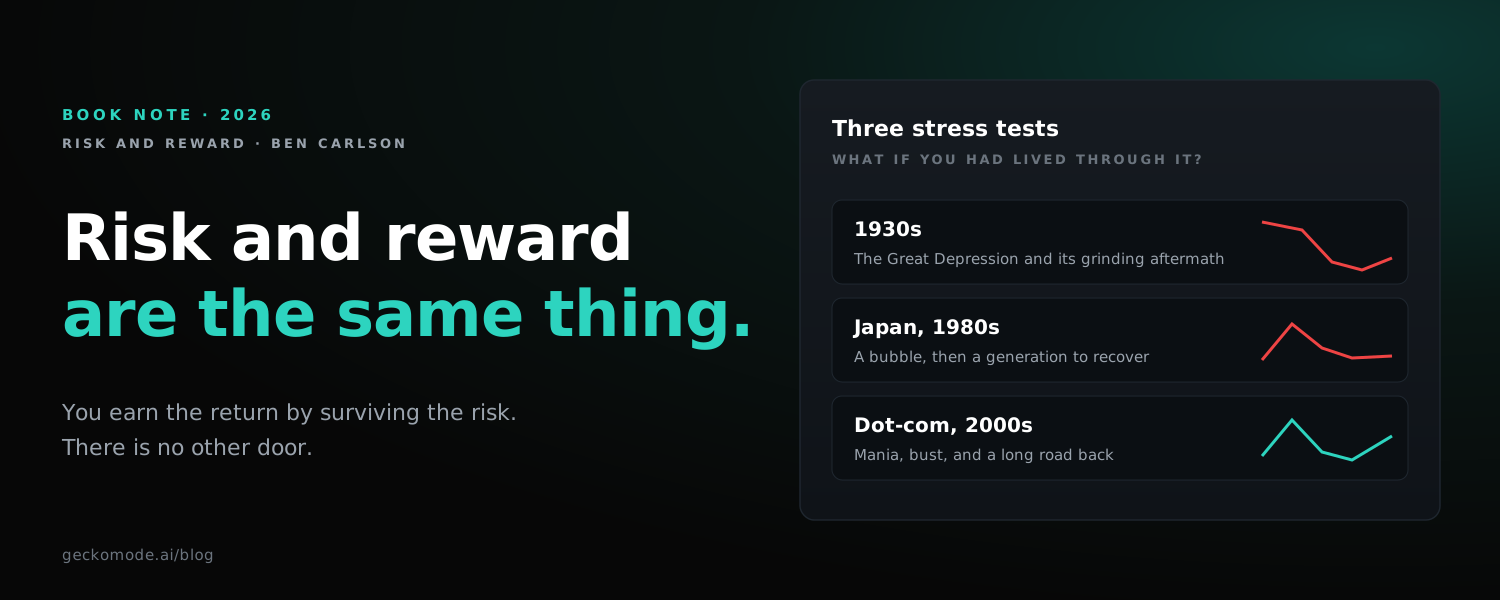
Most investing books are sales pitches for the author’s method. The best ones do the opposite: they attack their own conclusions and report honestly on what survives. Ben Carlson’s Risk and Reward, published by Harriman House in May 2026, belongs firmly in the second, rarer category. The publisher describes it as Carlson taking “a wrecking ball” to his own investment philosophy, which, for someone who has spent more than a decade as one of the most trusted voices for calm, stay-the-course, long-term investing, is a brave thing to do. The result is one of the most useful market books of the year, and its central lesson is exactly the one active traders violate most.
Key takeaways
- Carlson’s 2026 book does the rare, admirable thing: it stress-tests his own long-term investing philosophy against history’s worst markets to see where it breaks.
- The through-line is one idea every trader forgets under pressure: risk and reward are inseparable. You can’t have the returns without enduring the volatility.
- Its tour of the 1930s, Japan’s 1980s bubble and the dot-com bust is a powerful antidote to recency bias and “this time is different.”
- The one gap: it’s superb on philosophy and plan, but stops short of measuring whether your own behavior actually matches the advice.
Who’s writing, and why it matters
Ben Carlson is director of institutional asset management at Ritholtz Wealth Management, author of the long-running blog A Wealth of Common Sense and co-host of the Animal Spirits podcast. His whole brand is the unglamorous, data-driven, behavior-first case for staying invested, the opposite of the day-trading hype machine. That’s what makes this book interesting: it’s the calm-investing evangelist turning his skepticism on his own gospel. When someone whose reputation rests on “stay the course” writes a book probing where “stay the course” fails, it’s worth reading, because honesty is the only obvious incentive to write it. (His colleague Barry Ritholtz’s How Not to Invest makes a good companion.)
The thesis: you cannot separate the two
The title is the argument. Carlson’s core contention is that risk and reward are not two dials you can set independently; they are the same phenomenon viewed from two sides. The returns that build long-term wealth are the compensation for enduring volatility, drawdowns and the periodic conviction that the whole thing is falling apart. You don’t get the reward by cleverly dodging the risk; you get it by surviving the risk. Anyone who promises you the upside without the white-knuckle stretches is selling something that has never existed.
This sounds obvious written down, and it is exactly the thing that becomes impossible to remember at 2 p.m. on a crash day. The value of the book is that Carlson makes the abstract concrete by walking you through the actual history: not the sanitized “markets always recover” version, but the lived experience of how long, how deep and how psychologically unbearable the recoveries could be.
The best part: history as a stress test
Where the book earns its keep is the historical tour, because Carlson uses it as a genuine stress test rather than a highlight reel. He works through the Great Depression and its grinding 1930s aftermath, the Japanese bubble of the 1980s and the decades of stagnation that followed, and the bursting of the dot-com mania in the 2000s. In each, he asks the uncomfortable question most “long-term investing works” books avoid: what if you’d been the one living through it? What if your market was Japan, where the index took a generation to recover? What if the “temporary” drawdown lasted longer than your patience, or your career?
This is bracingly honest, and it’s the perfect counterweight to the habit we’ve written about repeatedly on this blog: recency bias and the conviction that the recent past predicts the future. By making the reader inhabit the ugliest episodes, Carlson inoculates against both the euphoria of a bull market and the despair of a crash. It’s the same service Sorkin’s 1929 performs for the crash and When Genius Failed performs for leverage: history as a vaccine against “this time is different.”
The real lesson: the danger is you
The deepest point in the book, and the one that makes it belong on a behavioral site, is that the crash is rarely what actually hurts investors. What hurts them is what they do during the crash. A market recovery does the investor no good if they sold at the bottom; the drawdown is survivable, but the panic sale is permanent. Carlson’s history keeps returning to this: the difference between the people who were destroyed by the 1930s or the dot-com bust and the people who came out ahead was far more often their behavior than their analysis. Reward went to those who could sit still while everything in them screamed to act.
This is the conclusion the behavior gap data reaches from the quantitative side, and the discipline the great traders we profile, from Paul Tudor Jones to Ed Thorp, build their careers on. Carlson arrives at it through history and common sense; the research arrives at it through data; the traders arrive at it through scar tissue. They all land in the same place: survival is a behavior, and behavior is most of the game.
The honest criticism
Two caveats, in fairness. First, this is a book for long-term investors, not active traders. Carlson’s prescriptions (diversify, keep costs low, hold through the pain, don’t try to time it) are aimed at building wealth over decades, and an active trader looking for setups or tactics won’t find them here. That’s not a flaw; it’s a different book than the title might suggest, and worth knowing going in.
Second, and more to our point: the book is excellent at telling you what to do and why, and largely silent on how to know whether you’re actually doing it. “Stay invested through the drawdown” is correct and, on its own, not very useful, because almost everyone agrees with it and many people still sell. The missing layer, and the one Gecko exists for, is measurement: an honest, dollar-denominated record of how you actually behaved the last time your screen turned red, versus how you tell yourself you behaved. Carlson gives you the philosophy. Your own history gives you the audit.
From belief to behavior: does your record match the advice?
Carlson’s lessons convert cleanly into things you can check in your own account.
| Carlson’s lesson | The fingerprint of ignoring it in your record |
|---|---|
| You earn returns by surviving risk. | Exits concentrated on the worst days, then no re-entry before the recovery: the permanent loss inside a temporary drawdown. |
| The danger is your behavior, not the crash. | Activity and size spiking with volatility rather than with edge; see after-loss tilt. |
| History rhymes; don’t extrapolate the present. | Sizing up on the recent trend, then a large loss on the reversal: recency bias in the data. |
| Survive to be paid. | A worst-loss-to-typical-win ratio a single event could end, or one holding that dominates the book; see size discipline. |
Carlson gives you the philosophy. Your record gives you the audit.
“Control your behavior in a drawdown” is easy to agree with and hard to verify. Gecko puts every account in one view with a return that strips out deposits and withdrawals, shows your drawdown and concentration across the whole portfolio, and scores uploaded trade history for drawdown behavior, tilt and sizing in dollars across twelve behavioral axes, so you can see whether you actually stay the course or just intend to.
See how you actually behave in a drawdown →Free to start. 14-day Pro trial. An educational tool, not financial advice.
Resources and further reading
- The book: Carlson, B. (2026), Risk and Reward: How to Handle Market Volatility and Build Long-Term Wealth, Harriman House (published May 12, 2026).
- The author: Ben Carlson’s blog A Wealth of Common Sense and the Animal Spirits podcast, for the fuller behavior-first, data-driven worldview.
- Companion 2026 read: Faber, M. (2026), Investing in America: The Rise of a 250-Year Bull Market, a decade-by-decade history of US markets and the case for long-run resilience.
- The history vaccine: Gecko on 1929 and When Genius Failed, the same use of history against “this time is different.”
- The behavioral evidence: DALBAR, Quantitative Analysis of Investor Behavior, on the measured cost of behaving badly in drawdowns.
Frequently asked questions
What is Risk and Reward by Ben Carlson about?
Published by Harriman House in May 2026, it argues that risk and reward are inseparable: you can’t earn the returns without enduring the volatility. Carlson, of Ritholtz Wealth Management and A Wealth of Common Sense, stress-tests his own long-term philosophy against history’s worst markets (the 1930s, Japan’s 1980s bubble, the dot-com bust) to see where the standard advice holds and where it breaks.
Who is Ben Carlson?
An investment writer and director of institutional asset management at Ritholtz Wealth Management, best known for the blog A Wealth of Common Sense and the Animal Spirits podcast, and for a plain-spoken, data-driven, behavior-first approach. Risk and Reward (2026) is his latest book.
What is the main lesson of Risk and Reward?
That there is no reward without risk, and the job is not to avoid volatility but to survive it long enough to be paid for it. History shows the danger is rarely the crash itself; it’s the investor’s behavior during the crash. The book is largely a guide to building the temperament and plan that make staying invested possible.
Is Risk and Reward worth reading for traders?
Yes, though it’s written for long-term investors, not active traders. Its core idea (risk and reward are inseparable, and behavior in drawdowns decides outcomes) is exactly what active traders most need, and its history tour is a strong antidote to recency bias. The gap for a trader is that it stops at philosophy and plan; it doesn’t help you measure whether your behavior matches the advice.
Book note in Gecko’s investing and trading psychology series. Details about Risk and Reward are drawn from the publisher’s materials and public descriptions of the book as of September 2026. Gecko has no commercial relationship with the author or publisher. Gecko is an educational and informational tool. Nothing here is financial, investment or trading advice. Investing and trading carry substantial risk of loss.
Drop in a single statement. Gecko produces a one-page Behavioral Diagnosis ranking your costliest habits in actual dollars. Free to start. No card. No broker connection.
Short notes, usually once or twice a month. Unsubscribe in one click.
No account needed. We use your email only to send Gecko blog posts, and the link at the bottom of every email opts you out in one click.
More on the blog
- Value Investing Is a Behavioral Strategy, Not an Analytical OneWhy does value investing work? If it were about analysis, the edge would have been arbitraged away decades ago. Lakonishok, Shleifer & Vishny (1994) argued the value premium comes from the crowd over-extrapolating growth, not from extra risk, and De Bondt & Thaler (1985) documented the overreaction it feeds on. The balance-sheet work is learnable and widely known; the temperament to buy what everyone hates and sit through a lost decade is rare. Your spreadsheet won't fail you. Your psychology will.
- Which Strategies Actually Make Millionaires? The Boring Answer, Backed by 10,000 of ThemIf you learned about wealth from social media, you'd think millionaires are minted by 0DTE options, ten-baggers, leveraged crypto, and Lamborghini day-trading. The largest study of US millionaires (Ramsey, 10,000 people) tells a very different story: 8 in 10 named their 401(k) as their #1 wealth-builder, none credited single-stock picking, 89% didn't inherit. Fidelity now counts ~645,000 401(k) millionaires; the average one is nearly 59 and has been in the same account ~25 years. The strategy that mints millionaires isn't a strategy — it's a habit repeated for decades. And it's the same trait every disciplined trader we've profiled shares.
- Jim Simons: The Mathematician Who Beat the Market — and Why You Can't Copy HimRenaissance Technologies' Medallion Fund averaged ~66% gross (~39% net) a year from 1988 to 2018, never had a losing year, and turned $1 into more than $27,000. It is the greatest track record ever recorded — and the definitive counterexample to the efficient-market hypothesis (Cornell, 2020, JPM). Simons wasn't a market natural. He was a world-class mathematician and former NSA codebreaker who turned pattern-detection on prices with an army of PhDs. The honest lesson: his edge is unrepeatable at retail scale — his RELATIONSHIP to evidence and risk (edge measured not felt, process over outcome, never blow up) is what's transferable.