Peter Lynch: The Legend Who Returned 29% a Year, While His Investors Lost Money
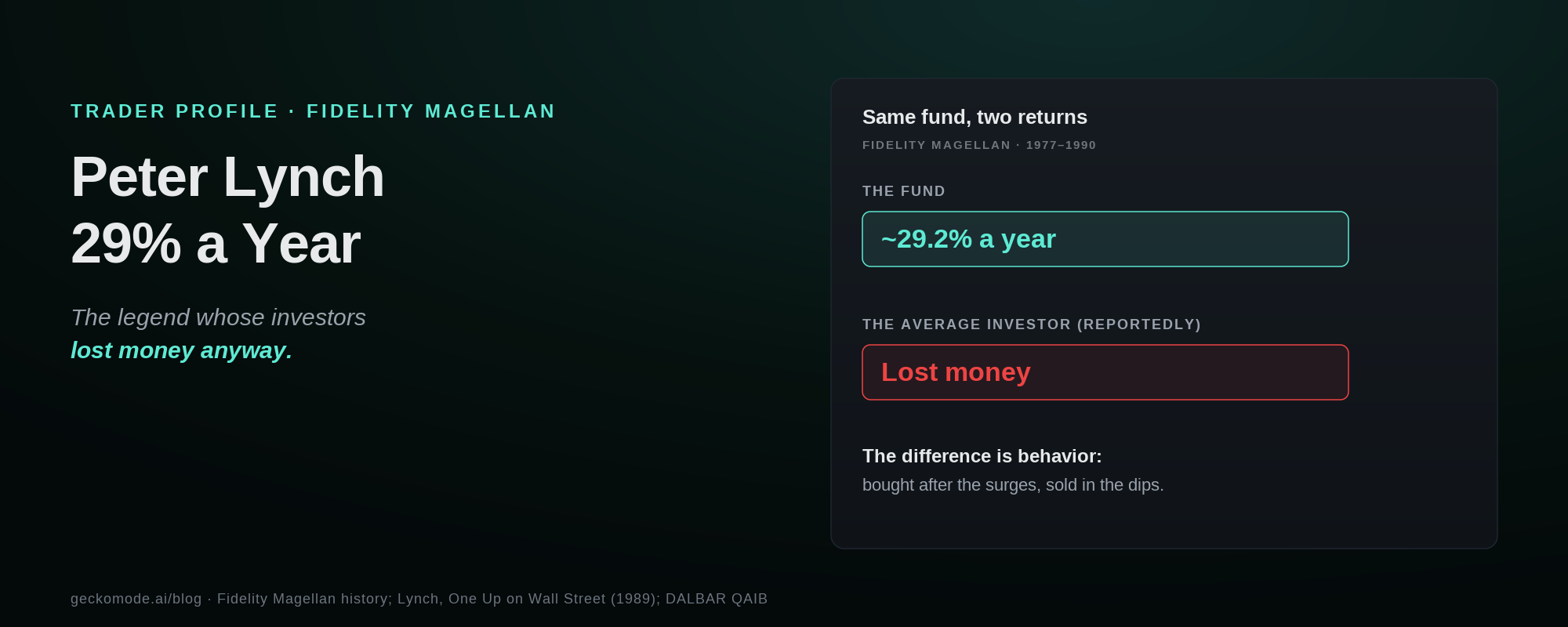
Here is the most important sentence in trading, told as a true story. In the 1980s there was a mutual fund so good it became a legend: Fidelity’s Magellan, run by a plain-spoken stock-picker named Peter Lynch, compounded at roughly 29% a year for 13 years, the kind of return that turns a modest sum into a fortune and makes a manager immortal. And according to a claim that has haunted the industry ever since, the average person who invested in that fund lost money. Not because the fund failed (it was spectacular) but because the investors couldn’t stop themselves from buying high and selling low. If you understand why that happened, you understand almost everything this company exists to fix.
Key takeaways
- Peter Lynch ran Fidelity Magellan to roughly 29% a year from 1977 to 1990, one of the greatest records in fund history, growing it from under $20M to ~$14B.
- His philosophy was disarmingly simple: “buy what you know,” hunt for ten-baggers, and never own a stock you can’t explain in a sentence.
- The gut-punch: a widely cited claim holds that the average Magellan investor lost money during his tenure, because they bought after the surges and sold in the dips.
- That’s the whole blog in one story. The best strategy on earth can’t save you from your own behavior, and the gap between the two is measurable.
The record, and the man
Lynch took over the small, obscure Magellan Fund in 1977 and ran it until he retired, young and on top, in 1990. Over those 13 years he averaged about 29.2% a year, roughly double the market’s return, and turned Magellan into the largest and most famous mutual fund in America. He did it not with exotic derivatives or macro genius but with shoe leather: he was famous for visiting companies, reading reports obsessively, and following his own curiosity about the products and stores winning in ordinary life. He is, by the numbers, one of the greatest stock-pickers who ever lived, and unusually, he walked away at the peak to spend time with his family, itself a kind of discipline.
The philosophy: buy what you know, and keep it simple
Lynch’s genius was partly that his method sounded like something anyone could do, and in spirit it was. “Buy what you know” was his banner: pay attention to the companies you encounter in daily life (the restaurant that’s always packed, the product your kids won’t stop using, the retailer quietly taking over) because ordinary people often spot great businesses before Wall Street does. But the slogan is widely misremembered. Lynch never said “buy a stock because you like the product.” He said use everyday observation to generate ideas, and then do the homework: read the financials, understand the business, know why it will grow. His discipline was clarity: if you couldn’t explain in a sentence why you owned a company, you had no business owning it.
He hunted for “ten-baggers,” stocks that rise tenfold, and his patience was central to the strategy: you don’t get a ten-bagger by trading in and out, you get it by finding a great company early and holding through the noise while it compounds. That combination of simple idea-generation, real research and patient holding is genuinely learnable, and it’s why One Up on Wall Street remains one of the most useful investing books ever written for a general reader.
The twist that makes him a Gecko hero
And now the part that elevates Lynch from “great investor” to “the most important cautionary tale in this whole blog.” The returns above are the fund’s returns: what you’d have earned by buying on day one and holding untouched to the end. But that’s not what people did. According to a much-repeated finding attributed to Fidelity’s own research, the average investor in Magellan actually lost money over Lynch’s tenure. How is that even possible in a fund compounding at 29%? Behavior. Money flooded in after Magellan had already posted a hot stretch and was splashed across magazine covers; then, when the fund had an inevitable rough patch (and even a 29%-a-year fund has gut-wrenching drawdowns along the way), those same investors panicked and redeemed. They bought high, sold low, and did it over and over, so their personal timing converted the best fund of the era into a personal loss.
An honest caveat, because we insist on them: the precise statistics here are debated, the “average versus most” wording varies by source, and the original Fidelity study is frustratingly hard to pin down. Treat the exact number as folklore. But the phenomenon is not folklore at all. It is the single most robust finding in all of personal finance, the behavior gap that DALBAR measures every year: the return investors actually earn is reliably lower than the return of the very funds they own, and the difference is entirely self-inflicted, created by buying and selling at the wrong times. Magellan is just the most dramatic example ever recorded. The best strategy on earth, handed to real humans, got sabotaged by the humans.
The final lesson: Lynch told you to index
There’s a perfect coda. After retiring, the greatest stock-picker of his generation spent years telling ordinary investors that they should mostly just buy a low-cost index fund and stop trying to be him. That wasn’t false modesty. It was the same clarity that made him great, applied to human nature. He understood that his edge was inseparable from a temperament and a workload most people don’t have, and that for the average person, the attempt to pick stocks and time the market would, through the behavior gap, do more harm than good. It’s the exact conclusion Malkiel reached from theory, arrived at here by the man who proved stock-picking could work, and watched his own clients fail to benefit from it.
From belief to behavior: are you earning your fund’s return?
| Lynch’s lesson | The fingerprint of ignoring it in your record |
|---|---|
| Hold winners into ten-baggers | Cutting winners early and trading in and out, forfeiting the compounding that is the entire point. |
| Buy in, stay in | Entering after a run-up and selling in the drawdown: the Magellan investor’s exact mistake, and the behavior gap in your own data. |
| Own only what you can explain | Positions with no one-sentence thesis, a feeling or a headline rather than a reason; see overtrading. |
| Behavior, not strategy, decides returns | A sound approach quietly undone by mistimed entries and exits; see size discipline. |
The fund made 29%; the average investor lost money. The gap is behavior, and it’s measurable in your own account. Upload a broker statement and Gecko scores your timing, holding behavior and overtrading in dollars across twelve behavioral axes. No login or broker connection needed, first 100 trades free.
An educational tool, not financial advice.
Resources and further reading
- In his own words: Lynch, P., One Up on Wall Street (1989) and Beating the Street (1993): “buy what you know,” ten-baggers, and his research process.
- The record: the Fidelity Magellan Fund history, ~29.2% annualized, 1977–1990.
- The behavior-gap claim: the widely cited (and debated) Fidelity finding that the average Magellan investor lost money during Lynch’s tenure. Treat exact figures as folklore, the phenomenon as well established.
- The documented gap: DALBAR’s Quantitative Analysis of Investor Behavior: the measured shortfall between fund returns and investor returns.
- The indexing conclusion: Gecko on A Random Walk Down Wall Street: the same advice Lynch gave, from theory.
Frequently asked questions
Who is Peter Lynch?
An American investor who ran Fidelity’s Magellan Fund from 1977 to 1990 to about 29.2% a year, one of the greatest fund records ever, growing it from under $20M to ~$14B. He popularized “buy what you know,” wrote One Up on Wall Street and Beating the Street, and later said most ordinary investors should simply buy a low-cost index fund.
What was his strategy?
Bottom-up, common-sense stock-picking: find promising companies in everyday life, then do the homework before buying. He hunted for ten-baggers and favored understandable businesses with strong growth at reasonable prices, famously insisting you should be able to explain in a sentence why you own a stock.
Did Magellan’s investors lose money under Lynch?
A widely repeated claim attributed to Fidelity research says the average Magellan investor lost money during his tenure despite the fund’s ~29% return, because they bought after surges and sold in pullbacks. The exact figures and “average vs most” wording are debated and the study hard to source, but the underlying behavior gap it illustrates is very well documented.
What can traders learn from Peter Lynch?
That a great strategy is worthless if your behavior sabotages it: even the best fund of its era couldn’t save people who bought high and sold low. The transferable habits: clarity (own only what you can explain), patience (let winners compound), and humility (he told the public to index). The gap between a good strategy and your actual returns is behavior.
Trader profile in Gecko’s trading psychology series. Lynch’s ~29.2% Magellan record is from Fidelity’s fund history; the claim that the average Magellan investor lost money during his tenure is widely cited but attributed to a Fidelity study that is difficult to source directly, and the exact figures are debated. It is presented here to illustrate the well-documented behavior gap, not as a precise statistic. Gecko has no affiliation with Peter Lynch or Fidelity. Gecko is an educational and informational tool. Nothing here is financial, investment or trading advice. Investing carries substantial risk of loss.
Drop in a single statement. Gecko produces a one-page Behavioral Diagnosis ranking your costliest habits in actual dollars. Free to start. No card. No broker connection.
Twelve checks, one per behavioral habit, that show what your own trading costs you. Then one behavioral self-check from the research, every other Friday.
No account needed. We only use your email for the newsletter, and every email has a one-click unsubscribe.
More on the blog
- Most Trading Journals Ask What You Did. Gecko Tells You What It Cost You.A trading journal is a logbook: you type in trades and feelings, then audit yourself. Gecko reads your broker statement, tests twelve behavioral habits for real patterns, and prices each one in dollars. Here's why we built it that way.
- The Behavioral Investor by Daniel Crosby: The Four Tendencies Behind Almost Every Investing MistakePsychologist and asset manager Daniel Crosby compresses the long list of investing biases into four roots: ego, conservatism, attention and emotion. His defense is process over willpower. What the book can't tell you is which tendency is costing you money.
- Our Dollar, Your Problem by Kenneth Rogoff: Is Dollar Dominance Running Out of Road?Harvard economist and former IMF chief economist Kenneth Rogoff traces seven decades of dollar dominance and argues it is real but contingent, with the gravest threats internal: debt, dysfunction and the end of ultra-low rates. For traders, the lesson is time horizon: a slow tide is not a daily signal.