The Art of Spending Money by Morgan Housel: The Sequel to The Psychology of Money, and What It Means for Traders
Morgan Housel has a rare gift: he writes about money the way a good novelist writes about people, and The Psychology of Money became one of the best-selling finance books of the century precisely because it was really a book about human nature. His 2026 follow-up, The Art of Spending Money, takes on the question the first book left open. The Psychology of Money taught you how to build wealth through patience and good behavior. This one asks the harder, stranger question that almost no finance book addresses: once you have some money, how do you actually spend it in a way that makes your life better? And why do so many people, including the rich, get this so badly wrong?
Key takeaways
- Housel’s 2026 follow-up to The Psychology of Money turns from building wealth to using it, and argues spending well is a psychological art, not a math problem.
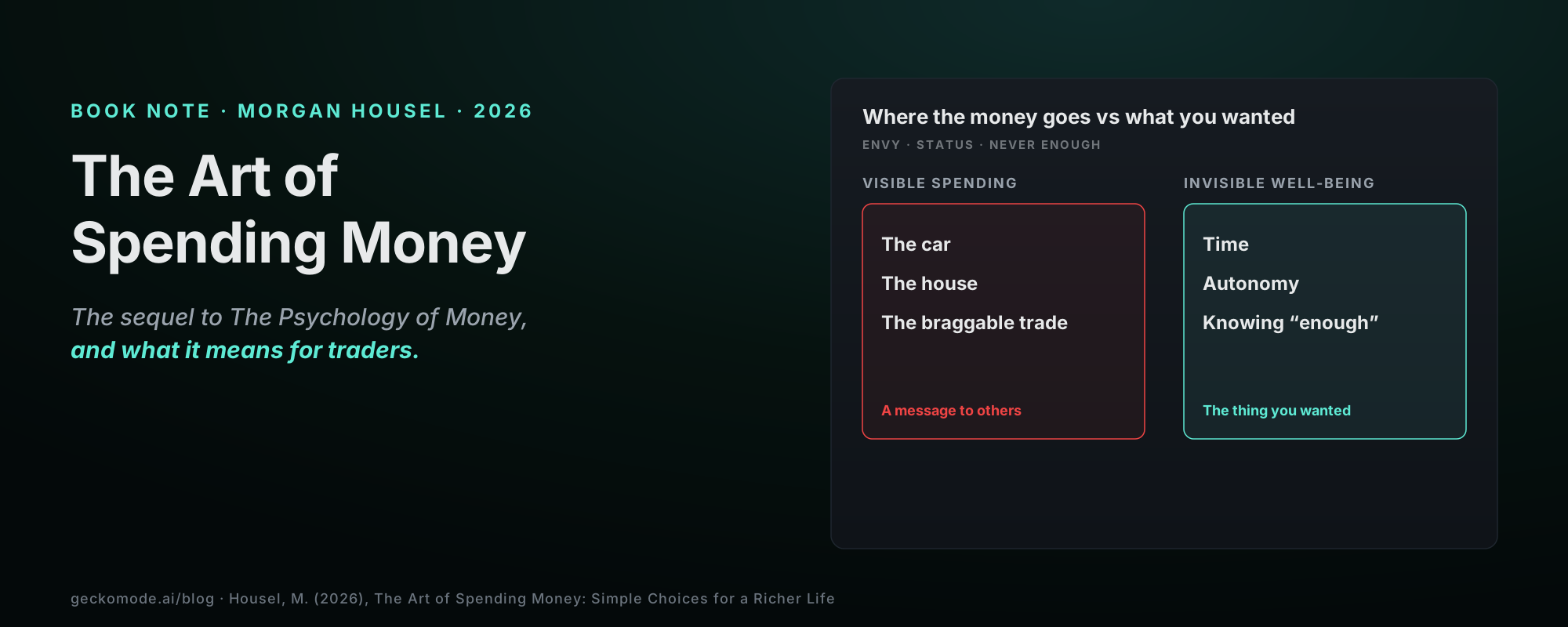
- The sharpest idea: visible spending tells you nothing about invisible well-being. The Ferrari in the driveway is a signal to others, not evidence of a good life.
- The highest returns on money, he argues, come from buying time, experiences and autonomy, not stuff.
- Why it’s on a trading blog: the same wiring that makes people spend to impress (envy, status, never feeling “enough”) is the wiring that makes traders overtrade, oversize and chase.
The thesis: spending is a feeling, not a formula
Housel’s central claim is deceptively simple and quietly radical: spending money well is a psychological skill, not a mathematical one. The personal-finance industry treats spending as an optimization problem (budgets, categories, the “latte factor”), but Housel argues that misses the point entirely, because the thing you’re really trying to optimize isn’t dollars, it’s life satisfaction, and life satisfaction runs on emotions that spreadsheets can’t see. Two people can spend identical sums and get wildly different amounts of happiness from them, because happiness depends on why they spent and what it meant to them, not on the amount.
From that follow his best reframes. The most pointed: visible spending tells you nothing about invisible well-being. The expensive car, the big house, the status purchase: these are signals aimed at other people, and they’re a terrible proxy for whether the owner is actually living a good life. Often they’re evidence of the opposite, of money spent to manage other people’s perceptions rather than one’s own contentment. And his most useful positive claim: the highest real returns on money come from buying time, experiences and autonomy (the freedom to control your own days) rather than possessions, which we adapt to and stop noticing with startling speed.
Why a trading blog is reviewing a book about spending
Here’s the connection that makes this more than an off-topic pick. The psychological forces Housel identifies behind bad spending are the exact same forces this blog spends its life identifying behind bad trading. Envy, spending to keep up with a neighbor, is the same engine as chasing a hot trade because someone on your feed posted gains. The failure to define “enough” (the reason a rich person keeps grinding for a bigger number that never satisfies) is the same reason a profitable trader can’t stop and gives it all back. Status-seeking, the need to look successful, is the same impulse that makes a trader take the exciting, braggable position over the boring, correct one.
Housel is, in effect, writing the spending chapter of the same book we write about trading. His entire worldview, that outcomes depend on behavior and temperament far more than technical knowledge, is the founding premise of behavioral trading. Whether the arena is a brokerage account or a shopping cart, the enemy is the same: a set of ancient social instincts (envy, status, adaptation, the inability to feel “enough”) that were useful on the savanna and are expensive in a market or a mall. Read this book and you’ll recognize your trading self on every page.
The honest criticism
Fairness requires the main knock, and reviewers have made it: if you’ve read Housel before, parts of The Art of Spending Money will feel familiar. His gift is clarity and reframing rather than novelty, and some longtime readers found this book reinforces and sharpens the emotional themes of The Psychology of Money more than it introduces new frameworks: a greatest-hits in a new key rather than a new album. That’s a real limitation if you’re looking for fresh intellectual machinery. It’s less of one if you accept that the lessons of behavioral finance are few, simple and almost impossible to actually live by, which is exactly why they bear repeating. We are not, as a species, short on money information. We are short on money behavior, and a book that makes the behavior stick is worth more than a book of novel facts you’ll ignore.
The other honest note: this is a book for people who have largely won the saving-and-investing game and still feel oddly unsatisfied. If you’re earlier in the journey, still building the discipline to save and not blow up, Housel’s Psychology of Money lessons on patience and behavior are the more urgent read.
From belief to behavior: the same wiring, two arenas
| Housel’s spending trap | The same instinct in your trade history |
|---|---|
| Envy / keeping up | Chasing hot, crowded trades because others are posting gains; see attention-driven buying. |
| Never defining “enough” | Giving back profits because you can’t stop; overtrading a winning streak into a loss. See overtrading. |
| Spending to signal status | Taking the exciting, braggable trade over the boring, correct one; oversizing for the story. |
| Adapting to gains, chasing more | Each win raising the bar so no profit satisfies: the treadmill that drives risk ever higher. See size discipline. |
Housel shows how envy and “never enough” wreck your spending. They wreck your trading the same way, and your record proves it. Upload a broker statement and Gecko scores your overtrading, sizing and chasing in dollars across twelve behavioral axes. No login or broker connection needed, first 100 trades free.
An educational tool, not financial advice.
Resources and further reading
- The book: Housel, M. (2026), The Art of Spending Money: Simple Choices for a Richer Life: the follow-up to The Psychology of Money, on using wealth well.
- The author’s canon: Housel, The Psychology of Money (2020) and Same as Ever (2023), and his writing at the Collaborative Fund.
- The behavioral science: research on hedonic adaptation and on experiences versus possessions (for example Gilovich and colleagues): the academic basis for “buy experiences, not stuff.”
- The trading parallel: Gecko on attention and sensation-seeking: the same envy and status wiring in the market.
- The wealth-building companion: Gecko on how people actually become millionaires: the behavior Housel’s first book taught.
Frequently asked questions
What is The Art of Spending Money about?
Published in 2026, Morgan Housel’s follow-up to The Psychology of Money shifts from building wealth to using it well. His argument: spending is a psychological art, not a math problem. Visible, status-driven spending reveals little about real well-being, and the best returns on money come from buying time, experiences and autonomy rather than possessions.
Who is Morgan Housel?
A writer and partner at the Collaborative Fund, best known for The Psychology of Money (2020), one of the century’s best-selling finance books, and Same as Ever (2023). His storytelling style argues that financial outcomes depend far more on behavior and temperament than technical knowledge, making him a leading voice in behavioral finance.
What is the main lesson?
That how you spend reveals and shapes what you value, and most people spend badly because of envy, status-seeking and failing to notice what truly makes them happier, not because of bad math. Treat time and autonomy as the real returns, be skeptical of spending meant to impress others, and define “enough” as a psychological state, not a number. Behavior, not knowledge, decides whether money improves your life.
Is it worth reading?
For most, yes: warm, readable, full of useful reframes about money and happiness. The caveat: longtime Housel fans may find it familiar territory, reinforcing The Psychology of Money more than breaking new ground. It suits readers who’ve largely solved saving and investing but still feel no happier; those still saving may get more from his earlier work.
Book note in Gecko’s trading psychology series. Details about The Art of Spending Money are drawn from the book, the publisher’s materials and published reviews as of 2026. Gecko has no commercial relationship with the author or publisher. Gecko is an educational and informational tool. Nothing here is financial, investment or trading advice. Trading carries substantial risk of loss.
Drop in a single statement. Gecko produces a one-page Behavioral Diagnosis ranking your costliest habits in actual dollars. Free to start. No card. No broker connection.
Twelve checks, one per behavioral habit, that show what your own trading costs you. Then one behavioral self-check from the research, every other Friday.
No account needed. We only use your email for the newsletter, and every email has a one-click unsubscribe.
More on the blog
- Divided Government and the Market: Is "Gridlock Good"? What the 2026 Midterms Mean for TradersThe 2026 midterms produced divided government. Wall Street's reflex is "gridlock is good," but the evidence is genuinely mixed, and a 152-year causal study finds the opposite. The configuration explains a small, noisy slice of returns. The bigger risk is trading your politics.
- Investing in America by Meb Faber: 250 Years, One Bull Market, and a Warning for TodayTimed to America's 250th birthday, Faber's 2026 book is a chart-and-photo history of US markets: $1 invested in 1800 would be worth roughly $200 million today. But it's not cheerleading. Faber pairs the optimism with a warning about record valuations and a case for global rebalancing, and its real power is as an antidote to panic selling.
- Jim Chanos: The Short-Seller Who Called Enron, and Is Sounding the Alarm on AIChanos spent 38 years finding the rot others missed, most famously Enron. His method is forensic: read the footnotes and believe the numbers over the narrative. Now he is one of the loudest skeptics of the AI data-center build-out, and his career is also the clearest lesson that being right and being early are different skills.