Our Dollar, Your Problem by Kenneth Rogoff: Is Dollar Dominance Running Out of Road?
In 1971, as the US cut the dollar’s last tie to gold and the rest of the world scrambled, Treasury Secretary John Connally reportedly told a room of European finance ministers that the dollar was “our currency, but your problem.” More than half a century later, Kenneth Rogoff has borrowed the line for the title of a book that asks whether the arrangement Connally so breezily described is finally running out of road. Our Dollar, Your Problem, published by Yale University Press in 2025, is at once a history, a memoir of a career spent inside global finance, and a sober, carefully hedged forecast.
Key takeaways
- Kenneth Rogoff (Harvard economist, former IMF chief economist, chess grandmaster) traces seven decades of dollar dominance and asks how long it can last.
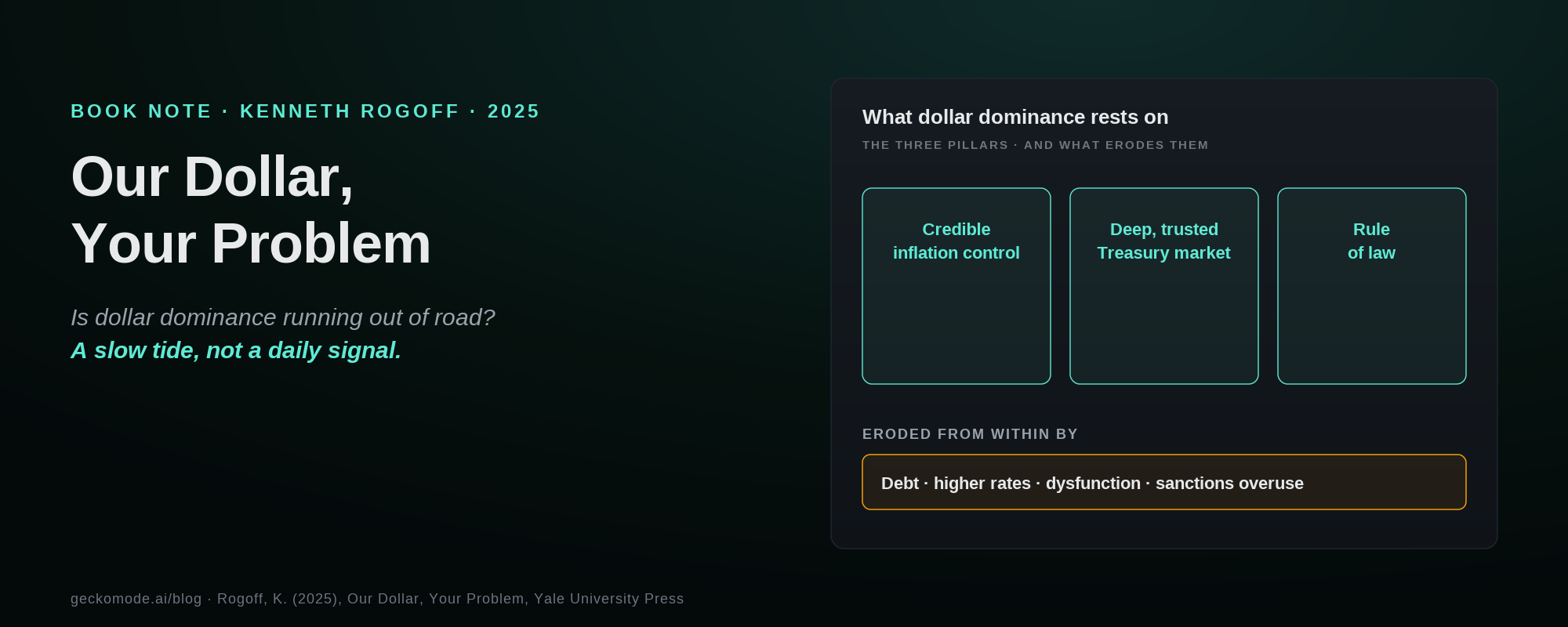
- His thesis: the dollar’s reign is real and valuable but contingent, not permanent. It rests on credible inflation control, deep Treasury markets, and the rule of law.
- The gravest threats are internal: unsustainable debt, political dysfunction, and the end of the ultra-low-rate era that flattered US finances, not any single foreign rival.
- For traders, the lesson is about time horizon: reserve-currency shifts are slow-moving tides, not daily signals, and mistaking one for the other is a behavioral error.
The authority behind the argument
Rogoff is uniquely placed to write this book. A professor of economics at Harvard, a former chief economist of the International Monetary Fund, and (in an earlier life) a world-class chess grandmaster, he co-wrote with Carmen Reinhart the landmark 2009 study of financial crises, This Time Is Different, which assembled centuries of data to show how predictably debt booms end in tears. That book’s discipline runs through this one: Rogoff is temperamentally suspicious of anyone, in any era, who insists the current arrangement is permanent because it has lasted a while. The phrase “this time is different,” he has long argued, is the four most dangerous words in finance.
What the dollar’s dominance actually buys
The book is clear-eyed about why dollar supremacy matters. It hands the United States what the French once enviously called an “exorbitant privilege”: the ability to borrow cheaply in its own currency, to run deficits others could not sustain, to clear a huge share of global trade and finance through its banks, and, increasingly, to project power through financial sanctions that work precisely because so much of the world runs on dollars. Rogoff walks through the crises of the last fifty years (the 1970s inflation, the Latin American debt crises, Japan’s bubble, the Asian financial crisis, 2008, the euro’s troubles) showing again and again how a shock somewhere else became, through the plumbing of dollar finance, everyone’s problem.
Why Rogoff thinks the risk is internal
The heart of the book, and its most relevant passage for anyone trading today, is Rogoff’s insistence that the dollar’s rivals are not its real danger. He is skeptical that the euro, the renminbi, gold or crypto will dethrone it any time soon; each faces deep structural or political limits. The threat he takes seriously is self-inflicted: a US debt load that an era of near-zero interest rates made to look manageable, now colliding with structurally higher rates; recurring political dysfunction around the debt ceiling and budgets; the temptation to inflate away obligations; and the overuse of sanctions, which quietly gives the rest of the world a motive to build workarounds. None of these produces a dramatic collapse. They erode, slowly, the three pillars Rogoff says dominance rests on: credible inflation control, deep and trusted Treasury markets, and the rule of law.
Crucially, Rogoff does not predict the dollar’s fall. His is a probabilistic argument: the odds of erosion are higher than the comfortable consensus assumes, and the costs of being wrong are large. Reviewers at the Financial Times and The Economist praised exactly this restraint: a book by someone who knows too much history to make a punchy forecast, and says so.
Why a trading-psychology blog cares about a macro book
Here is the connection. A book like this is catnip for a particular kind of trading error. Rogoff describes forces that play out over decades: reserve-currency erosion, debt dynamics, the slow loss of trust. The behavioral danger is taking that long, slow, probabilistic thesis and trading it on a Tuesday. Markets are full of people who read a compelling structural argument (“the dollar is doomed,” “debt will break the Treasury market”) and promptly build a leveraged, impatient position as though the thesis had a delivery date. It doesn’t. The graveyard of macro trading is full of people who were eventually right and financially ruined first, because the tide they correctly identified took ten years and their position took three months to blow up.
This is the same confusion we flagged in our essays on the Fed’s real levers and divided government: slow-moving structural forces are genuinely important and almost never actionable on the timescale at which people actually trade. Rogoff gives you the map of the tides. Whether you then confuse a tide for a wave, and bet the account on your conviction arriving on schedule, is a behavioral question, and it shows up in your trade record long before it shows up in the headlines.
From belief to behavior: trading the slow tide
| Rogoff’s structural insight | How it goes wrong in a trade record |
|---|---|
| Erosion is slow and probabilistic | Leveraged, impatient bets on a decade-long thesis: right eventually, margin-called first; see position sizing. |
| Risk is internal and gradual | Overtrading every debt-ceiling or CPI headline as though it were the turning point. |
| “This time is different” is a trap | Assuming the current regime (low rates, strong dollar) is permanent, until it isn’t. |
| Being right ≠ being paid | Holding a losing macro bet past all discipline because the thesis “has” to work; see the disposition effect. |
Rogoff maps the slow tides; your record shows whether you traded them with patience or blew up betting on your timing. Upload a broker statement and Gecko scores your overtrading, oversizing and holding-losers behavior in dollars across twelve behavioral axes. No login or broker connection needed, first 100 trades free.
An educational tool, not financial advice.
Resources and further reading
- The book: Rogoff, K. (2025), Our Dollar, Your Problem, Yale University Press: seven decades of dollar dominance and the road ahead.
- The companion classic: Reinhart, C. & Rogoff, K. (2009), This Time Is Different: Eight Centuries of Financial Folly: the data behind his skepticism.
- On exorbitant privilege: Eichengreen, B., Exorbitant Privilege: The Rise and Fall of the Dollar, for a complementary history.
- Reviews: coverage of the book in the Financial Times and The Economist (2025) for independent assessments.
- Gecko companions: What the Fed Can and Can’t Do and Divided Government and Markets.
Frequently asked questions
What is Our Dollar, Your Problem about?
Published by Yale in 2025, it’s Harvard economist Kenneth Rogoff’s history and assessment of the dollar’s dominance over roughly seven decades. The title echoes a 1971 quip by Treasury Secretary John Connally. Rogoff explains how the dollar came to anchor world finance, why that status has been durable, and why he believes it’s neither permanent nor guaranteed, with the greatest dangers being internal: unsustainable US debt and higher interest rates, not a single foreign rival.
Who is Kenneth Rogoff?
A professor of economics at Harvard, former chief economist of the IMF, and a former chess grandmaster. With Carmen Reinhart he co-wrote the influential 2009 crisis history This Time Is Different. He’s among the most prominent living scholars of sovereign debt, exchange rates and financial crises.
What is the main argument?
That dollar dominance is real and valuable (delivering cheap borrowing, leverage and sanctions power) but contingent, not eternal. It rests on credible inflation control, deep trusted Treasury markets and the rule of law, and the ultra-low-rate era that flattered US debt is ending. The biggest risks are self-inflicted: rising debt, dysfunction, inflationary temptation and sanctions overuse.
Is it worth reading?
Yes, for a serious, readable grounding in why the dollar matters to every market. The FT and The Economist praised its sweep. Caveats: it’s a probabilistic case, not a collapse prediction, and offers no timeline or trade idea. Its value for a trader is perspective: it reframes debt, rates and reserve-status headlines as slow-moving forces rather than daily signals.
Book note in Gecko’s trading psychology series. Details about Our Dollar, Your Problem and its reception are drawn from the publisher’s materials and published reviews as of 2026; the book was published in 2025. Gecko has no commercial relationship with the author or publisher. Gecko is an educational and informational tool. Nothing here is financial, investment, economic or trading advice. Markets carry substantial risk of loss.
Drop in a single statement. Gecko produces a one-page Behavioral Diagnosis ranking your costliest habits in actual dollars. Free to start. No card. No broker connection.
Twelve checks, one per behavioral habit, that show what your own trading costs you. Then one behavioral self-check from the research, every other Friday.
No account needed. We only use your email for the newsletter, and every email has a one-click unsubscribe.
More on the blog
- Most Trading Journals Ask What You Did. Gecko Tells You What It Cost You.A trading journal is a logbook: you type in trades and feelings, then audit yourself. Gecko reads your broker statement, tests twelve behavioral habits for real patterns, and prices each one in dollars. Here's why we built it that way.
- The Behavioral Investor by Daniel Crosby: The Four Tendencies Behind Almost Every Investing MistakePsychologist and asset manager Daniel Crosby compresses the long list of investing biases into four roots: ego, conservatism, attention and emotion. His defense is process over willpower. What the book can't tell you is which tendency is costing you money.
- Nvidia After the Air Came Out: A Behavioral Read on NVDARecord revenue, a stock near 52-week lows, a drift to Hold ratings and a sudden CEO change. Gecko has no view on whether NVDA is a buy. The useful question is how you behave around the market's most emotionally charged ticker.