The Behavioral Investor by Daniel Crosby: The Four Tendencies Behind Almost Every Investing Mistake
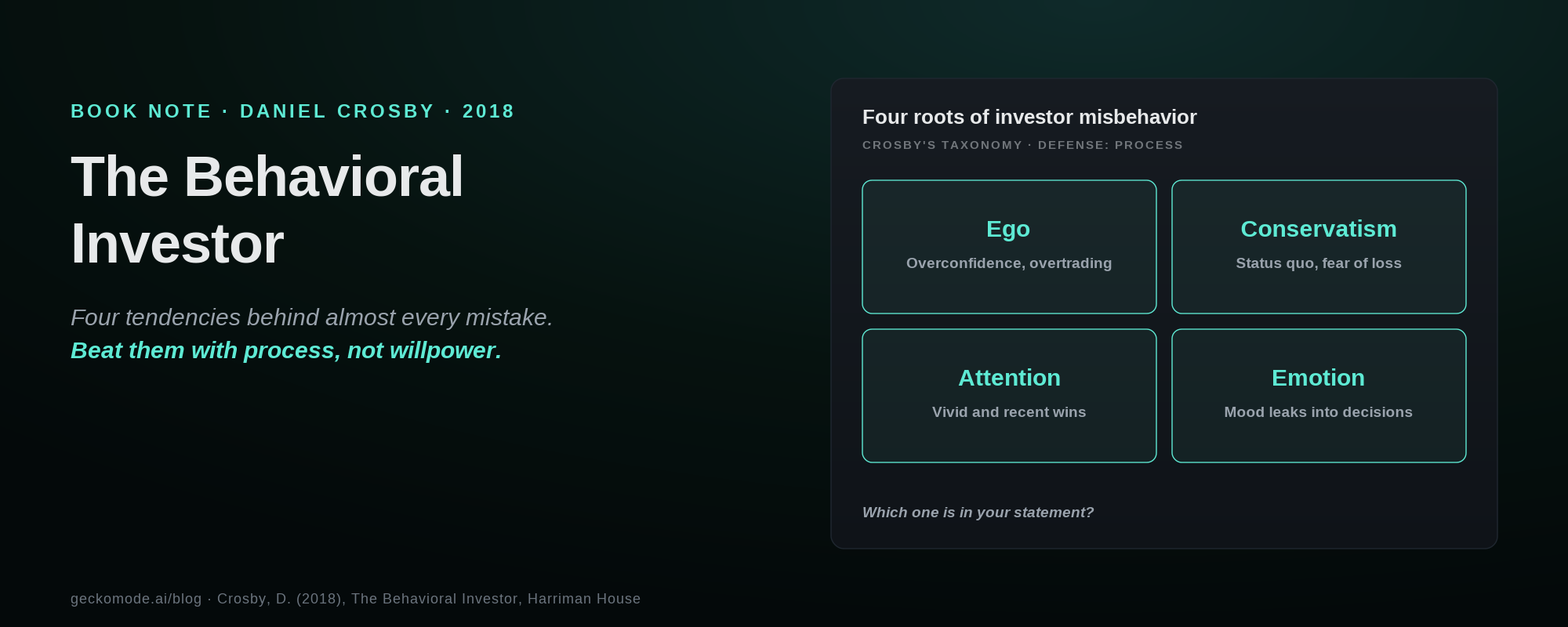
If Trading in the Zone is the trader’s psychology book, The Behavioral Investor is the investor’s: more academic, more systematic, and grounded in research rather than the trading pit. Daniel Crosby, a clinical psychologist turned fund manager, set out to write a comprehensive popular account of why humans are so badly built for investing, and then what to actually do about it.
Key takeaways
- Crosby organizes investor misbehavior into four tendencies: ego, conservatism, attention and emotion.
- He starts with the brain and body (sociology, neurology, physiology) before a single chart, because that’s where the errors are generated.
- The practical payoff is a defense: rules-based, low-emotion processes that assume you will be irrational and build around it.
- The limit: Crosby describes the four tendencies brilliantly, but only your own record shows which one is costing you money right now.
The four tendencies
Crosby’s organizing contribution is to compress the sprawling list of named biases into four roots:
- Ego: the need to feel competent and in control, which produces overconfidence and overtrading.
- Conservatism: a preference for the status quo and an outsized fear of loss, which produces paralysis and selling at the bottom. See loss aversion.
- Attention: judging probability by how vivid or recent something is, which produces bubble-chasing and panic.
- Emotion: the way passing mood bleeds into supposedly rational decisions.
Nearly every specific bias you’ve heard of, he argues, is a child of one of these four.
Brain, body, then markets
What sets the book apart is its order. Before Crosby talks about portfolios, he spends real time on the social, neurological and physiological machinery that generates the errors: stress hormones, evolutionary wiring, social conformity. The implication is freeing. These aren’t character flaws to be ashamed of; they’re factory settings. You won’t out-discipline your own neurochemistry by trying harder. You beat it with process.
The defense he prescribes
Crosby’s prescription is rules-based investing that deliberately takes the moment-to-moment human out of the loop: predetermined criteria, automatic rebalancing, and a process that assumes you’ll be emotional exactly when calm is most valuable. It’s the same conclusion our pieces on how successful traders manage risk and on Ed Thorp reached from other directions: the edge is in the pre-commitment, not the in-the-moment judgment.
The behavioral turn
Crosby gives you the taxonomy. What he can’t give you is the diagnosis of your own case. Is your money leaking through ego (too many trades, sizes creeping up with confidence), through conservatism (winners cut early, losers nursed), or through attention (piling into whatever just ran)? The four tendencies leave different fingerprints, and they’re all sitting in your broker statement right now. Reading the field guide is step one. Finding out which one is actually in your house is step two, and that takes data, not insight.
Upload a broker statement and Gecko scores twelve behavioral habits in dollars, from overtrading and oversizing to cutting winners early, so you can see which of Crosby’s four is actually at work. Free for your first 100 trades.
An educational tool, not financial advice.
Resources and further reading
- The book: Crosby, D. (2018), The Behavioral Investor, Harriman House.
- On Gecko: recency bias and why value investing is a behavioral strategy.
Frequently asked questions
What is The Behavioral Investor about?
Published by Harriman House in 2018, it’s psychologist and asset manager Daniel Crosby’s account of why people make predictable investing mistakes, organized into four tendencies (ego, conservatism, attention and emotion), and how rules-based processes can protect against them.
Is it worth reading?
Yes, if you want a research-grounded map of investor psychology. It is more systematic than most trading-psychology books. Its limit is the limit of every such book: it describes the tendencies but can’t tell you which one is costing you money.
Book note in Gecko’s trading psychology series. Gecko has no commercial relationship with the author or publisher. Gecko is an educational and informational tool. Nothing here is financial or investment advice. Investing carries substantial risk of loss.
Drop in a single statement. Gecko produces a one-page Behavioral Diagnosis ranking your costliest habits in actual dollars. Free to start. No card. No broker connection.
Twelve checks, one per behavioral habit, that show what your own trading costs you. Then one behavioral self-check from the research, every other Friday.
No account needed. We only use your email for the newsletter, and every email has a one-click unsubscribe.
More on the blog
- Most Trading Journals Ask What You Did. Gecko Tells You What It Cost You.A trading journal is a logbook: you type in trades and feelings, then audit yourself. Gecko reads your broker statement, tests twelve behavioral habits for real patterns, and prices each one in dollars. Here's why we built it that way.
- Our Dollar, Your Problem by Kenneth Rogoff: Is Dollar Dominance Running Out of Road?Harvard economist and former IMF chief economist Kenneth Rogoff traces seven decades of dollar dominance and argues it is real but contingent, with the gravest threats internal: debt, dysfunction and the end of ultra-low rates. For traders, the lesson is time horizon: a slow tide is not a daily signal.
- Nvidia After the Air Came Out: A Behavioral Read on NVDARecord revenue, a stock near 52-week lows, a drift to Hold ratings and a sudden CEO change. Gecko has no view on whether NVDA is a buy. The useful question is how you behave around the market's most emotionally charged ticker.