1929 by Andrew Ross Sorkin: The Best Markets Book of 2025 Is a Warning About This One
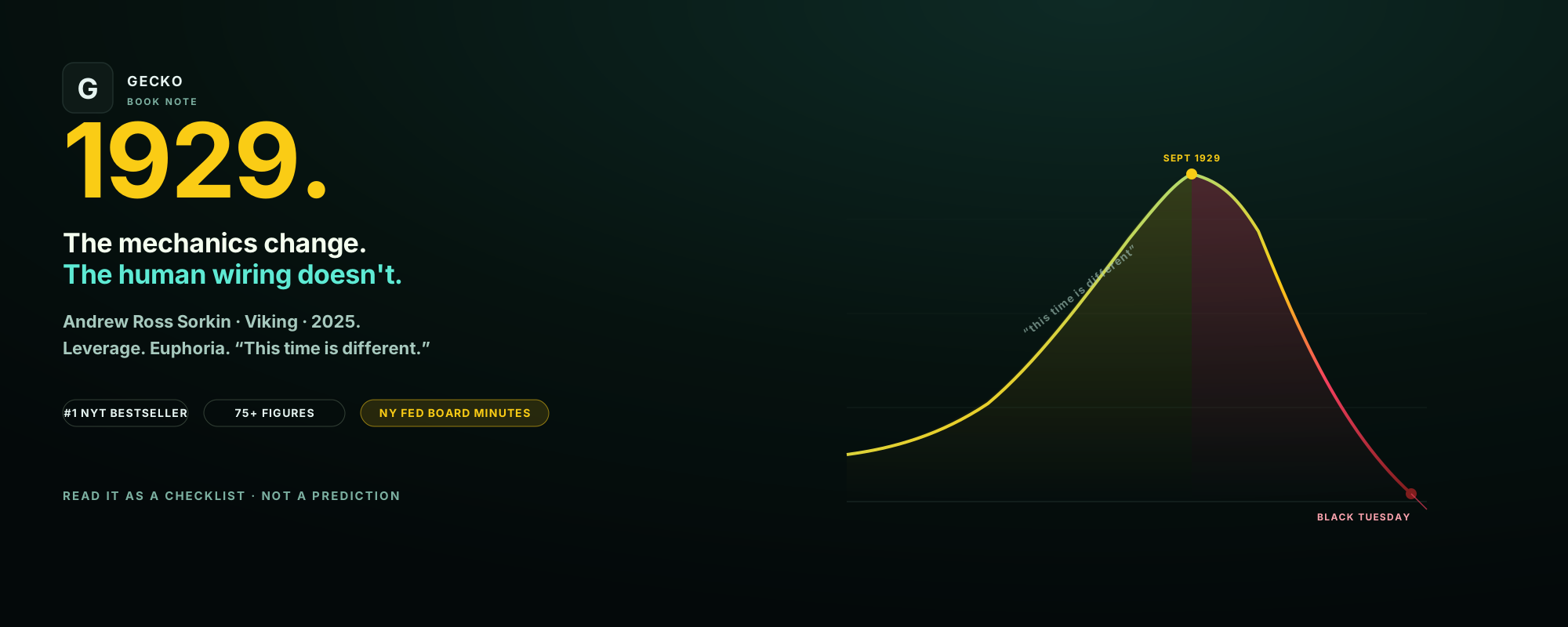
There is a specific kind of book that sells not because of what it says about the past but because of what readers fear about the present. Andrew Ross Sorkin’s 1929 is that book for this cycle. It arrived in October 2025 into a market openly debating whether the AI trade had become a mania, and it offered the most detailed reconstruction ever written of the last time American investors convinced themselves the old rules no longer applied. It became a #1 New York Times bestseller, a New York Times Notable Book, and a Best Book of 2025 at what feels like every outlet that keeps a list — the Washington Post, TIME, The Economist, Bloomberg, and more, and even Barack Obama’s year-end favorites.
We review it here not as history buffs but as behavioral traders, because underneath the archival richness 1929 is a case study in the exact failures this blog measures — just with fedoras instead of phone screens.
Key takeaways
- Sorkin’s 1929 was the markets book of the year — a #1 NYT bestseller and a Best Book of 2025 across the Washington Post, TIME, The Economist, Bloomberg and more.
- Built on archival material not seen before, including the New York Fed’s board minutes and private diaries, it reconstructs the crash through 75-plus figures.
- Its enduring value for a trader isn’t the history. It’s the anatomy of the behavior: margin, euphoria, and the certainty that “this time is different.”
- The book landed in a market arguing about an AI bubble — and its real lesson is that the mechanics change while the human wiring doesn’t.
What the book actually is
Sorkin — best known to traders for Too Big to Fail, his definitive account of the 2008 crisis — brings the same method to the crash that defined the twentieth century. 1929 is narrative non-fiction built on genuinely new primary sources: private letters, diaries, an insider’s unpublished memoir, and, most valuably for anyone interested in the machinery of markets, the minutes of the Federal Reserve Bank of New York’s board meetings. The result follows more than seventy-five figures — Wall Street titans like National City’s Charles Mitchell, the House of Morgan, and the political leadership of Hoover and then Roosevelt — through the boom, the break, and the wreckage that became the Depression.
As a piece of writing it is a genuine achievement, and it is worth reading purely for the texture: what it actually felt like inside the institutions as the mania built and then as it came apart. But this is Gecko, so we care less about the pageant and more about the pathology. And the pathology is stunningly familiar.
The three behaviors under the history
Strip 1929 down to its mechanism and you find the same three ingredients that precede every great unwinding — and, at smaller scale, every blown retail account.
Leverage: the accelerant
The 1929 bubble was, above all, a margin bubble. Ordinary investors bought stocks with borrowed money, sometimes putting up as little as a tenth of the price, on the serene assumption that prices only rose. Leverage is the thing that turns a correction into a catastrophe, because it forces selling at exactly the wrong moment: the margin call arrives when prices are already falling, converting a paper loss into a forced liquidation. Sorkin’s account of the cascade is really an account of leverage doing what leverage does. The instruments today are different — options, perps, funded accounts — but the mechanism is identical, and so is the outcome for the over-leveraged.
Euphoria: the crowd all-in at the top
The second ingredient is the mood, and Sorkin captures it better than any statistic could: the shoeshine-boy certainty, the sense that not participating was the only real risk. This is attention-driven buying at civilizational scale — the entire population crowding into the same trade because it was the only one anybody was talking about. The crowd is never more unanimous than at the top, which is precisely why the top is where it is.
“This time is different”: the suspension of disbelief
The most expensive four words in finance run through the whole book. In 1929 the New Era was electrification, mass production, and a Federal Reserve believed to have abolished the business cycle. The specifics are quaint; the psychology is not. Every bubble requires a story that explains why the old rules of valuation no longer bind — and the story is always plausible, because it is always built on something genuinely new.
The technology in a bubble is usually real. The mistake is never the technology. The mistake is the leverage and the certainty that get attached to it.
The honest criticism
A fair review has to note the book’s most common critique, because it bears on how a trader should read it. Several reviewers have argued that Sorkin is, at times, more sympathetic to his protagonists than the record warrants — that he spends more energy humanizing the bankers who inflated the bubble than holding them to account, and that the book is stronger on what happened than on what we should conclude. That’s a real limitation. For our purposes it’s also easily managed: read 1929 for its unmatched reconstruction of the behavior, and supply the hard conclusions yourself. The lesson is there whether or not the author underlines it.
Why it matters right now — without pretending to predict
It would be cheap, and false, to claim this book tells you a crash is imminent. It doesn’t, and neither can we. Markets can stay elevated for years, the “new era” story sometimes turns out to be substantially true, and calling a top is one of the great destroyers of trading capital. The value of 1929 is not a market timing signal. It is a diagnostic checklist of conditions: when you see broad leverage, unanimous euphoria, and a confident “this time is different” narrative in the same place at the same time, you are in an environment that has historically ended a particular way. That doesn’t tell you when. It tells you how much risk the room is carrying — and, far more usefully, it tells you what to go and check about yourself.
Because here is the part the reader controls. You cannot manage the market’s leverage or the crowd’s mood. You can manage your own, and unlike the investors of 1929, you have a full record of your behavior sitting in your brokerage statement.
From belief to behavior: run 1929 on your own account
Each of Sorkin’s ingredients converts into a question you can answer from your own data.
| The 1929 condition | The fingerprint it leaves in your trade history |
|---|---|
Leverage | Position sizes that only make sense with borrowed money or options leverage — and a worst-loss-to- typical-win ratio that a single margin event could blow open. See size discipline. |
Euphoria | Entries clustered into the most crowded, most-talked-about names, near extended highs — the crowd trade rather than your setup. |
“This time is different” | Rules quietly relaxed during a hot streak: stops widened, size increased, the plan suspended because it “doesn’t apply to this one.” |
Chasing the mania | Trade frequency rising with the market’s excitement rather than with the quality of your opportunities; classic overtrading. |
You can’t see the market’s leverage, but you can see yours. Upload a broker statement and Gecko scores your sizing, overtrading, and tilt in dollars across twelve behavioral axes — so the conditions that end badly are numbers you can watch, not a mood you notice too late. No login or broker connection needed, first 100 trades free.
An educational tool, not financial advice.
Resources and further reading
- The book: Sorkin, A. R. (2025), 1929: Inside the Greatest Crash in Wall Street History and How It Shattered a Nation, Viking — built partly on the New York Fed’s board minutes and previously unavailable private papers.
- The classic companion: Galbraith, J. K. (1954), The Great Crash, 1929 — still the essential short economic account of the same events.
- The behavioral lineage: Mackay, C. (1841), Extraordinary Popular Delusions and the Madness of Crowds — reviewed in our Book Notes, on why crowds, not fundamentals, drive manias.
- The modern echo: Gecko, Michael Burry — the investor betting that today’s AI enthusiasm rhymes with the run-ups this book describes.
- The research on turnover: Barber & Odean (2000), “Trading Is Hazardous to Your Wealth,” on why chasing a mania reliably costs the chaser.
Frequently asked questions
Published by Viking in October 2025, it reconstructs the run-up to and aftermath of the 1929 crash through more than 75 figures — from bankers like Charles Mitchell to Presidents Hoover and Roosevelt — using archival material not previously available, including the New York Fed board’s minutes and private diaries. It became a #1 NYT bestseller and a Best Book of 2025 at many outlets.
That the mechanics of a bubble change but the behavior doesn’t. 1929 was fueled by margin, plus the conviction a new era had repealed the old rules. Leverage into euphoria, “this time is different,” and the crowd all-in at the top aren’t historical curiosities — they’re recurring behaviors that leave measurable fingerprints in a modern trade history.
Yes — as the most vivid account of how leverage and mass psychology build and detonate a market. Read it alongside its main criticism, that Sorkin is sometimes more sympathetic to his characters than to the lessons of their failure, and draw the hard conclusions yourself.
It arrived in a market debating whether AI is a bubble, which is why it resonated. It won’t tell you whether today is 1929 — nobody can — but it gives you a checklist of the human conditions that preceded the last great crash, so you can watch for them in the market and, more usefully, in your own account.
Book note in Gecko’s trading psychology series. Details about 1929, its sources, and its reception are drawn from the publisher’s materials and published reviews as of July 2026. Nothing here forecasts a market crash or claims present conditions match 1929. Gecko is an educational and informational tool. Nothing here is financial, investment, or trading advice, or a recommendation for or against any security or strategy. Trading carries substantial risk of loss.
Drop in a single statement. Gecko produces a one-page Behavioral Diagnosis ranking your costliest habits in actual dollars. Free to start. No card. No broker connection.
Short notes, usually once or twice a month. Unsubscribe in one click.
No account needed. We use your email only to send Gecko blog posts, and the link at the bottom of every email opts you out in one click.
More on the blog
- The AI Debt Machine: Circular Financing, Off-Balance-Sheet Data Centers, and the Ghosts of Bubbles PastThe AI build-out has quietly shifted from cash to debt: hyperscaler bonds near $194 billion in 2026, private credit's share of AI financing up from about 9% to 34%, debt parked in off-balance-sheet vehicles, and a circular loop among Nvidia, OpenAI, Oracle and CoreWeave. What telecom, Enron and the 1920s say about it, and what a trader should actually do.
- When the Consumer BreaksHousehold debt booms have a long record of ending in slowdowns that forecasters miss. What that history says about markets, and about the most overlooked balance sheet in trading: your own.
- How Banking Crises Actually StartThe run is the last chapter, not the first. What 150 years of bank failures teach traders about reading stress, and about the mistakes made when the headlines finally arrive.