Concentrated Portfolios vs Index Funds: What the Research Really Says, and Why the Index Isn't What It Used to Be
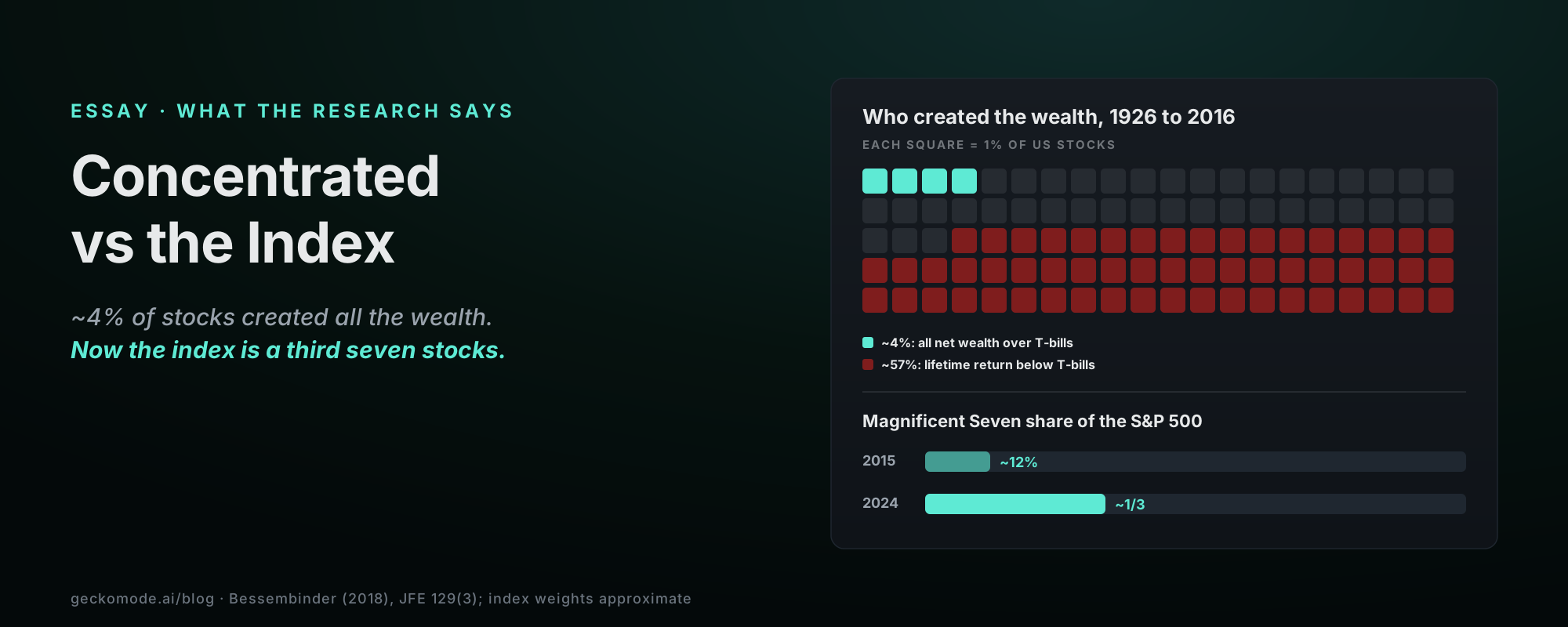
The oldest argument in investing is concentration versus diversification. Warren Buffett has called diversification “protection against ignorance” and concentrates heavily; the index-fund movement says the opposite: own everything, cheaply, forever. For decades this was a matter of philosophy and temperament. Then a finance professor named Hendrik Bessembinder ran the numbers on nearly a century of stock returns and produced a finding stark enough to settle most of the argument. It also explains the strangest feature of the modern market: its extreme concentration in a handful of names. Let’s take the research seriously, then ask the question everyone is really asking: are things different now?
Key takeaways
- Bessembinder’s landmark study found that since 1926, about 4% of US stocks created all of the market’s net wealth above Treasury bills, and most individual stocks underperformed cash.
- That one fact reframes the debate: concentration more often destroys wealth than builds it, because the winners are a tiny, hard-to-predict minority you are likely to miss.
- It also explains the Magnificent Seven: roughly a third of the S&P 500 by 2024, up from about 12% in 2015, and the source of most of the index’s recent returns.
- So “just buy the index” now means buying a concentrated bet on a few mega-caps. A few stocks driving everything is an old story; how concentrated the index you hold has become is not.
The finding that reframes everything
In “Do Stocks Outperform Treasury Bills?” (2018), Hendrik Bessembinder examined the lifetime returns of nearly 26,000 US common stocks going back to 1926. The results are counterintuitive to the point of being disorienting. Four of every seven had lifetime buy-and-hold returns below those of one-month Treasury bills: most individual stocks lost to cash over their lives. The entire net wealth the US stock market created over T-bills, roughly $35 trillion through 2016, came from just 1,092 companies, about 4.3% of the total. And 86 stocks accounted for half of it.
Sit with what that means. The market’s famous long-run return is not a broad tide lifting most boats. It is the product of a small number of extreme winners whose gains are so large they pull the whole average up, while the typical stock quietly trails a savings account. Wealth creation in the stock market is not democratic. It is spectacularly concentrated in a few names.
Why this is the strongest argument for indexing, and against stock picking
Here’s the twist people miss. On its face, Bessembinder’s finding is a case for owning a few great stocks; that is where all the money is. Turn it around and it becomes one of the strongest arguments for broad indexing ever produced. If roughly 4% of stocks are responsible for all the gains, and those winners are notoriously hard to identify in advance, then a concentrated portfolio is a bet that you can pick from a deck where about 96% of the cards range from mediocre to ruinous. The base rate is brutal: a concentrated portfolio is more likely to miss the few big winners than to catch them, which is why, as Bessembinder notes, poorly diversified active strategies so often underperform.
The index fund solves the problem by brute force: own everything, and you are certain to own the 4% that matter. You accept that many holdings will be duds in exchange for certainty that you’ll capture the few superstars whose returns make the whole thing work. This is the research-grounded case for indexing. It isn’t “markets are efficient”; it’s “the winners are too concentrated and too unpredictable to risk missing.” It’s also why the studies of actual millionaires find them built on boring diversified funds, not concentrated bets.
The catch: concentration cuts both ways
In fairness to the concentrators, the same data contains their defense. People who did hold the 4%, who bought and held one of the great compounders for decades, earned life-changing returns no index could match, and a handful of brilliant or lucky investors built fortunes exactly this way. Concentration is how you get spectacularly rich; diversification is how you get reliably wealthy. The honest framing is that concentration has a wildly skewed payoff: a small chance of enormous wealth and a large chance of trailing cash. Whether that is a good bet depends on whether you can identify winners in advance, and the evidence that almost anyone can do that reliably is thin; Jim Simons is the rare exception that proves how hard it is.
| Concentrated portfolio | Broad index fund | |
|---|---|---|
| Payoff shape | Small chance of huge wealth; large chance of trailing cash | Market return minus small fees; certain to own the winners |
| Depends on | Picking from the ~4% in advance (very hard) | Patience and not selling |
| Base rate | Most individual stocks underperform T-bills | Beats most active managers over long periods (SPIVA) |
| Main risk | Missing the winners, or a blow-up | Hidden concentration (below) and the behavior gap |
Are things different now? The Magnificent Seven problem
Now the modern wrinkle, and it’s a big one. The clean “the index diversifies you” story has a hole in it, because the index has itself become a concentrated bet. The Magnificent Seven (Apple, Microsoft, Nvidia, Alphabet, Amazon, Meta and Tesla) grew from about 12% of the S&P 500 in 2015 to roughly a third by 2024, and those seven names drove well over half of the index’s return in 2023. Morgan Stanley found the pace at which the largest stocks’ share of the index rose to be the fastest since 1950. When you buy an S&P 500 fund today, about a third of your money goes into seven closely related mega-cap technology companies. That is not the broad, own-everything portfolio the index-fund pitch describes. It is, increasingly, a big-tech bet dressed as diversification.
So are things different? The honest answer is more interesting than either “it’s a bubble” or “relax.” The concentration of the index is unusual: by historical standards it is extreme, and the growth of passive investing may be amplifying it, since cap-weighted index flows buy more of whatever is already biggest regardless of price. But the concentration of returns is not new at all. Bessembinder’s whole point is that a tiny fraction of stocks has always driven nearly all of the market’s wealth; every era has had its own handful. What’s unprecedented is how much of the index you hold is now those winners. What’s ancient is that the winners were always a tiny few.
What it means for the long-term investor
Put the pieces together and a clear-eyed conclusion emerges. For most people, broad indexing remains the evidence-based default, because the Bessembinder math makes stock picking a loser’s game for all but the exceptional. But it is worth dropping the comforting idea that an S&P 500 fund is fully diversified: it is substantially a bet on seven companies, and if those names fall together, so does the “diversified” portfolio. The practical questions aren’t exotic. Do you know your real exposure across every account and fund? Is any deliberate concentration sized so that being wrong can’t ruin you? And whichever path you choose, the thing most likely to hurt you is rarely the structure. It’s your behavior when the concentrated bet, index or otherwise, has its inevitable bad stretch.
From belief to behavior: concentration is a decision you keep making
| The concentration question | The fingerprint in your own record |
|---|---|
| Do you actually own the winners? | A concentrated book that happens to exclude the market’s few big winners: the statistical default, and the reason most stock pickers trail. |
| Hidden concentration. | “Diversified” holdings that are really one correlated bet, such as several funds and stocks riding the same theme; see size discipline. |
| Chasing the winners after the run. | Piling into the mega-caps near highs: recency bias, buying the concentration at its most expensive. |
| Panic in the drawdown. | Selling the concentrated bet, or the top-heavy index, at the bottom: the behavior gap that undoes either strategy. |
Is your portfolio concentrated without you realizing?
“Diversified” and “one big correlated bet” can look identical until the drawdown. Connect your accounts and Gecko rolls every holding into one view and shows your real concentration, sector overlap and correlation across all of them, so you see the exposure you actually have rather than the one you assume. Trade history uploads are scored across twelve behavioral axes, including sizing and drawdown behavior, in dollars.
See your real concentration →Free to start. 14-day Pro trial. An educational tool, not financial advice.
Resources and further reading
- The landmark study: Bessembinder, H. (2018), “Do Stocks Outperform Treasury Bills?”, Journal of Financial Economics 129(3): 440–457.
- Global confirmation: Bessembinder, H., Chen, T.-F., Choi, G. & Wei, K. C. J., “Do Global Stocks Outperform US Treasury Bills?”: the same skew across dozens of markets.
- Concentration data: Morgan Stanley research and CNBC reporting on the S&P 500’s rising top-heaviness and the Magnificent Seven’s share of index returns.
- The active-vs-passive evidence: S&P Dow Jones Indices, SPIVA Scorecard; see also Gecko on which strategies actually work.
- The case for indexing: Malkiel, B. G., A Random Walk Down Wall Street, reviewed in Gecko’s Book Notes.
Frequently asked questions
Are concentrated portfolios better than index funds?
For most investors, the evidence says no. Bessembinder found that about 4% of stocks created all of the market’s net wealth since 1926 while most individual stocks trailed Treasury bills. Because the winners are a tiny, hard-to-predict minority, a concentrated portfolio is statistically likely to miss them; a broad index is certain to own them. Concentration can make a few people spectacularly rich, but on the base rates it more often destroys wealth than builds it.
What did Bessembinder’s research show?
Across nearly 26,000 US stocks since 1926, four of every seven had lifetime returns below one-month T-bills. All of the roughly $35 trillion of net wealth over T-bills came from 1,092 companies (about 4.3%), and 86 stocks accounted for half.
Is the S&P 500 too concentrated now?
It is unusually concentrated. The Magnificent Seven rose from about 12% of the index in 2015 to roughly a third by 2024 and drove well over half of its 2023 gain; Morgan Stanley found the pace of top-heaviness the fastest since 1950. Buying “the index” today is substantially a bet on seven mega-cap tech names, so the diversification is less complete than many assume.
Are markets different now because of concentration?
Partly. The concentration of the index is historically extreme and possibly amplified by passive flows. But the concentration of returns in a few winners is old: Bessembinder shows it has held for a century. What’s new is that the index you hold is largely made of the current winners. Both facts argue for humility.
Essay in Gecko’s investing and trading psychology series. Figures are drawn from Bessembinder (2018) and market-concentration research and reporting (Morgan Stanley, CNBC) as of 2026, and are approximate. Nothing here is a market forecast or a recommendation of any security, fund or strategy; the concentration-versus- diversification choice depends on your own circumstances. Gecko is an educational and informational tool. Nothing here is financial, investment or trading advice. Investing carries substantial risk of loss.
Drop in a single statement. Gecko produces a one-page Behavioral Diagnosis ranking your costliest habits in actual dollars. Free to start. No card. No broker connection.
Short notes, usually once or twice a month. Unsubscribe in one click.
No account needed. We use your email only to send Gecko blog posts, and the link at the bottom of every email opts you out in one click.
More on the blog
- Risk and Reward by Ben Carlson: The 2026 Book That Takes a Wrecking Ball to Its Own AdviceBen Carlson's 2026 book stress-tests his own stay-the-course philosophy against the 1930s, Japan's 1980s bubble and the dot-com bust. Its lesson in four words: risk and reward are inseparable. You earn the return by surviving the risk, and history shows the danger is rarely the crash itself but what investors do during it. Superb on philosophy and plan; the one gap is measuring whether your own behavior matches the advice.
- Value Investing Is a Behavioral Strategy, Not an Analytical OneWhy does value investing work? If it were about analysis, the edge would have been arbitraged away decades ago. Lakonishok, Shleifer & Vishny (1994) argued the value premium comes from the crowd over-extrapolating growth, not from extra risk, and De Bondt & Thaler (1985) documented the overreaction it feeds on. The balance-sheet work is learnable and widely known; the temperament to buy what everyone hates and sit through a lost decade is rare. Your spreadsheet won't fail you. Your psychology will.
- Which Strategies Actually Make Millionaires? The Boring Answer, Backed by 10,000 of ThemIf you learned about wealth from social media, you'd think millionaires are minted by 0DTE options, ten-baggers, leveraged crypto, and Lamborghini day-trading. The largest study of US millionaires (Ramsey, 10,000 people) tells a very different story: 8 in 10 named their 401(k) as their #1 wealth-builder, none credited single-stock picking, 89% didn't inherit. Fidelity now counts ~645,000 401(k) millionaires; the average one is nearly 59 and has been in the same account ~25 years. The strategy that mints millionaires isn't a strategy — it's a habit repeated for decades. And it's the same trait every disciplined trader we've profiled shares.