Jim Chanos: The Short-Seller Who Called Enron, and Is Sounding the Alarm on AI
Most of the traders we profile made their money by being right about where prices were going up. Jim Chanos built one of the great careers in finance by being right about where they were going down, and about why: usually because a company everyone admired was quietly rotten underneath. Short-selling is the loneliest, most psychologically punishing corner of the market. You fight the long-run upward drift of stocks, you take unlimited downside for capped gains, and you are hated by everyone whose stock you’re betting against. Chanos did it, brilliantly, for 38 years. And now, having closed his funds, he’s turned the same forensic eye on the biggest boom of the age, and he doesn’t like what he sees.
Key takeaways
- Jim Chanos spent 38 years as the most famous short-seller alive, finding the rot others missed, most famously calling Enron “the market call of the decade.”
- His method is forensic: read the footnotes, the off-balance-sheet disclosures and the cash flows to find the gap between a company’s story and its numbers.
- He wound his hedge funds down in 2023, and is now one of the loudest skeptics of the AI data-center build-out, warning of circular financing, maturity mismatch and a “golden age of fraud.”
- The lesson isn’t “short what you dislike.” It’s that being right and being early are different skills: the short-seller’s eternal curse, which is itself a behavioral problem.
The call that defined him: Enron
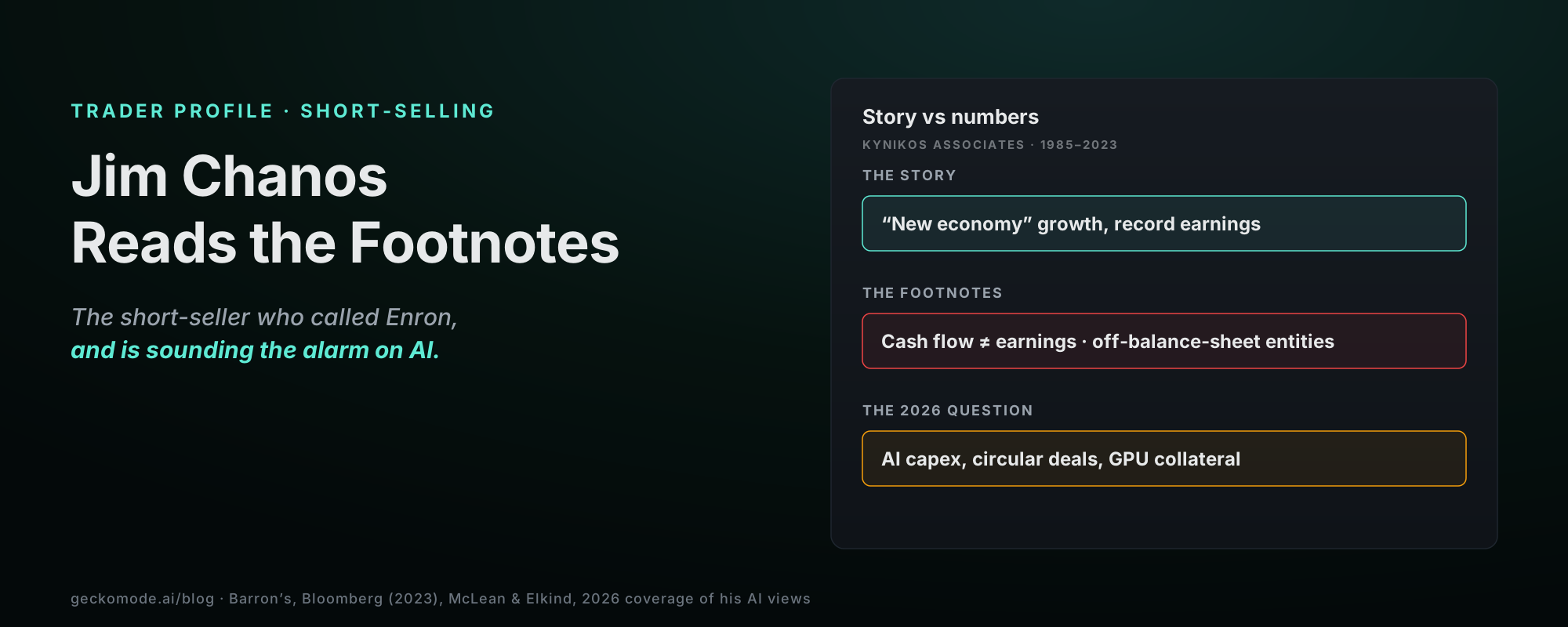
In 2000, Enron was a Wall Street darling: the seventh-largest company in America, a “new economy” energy-trading colossus, beloved by analysts. Chanos did something almost no one else bothered to do: he read the financial statements carefully. What he found didn’t add up. The company’s reported returns on capital were thin and falling, its cash flow didn’t match its reported earnings, and buried in the footnotes were references to opaque, off-balance-sheet “related-party” entities that seemed to exist to move debt and losses out of sight. He couldn’t prove fraud from the outside, but he could see that the numbers told a different story than the stock price did. So he shorted it, and kept shorting as the price held up.
In 2001, Enron collapsed into what was then the largest bankruptcy in US history, its off-balance-sheet structures revealed as the mechanism that had hidden its leverage and manufactured its earnings. Chanos was vindicated spectacularly, and Barron’s later called his Enron short “the market call of the decade, if not the past fifty years.” It made him the most famous short-seller in the world, but the Enron playbook, not the fame, is the point. He found it the same way he found every other winner: by reading what the crowd skipped.
The method: forensic short-selling
Chanos founded Kynikos Associates (Greek for “cynic”) in 1985, and built it into the premier short-only shop on Wall Street. His process is the opposite of the momentum-chasing that defines most retail trading. He and his analysts hunt for a specific profile: companies with aggressive or misleading accounting, deteriorating business models dressed up as growth stories, hidden leverage, and a widening gap between the story management tells and the cash the business actually generates. Over the decades the targets rolled in and then rolled over: Baldwin-United, Tyco, Sunbeam, Conseco, Boston Chicken, a gallery of once-loved names that forensic analysis flagged before the market caught up.
What makes this a behavioral discipline, and not just an accounting one, is the temperament it demands. A short-seller is, by definition, fading the crowd at the moment the crowd is most euphoric. Every instinct the research documents (recency bias, social proof, the pain of watching a stock you’re short keep rising) screams at you to cover and join the party. Chanos’s achievement was psychological as much as analytical: the ability to hold a position that looked wrong, sometimes for a long time, because the numbers said the market was the one that was wrong. That is the same contrarian temperament we saw in GCR’s LUNA short, the same willingness to be unpopular that defines every great fader of manias.
The honest part: being early is being wrong, even for the best
A profile that only celebrated Chanos would be dishonest about the hardest truth of short-selling, which he himself embodies. Being right about a company and being right about when it falls are completely different skills, and the gap between them has punished even Chanos. His firm shorted plenty of overvalued names that stayed overvalued for years before (or without) resolving in his favor; his well-known skepticism of certain high-flying stocks was, for long stretches, a losing position even when the underlying analysis was sound. This is the short-seller’s eternal curse, and it’s a behavioral trap at its core: the market can stay irrational longer than your short can stay solvent, and the psychological toll of being “early” (which is indistinguishable from being wrong until the moment it isn’t) is precisely why so few people can run the strategy. It’s the same lesson we drew from Michael Burry, from the other side of the Big Short.
That Chanos wound down his hedge funds in 2023, after decades in which a historic bull market made life relentlessly hard for short-sellers, is itself a comment on the difficulty. Being the smartest skeptic in the room does not guarantee you get paid on your timeline, and running a dedicated short fund through a 15-year bull market is one of the toughest assignments in finance.
Why he’s back in the conversation: the AI warning
Chanos no longer manages outside capital, but he hasn’t stopped doing what he does best, and his current target is the AI data-center build-out, which makes him the perfect lens for our feature on AI debt and circular financing. His argument is vintage Chanos: look past the dazzling narrative and read the structure. He compares today’s AI capital spending to the 1998–2000 telecom build-out, noting that a single hyperscaler now spends more on data centers in one year than the dot-com-era telecom and internet industries spent combined over five years. He characterizes data centers as capital-intensive, low-return “equipment leasing” businesses being marketed to investors as something more glamorous, and he has flagged the circular financing, the maturity mismatch between short-term funding and fast-depreciating GPUs, and what he calls a coming “golden age of fraud.”
Whether he’s right this time is unknown, and worth stating plainly: these are his contested views, and he has been early before. But the method is the enduring lesson, and it’s as relevant to a retail trader as to a hedge-fund titan: when a boom is this loud and this adored, the most valuable thing you can do is stop listening to the story and start reading the numbers.
The crowd falls in love with the story. The short-seller reads the footnotes. Chanos’s whole career is a reminder that the two are often telling you opposite things.
From belief to behavior: can you read your own footnotes?
You don’t need to short anything to steal Chanos’s discipline. His edge was skepticism applied to evidence, and the evidence about your own trading is sitting in your account.
| The Chanos discipline | The retail fingerprint of lacking it |
|---|---|
| Believe the numbers over the narrative | Trades driven by a story or a headline rather than a tested, repeatable edge with positive expectancy. |
| Fade the crowd, on evidence | Chasing the most-loved, most-crowded trade near its peak; see recency bias. |
| Survive being early | A position so large that being early forces you out before you’re proven right; see size discipline. |
| Audit your own record | Never reviewing your trade history for the gap between the story you tell yourself and what you actually did. |
Chanos’s edge was reading the numbers others ignored. Your own numbers are the most honest research you’ll ever get. Upload a broker statement and Gecko scores your expectancy, sizing and tilt in dollars across twelve behavioral axes: the forensic read on your own trading. No login or broker connection needed, first 100 trades free.
An educational tool, not financial advice.
Resources and further reading
- The Enron call: accounts of Chanos’s short in Bethany McLean and Peter Elkind’s The Smartest Guys in the Room, and Barron’s on “the market call of the decade.”
- The wind-down: Bloomberg (November 2023) on Chanos closing his hedge funds after 38 years and continuing via Chanos & Co.
- The AI warnings: 2026 coverage of Chanos’s data-center and AI capex skepticism (iConnections Global Alts, RiskReversal, and Benzinga’s earlier fiber-optic comparison).
- The structure he’s reading: Gecko’s feature on AI debt and circular financing.
- The timing lesson: Gecko on Michael Burry: being early is being wrong, from the other side of the Big Short.
Frequently asked questions
Who is Jim Chanos?
One of the most famous short-sellers in history. He founded Kynikos Associates in 1985, specializing in overvalued companies and accounting problems, and is best known for shorting Enron before its 2001 collapse, which Barron’s called the market call of the decade. Other shorts included Tyco, Sunbeam, Conseco and Boston Chicken. In November 2023, after about 38 years, he wound down his hedge funds, continuing to advise and publish via Chanos & Co.
What is forensic short-selling?
Digging into financial statements and corporate structure to find overvaluation, aggressive accounting, hidden leverage and broken business models, then betting the price falls as reality catches up. Chanos is its most famous practitioner; Enron’s off-balance-sheet entities were the archetype his footnote-reading exposed.
What has Chanos said about AI and data centers?
He’s been skeptical of the AI data-center build-out since about 2022 and sharpened it in 2026: comparing the capex boom to 1998–2000 telecom, noting a single hyperscaler now out-spends the dot-com industries over five years, describing data centers as low-return “equipment leasing” dressed up, and flagging circular financing and a “golden age of fraud.” These are his contested views, and he has been early before.
What can traders learn from Chanos?
Two opposing things: the value of evidence-based conviction against the crowd, and the brutal difficulty of the short side. Being right about a company and right about the timing are different skills. The lesson isn’t to short what you dislike; it’s to pair real forensic conviction with ruthless risk control, because the market can stay irrational longer than a short can stay solvent.
Trader profile in Gecko’s trading psychology series. Biographical details are drawn from public reporting (Bloomberg, Barron’s, Yale SOM) and books; Chanos’s AI and data-center views are his own contested arguments as reported in 2026, not established facts. Nothing here alleges wrongdoing by any current company. Gecko is an educational and informational tool. Nothing here is financial, investment or trading advice, or a recommendation to short or buy any security. Short-selling carries unlimited risk; trading carries substantial risk of loss.
Drop in a single statement. Gecko produces a one-page Behavioral Diagnosis ranking your costliest habits in actual dollars. Free to start. No card. No broker connection.
Short notes, usually once or twice a month. Unsubscribe in one click.
No account needed. We use your email only to send Gecko blog posts, and the link at the bottom of every email opts you out in one click.
More on the blog
- The System Works. You Don't.A century of evidence says simple rules can earn real returns. The harder evidence is about the people running them: why traders override, tweak and abandon systems that were beating them.
- The AI Debt Machine: Circular Financing, Off-Balance-Sheet Data Centers, and the Ghosts of Bubbles PastThe AI build-out has quietly shifted from cash to debt: hyperscaler bonds near $194 billion in 2026, private credit's share of AI financing up from about 9% to 34%, debt parked in off-balance-sheet vehicles, and a circular loop among Nvidia, OpenAI, Oracle and CoreWeave. What telecom, Enron and the 1920s say about it, and what a trader should actually do.
- When the Consumer BreaksHousehold debt booms have a long record of ending in slowdowns that forecasters miss. What that history says about markets, and about the most overlooked balance sheet in trading: your own.