The AI Debt Machine: Circular Financing, Off-Balance-Sheet Data Centers, and the Ghosts of Bubbles Past
This is a fast-moving, contested area. The dollar figures below come from contemporaneous reporting (Reuters/LSEG, Bloomberg, the Financial Times, Axios, the OECD, the Bank of England and law-firm alerts) as of late 2026. Sources disagree and deals change weekly, so treat specific numbers as indicative and verify against primary filings. This is analysis of financial structure and risk, not investment advice, and not an allegation of wrongdoing by any named company.
For most of the AI boom, the bulls had an unanswerable retort to every bubble warning: this time the spending is real, and it’s being paid for in cash. Unlike the debt-soaked telecoms of 1999 or the mortgage machine of 2007, the hyperscalers driving the AI build-out (Microsoft, Alphabet, Amazon, Meta) were among the most profitable companies in history, funding their enormous capital expenditure out of operating cash flow. It was a strong argument, and we made it ourselves in our evenhanded look at the AI-bubble question.
That argument is quietly eroding. Over the course of 2026, the way the AI build-out is financed has changed in ways that should make even a committed optimist pay attention. The cash is running low relative to the ambition, and the gap is being filled by debt: a lot of it, in forms designed to be hard to see, routed through a web of deals so interconnected that money appears to chase itself in a circle. This is a feature-length look at how the AI boom is now being paid for, why the structure matters more than the valuations, and what the ghosts of past bubbles (telecom, Enron, the utility pyramids of the 1920s) have to say about it. We’ll be scrupulously fair to the bull case, because it isn’t dead. But the burden of proof has shifted.
Key takeaways
- The AI build-out has quietly shifted from being funded by cash to being funded by debt: hyperscaler bond issuance reportedly near $194 billion in 2026, and private credit’s share of AI financing jumping from about 9% to about 34% in a year.
- A growing slice of that debt sits in off-balance-sheet vehicles. A separate entity reportedly issued about $27.3 billion for Meta’s Hyperion data center, echoing the structures that masked Enron’s leverage.
- Layered on top is a circular financing loop among Nvidia, OpenAI, Oracle and CoreWeave that critics say can inflate apparent demand, a mechanism that rhymes with dot-com telecom vendor financing and the 1920s utility pyramids.
- None of this proves a crash is near. It proves there is now real leverage and interconnection under the AI trade: a reason for humility and risk control, not a bet on timing the top.
Part 1: The quiet switch from cash to debt
The first thing that changed is the simplest: the hyperscalers started borrowing, heavily. Industry estimates put hyperscaler bond issuance at roughly $121 billion in 2025, already more than four times the prior five-year average, and reporting in 2026 suggests bonds from Amazon, Alphabet, Meta and Oracle reached on the order of $194 billion by the middle of the year. Meta alone reportedly sold a $30 billion bond in late 2025. The capital needs of training ever-larger models and building the data centers to run them have outstripped even history’s greatest cash flows, and the shortfall is being bridged with borrowed money.
Where the cash-funded argument really breaks down, though, is private credit. According to OECD data cited in 2026 reporting, private credit’s share of AI investment financing jumped from about 9% in 2024 to roughly 34% in 2025. That is an enormous shift in a single year, and it matters because private credit is less transparent, less liquid and less tested in a downturn than public bond markets. A meaningful chunk of the AI build-out is now financed by vehicles that most investors cannot see into, backed in part by collateral (the GPUs themselves) that the Bank of England has explicitly flagged as a risk, because AI chips can become obsolete within a few years while the debt against them runs far longer. Lending long against an asset that depreciates fast is a classic way to turn a slowdown into a solvency problem.
Part 2: The debt you’re not supposed to see
The second change is where the debt is being parked. A striking amount of AI-infrastructure borrowing is being done not by the tech giants directly, but by separate legal entities, special purpose vehicles, that keep the debt off the parent company’s balance sheet. The most-cited example: a separate entity reportedly issued about $27.3 billion of bonds to finance Meta’s Hyperion data center, with the debt structured so it doesn’t appear as Meta’s own borrowing. Separately, BlackRock is reported to be raising over $12 billion for a Meta data center in El Paso through yet another vehicle. The effect is that a company can command tens of billions in data-center capacity while its own reported leverage looks modest.
If that structure makes the hair on the back of your neck stand up, it should, because off-balance-sheet special purpose entities are the exact mechanism that let Enron hide its leverage until the whole thing collapsed in 2001. We are not saying these AI vehicles are fraudulent. SPVs are a legal, common and often legitimate financing tool, and there is no suggestion of the accounting fraud that defined Enron. The point is narrower and still important: when leverage migrates off the balance sheet, the public numbers understate the real risk in the system, and investors relying on reported debt ratios are seeing a flattering picture. Markets have been surprised by hidden leverage before, and the surprise is never pleasant.
Part 3: The circle, when the customer is also the funder
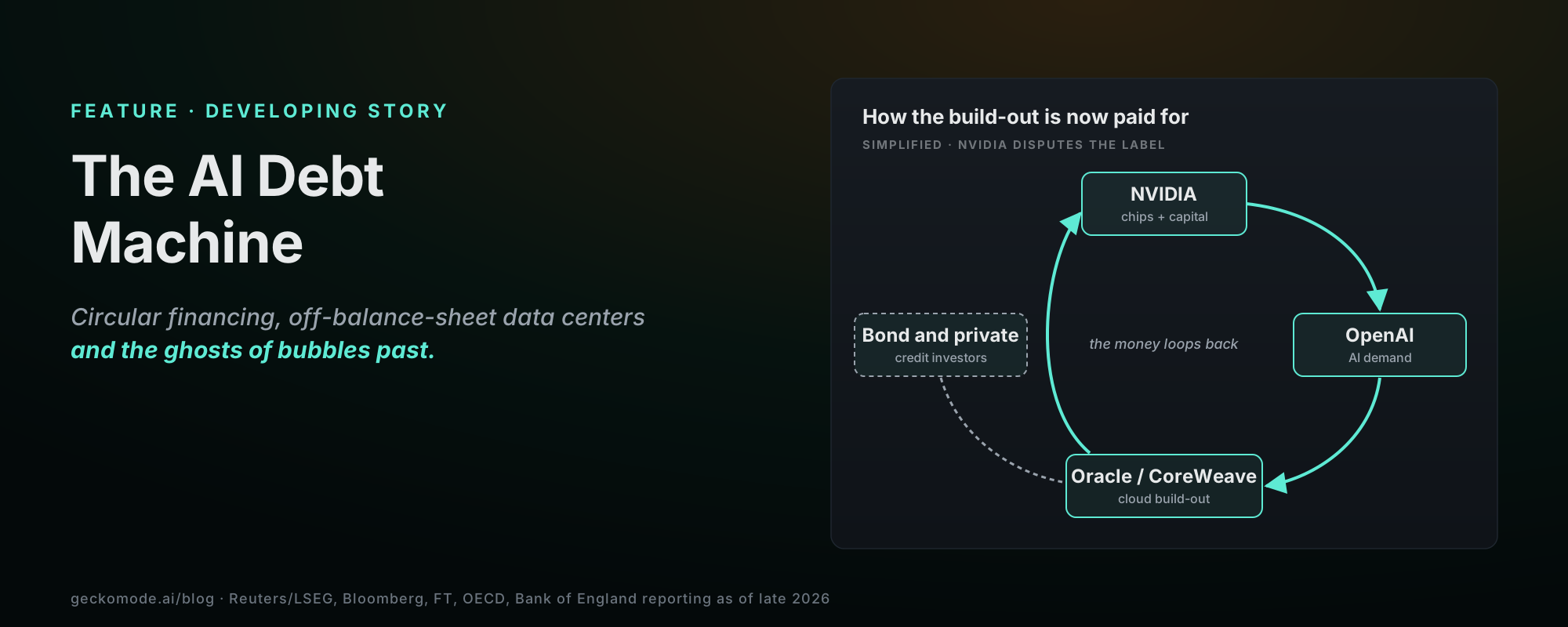
The third and most talked-about change is circular financing, and it’s worth drawing, because the shape is the argument.
The specific deals are real, even where the labels are contested. OpenAI has reportedly agreed to purchase on the order of $300 billion in computing power from Oracle, around $38 billion from Amazon, and roughly $22 billion from CoreWeave. Nvidia agreed to invest in OpenAI (a 2025 letter of intent discussed figures up to $100 billion, later reported to have evolved into a smaller equity stake), and has taken stakes in and commitments to cloud providers. AMD struck a multi-year arrangement with OpenAI reportedly worth tens of billions, plus warrants for up to 160 million AMD shares. Follow the arrows and you see the concern: a chipmaker’s capital helps fund a customer whose contracts fund a cloud provider that buys the chipmaker’s chips. Revenue that looks like independent end-demand may, in part, be the same dollars completing a lap.
Why is that dangerous? Because circular financing can manufacture the appearance of demand. If Nvidia’s reported sales are partly powered by capital Nvidia itself put into the ecosystem, then the sales number overstates how much genuinely external money is pulling AI forward. And if the outside funding stops, the circle can run in reverse just as fast, with cancelled orders and evaporating “revenue.” Jim Chanos, the short-seller who called Enron and whom we profile next week, has warned of exactly this, cautioning that AI orders “could begin to be cancelled” if the capacity isn’t needed in 2027 or 2028, and calling the broader environment a coming “golden age of fraud.”
Part 4: The ghosts, four bubbles that rhyme
History doesn’t repeat, but financial engineering has a small vocabulary, and the same words keep recurring. Here is what the current structure echoes, and, importantly, where the echoes are imperfect.
| Historical episode | The mechanism it shares with AI now | How today differs |
|---|---|---|
| Telecom / dot-com (1999–2001) | Vendor financing: Lucent and Nortel lent customers money to buy their equipment, booking revenue that vanished when the customers failed. Massive fiber overbuild. | Today’s leaders are far more profitable; some Nvidia arrangements are short-dated receivables (reportedly about 53-day terms), not multi-year loans. |
| Enron (2001) | Off-balance-sheet special purpose entities hid leverage until confidence broke. | No evidence of Enron-style fraud; AI SPVs are legal, disclosed financing, but still move leverage out of plain sight. |
| 1920s utility pyramids | Interlocking holding companies (Insull’s, for example) used layered debt and cross-ownership so a small equity base controlled vast assets, until the cascade. | AI firms aren’t a single pyramid, but the cross-investment and interconnection create similar correlation risk. |
| 2008 structured credit | Maturity mismatch: short-term funding behind long-lived assets, plus collateral (mortgages) that could reprice violently. | GPUs, not mortgages, are the collateral, and they depreciate on a schedule, which is arguably worse, not better. |
The telecom comparison is the one that keeps analysts up at night, and the numbers are sobering. By one widely shared estimate, Nvidia’s vendor-financing-style commitments are several times larger, relative to its revenue, than Lucent’s roughly $8.1 billion of vendor financing in 1999–2000, and Lucent’s off-balance-sheet guarantees famously obscured its true exposure right up until the bust. Chanos has made the scale vivid: a single hyperscaler now spends more on data centers and AI infrastructure in one year than the entire dot-com-era telecom and internet industries spent combined over five years. If even a fraction of that capacity turns out to be unneeded, the write-downs would be historic.
Every bubble is paid for in a slightly new way, but the new way always turns out to be an old way in a costume. Vendor financing, off-balance-sheet debt, maturity mismatch: we have met all three before.
Part 5: The honest counterargument
Now the other side, stated as strongly as we can, because intellectual honesty demands it and because the bears have been wrong for years. First, the companies dispute the framing: Nvidia has publicly stated it is not using “circular financing” schemes, and describes its deals as ordinary strategic investments and customer financing with short payment terms, not loans propping up fake demand. Second, the end-demand may be enormous: if AI is as transformative as its champions believe, the compute really will be used, and the build-out is rational preparation rather than speculative excess. Third, the hyperscalers at the center of this are real, cash-generating businesses with fortress balance sheets, nothing like the pre-revenue dot-coms or the thinly capitalized telecoms. And fourth, as a matter of logic, interconnection is not the same as fraud: suppliers taking stakes in customers and customers pre-committing to suppliers is normal in capital-intensive industries, and circular deals can be perfectly rational win-wins.
All of that is fair, and a responsible reading lands somewhere uncomfortable: the AI build-out is a genuine technological revolution and is also being financed with an increasing amount of leverage, opacity and circularity that raises the stakes if the revenue arrives slower than the spending assumed. Both things are true. The technology being real is exactly what the telecom bulls said in 1999, and they were right about the internet and wrong about the stocks. We made the same point in The Technology Was Real. The Returns Weren’t. Being right about the destination tells you nothing about surviving the journey.
Part 6: What a trader should actually do with this
Here is where we land, and it will be familiar to anyone who reads this blog. Knowing that there is hidden leverage and circular financing under the AI trade is useful context, and almost useless as a timing signal. Debt-fueled booms are notorious for running years longer than the skeptics expect; the telecom build-out inflated for years after the first credible warnings, and traders who shorted it early were carried out before they were vindicated. As we argued with Michael Burry, LTCM and the Situational Awareness collapse, being early is indistinguishable from being wrong, and betting the account on timing a credit unwind is how good analysts go broke.
The useful responses are structural, not predictive. Understand your real exposure: if you hold an S&P 500 index fund, you are already heavily invested in the companies at the center of this web, whether you meant to be or not (see our essay on concentration and index funds). Avoid the leverage that would turn a correction into a personal solvency event; the whole lesson of this feature is what leverage does when the music slows. Resist the recency bias that makes the build-out feel permanent. And size everything so that whichever way this resolves (a soft landing, a correction or something worse) you are still trading afterward. The system’s leverage is a reason to manage your own with more care, not less.
From belief to behavior: is the AI trade your whole book?
| The AI-debt risk | The fingerprint in your own record |
|---|---|
| Hidden concentration | “Diversified” holdings that are really one correlated AI bet (chips, clouds, power) that rise and fall together. See size discipline. |
| Your own leverage | Margin or options exposure that a sharp AI drawdown could turn into a forced liquidation: the personal version of the systemic risk. |
| Chasing the build-out | Entries into extended AI names near highs on momentum: recency bias buying the concentration at its most expensive. |
| Shorting the top repeatedly | A string of premature shorts bleeding against the trend, “early” over and over, the way skeptics lost money in 1999. |
Whether this ends in a soft landing or a reckoning, the question you can answer is whether your own book is secretly one leveraged AI bet. Upload a broker statement and Gecko scores your concentration, leverage and drawdown behavior in dollars across twelve behavioral axes. No login or broker connection needed, first 100 trades free.
An educational tool, not financial advice.
Resources and further reading
- The debt data: Reuters/LSEG and Bloomberg tallies of 2025–2026 hyperscaler and data-center bond issuance; OECD data on private credit’s rising share of AI financing; Axios and the FT on Oracle’s downgrade and CDS.
- Off-balance-sheet structures: reporting on the Meta Hyperion (about $27.3B) and El Paso data-center financing vehicles, and the Bank of England’s financial-stability flag on GPU collateral and maturity mismatch.
- Circular financing: coverage of the Nvidia–OpenAI, Oracle (about $300B), CoreWeave (about $22B) and AMD–OpenAI arrangements, and Nvidia’s statement that it does not use circular financing.
- The historical rhymes: accounts of Lucent/Nortel vendor financing (1999–2000), Enron’s off-balance-sheet SPVs, the 1920s Insull utility pyramids, and 2008 maturity mismatch.
- The skeptic’s case: Jim Chanos’s data-center and AI capex warnings (our full profile of Chanos publishes Thursday, October 29); and the timing lesson in When Genius Failed.
Frequently asked questions
What is circular financing in AI?
An arrangement where money loops among connected companies so a firm effectively helps fund the customers who buy its products. In AI, critics point to Nvidia investing in and committing to OpenAI, OpenAI signing huge compute contracts with Oracle and CoreWeave, and those providers buying Nvidia chips: revenue returning to where the capital started. The worry is that such loops inflate apparent demand. Nvidia disputes the “circular financing” label, calling its deals ordinary investments and short-dated receivables.
Is the AI data-center boom funded by debt?
Increasingly, yes, a shift from 2025’s cash funding. Reporting indicates hyperscaler and data-center bond issuance surged (near $194B by mid-2026 on one tally), private credit’s share of AI financing rose from about 9% to about 34% in a year, and large sums sit in off-balance-sheet vehicles (for example about $27.3B for Meta’s Hyperion). Figures vary by source; verify against filings.
How does it compare to the dot-com telecom bubble?
The closest rhyme is 1999–2000 telecom vendor financing: equipment makers lending customers money to buy gear, booking revenue that later vanished. Chanos and others note a single hyperscaler now out-spends the whole dot-com telecom and internet industry over five years, and warn of maturity mismatch. But today’s leaders are far more profitable and some deals are receivables, not loans: a rhyme, not a replay.
What does AI debt mean for individual traders?
That there’s now systemic leverage and interconnection under a trade many hold via index funds: a reason for risk awareness, not a signal to short the top. Debt booms run longer than skeptics expect, and being early is indistinguishable from being wrong. Understand your true exposure, avoid leverage a correction could compound, resist recency bias, and size to survive either outcome.
Feature in Gecko’s trading psychology series, and a developing story. Figures on bond issuance, private credit, SPVs, CDS and the various AI deals are drawn from contemporaneous reporting (Reuters/LSEG, Bloomberg, FT, Axios, OECD, Bank of England and law-firm alerts) as of late 2026; sources disagree and the situation is changing, so verify against primary filings. Nothing here alleges wrongdoing by any named company; it analyzes financial structure and risk. Gecko is an educational and informational tool. Nothing here is financial, investment or trading advice, a market forecast, or a recommendation for or against any security. Trading and leverage carry substantial risk of loss.
Drop in a single statement. Gecko produces a one-page Behavioral Diagnosis ranking your costliest habits in actual dollars. Free to start. No card. No broker connection.
Short notes, usually once or twice a month. Unsubscribe in one click.
No account needed. We use your email only to send Gecko blog posts, and the link at the bottom of every email opts you out in one click.
More on the blog
- When the Consumer BreaksHousehold debt booms have a long record of ending in slowdowns that forecasters miss. What that history says about markets, and about the most overlooked balance sheet in trading: your own.
- How Banking Crises Actually StartThe run is the last chapter, not the first. What 150 years of bank failures teach traders about reading stress, and about the mistakes made when the headlines finally arrive.
- The Technology Was Real. The Returns Weren't.What railways, the internet and every tech boom in between teach traders about bubbles, and the habits that turn a real revolution into a personal loss.