Value Investing Is a Behavioral Strategy, Not an Analytical One
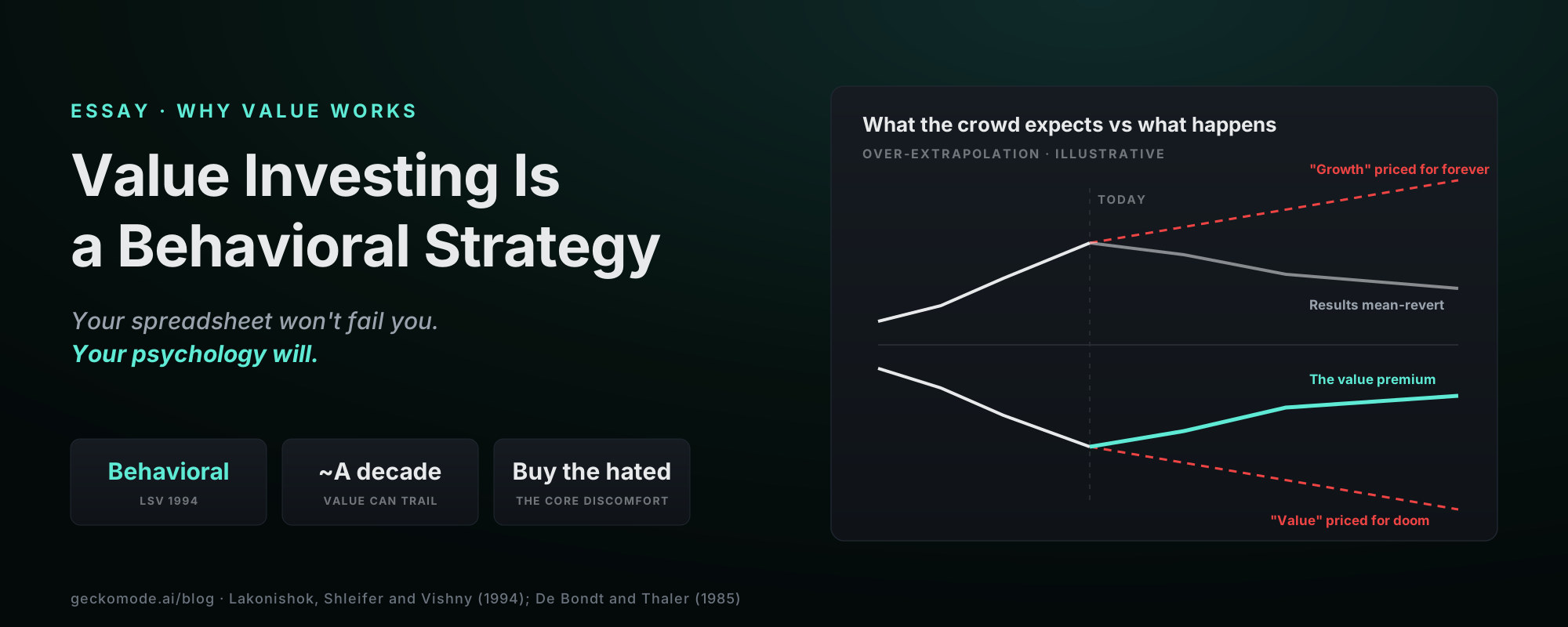
Ask most people why value investing works and you’ll get some version of “you buy things for less than they’re worth, so you make money when the price catches up.” True, but incomplete in a way that matters enormously, because it makes value sound like an analytical problem: a matter of running the numbers well enough to spot the bargain. If that were the whole story, the edge would have been arbitraged away decades ago. The numbers are not secret, and every value investor has read the same Graham. The value premium persists for a reason that has almost nothing to do with analysis and everything to do with the thing this blog cares about most: behavior.
Key takeaways
- The value premium is one of the most documented patterns in finance, and a leading explanation says it exists because value stocks are psychologically painful to hold, not because they’re riskier.
- Lakonishok, Shleifer & Vishny (1994) argued value works by exploiting the crowd’s habit of over-extrapolating growth; De Bondt & Thaler (1985) documented the overreaction it feeds on.
- That makes the edge behavioral. The analysis (read a balance sheet, demand a margin of safety) is learnable and widely known. The temperament to act on it is rare.
- The value investor’s real job is to buy what everyone hates and sit through a “lost decade” without flinching. Your spreadsheet won’t fail you. Your psychology will.
What the research actually says about why value works
There are two competing explanations for the value premium, and which one you believe changes how you practice it. The first, associated with Eugene Fama and Kenneth French, is risk-based: value stocks earn more because they’re riskier in some way the market rationally demands compensation for. The second, and the more persuasive for anyone who thinks in behavioral terms, comes from a landmark 1994 paper by Josef Lakonishok, Andrei Shleifer and Robert Vishny, bluntly titled “Contrarian Investment, Extrapolation, and Risk.”
Their finding was direct: value strategies outperformed because they exploited the suboptimal behavior of the typical investor, and the authors found little evidence that they were fundamentally riskier. The mechanism is over-extrapolation. Investors take a company’s recent growth, booming or dismal, and project it too far into the future. They fall in love with the exciting “growth” story and bid it to a price that assumes the good times never end; they recoil from the boring, troubled “value” name and dump it to a price that assumes the bad times never end. Both are wrong on average, because business results mean-revert more than people expect. The value investor is simply the person on the other side of that mistake.
This connects directly to the oldest evidence in behavioral finance, De Bondt and Thaler’s 1985 “Does the Stock Market Overreact?”, which we covered in the essay on recency bias: prior “loser” stocks went on to beat prior “winners” over the following years, consistent with the crowd having overreacted. Value investing, at its core, is a systematic bet against that overreaction. It is the disciplined, industrialized form of buying what the recency-biased crowd has thrown away.
Which is why it’s so hard, by design
Here’s the part every long-term value investor eventually learns. If the edge came from analysis, it would be easy to keep: once you’d learned to value a business, you’d just do it. But if the edge comes from behavior, its difficulty renews itself every day, and the difficulty is the reason it survives. An edge that were easy to hold would be crowded out; the value premium persists precisely because so few people can endure what capturing it requires.
Consider what value actually demands of you. You must buy the companies in the headlines for the wrong reasons, the ones your friends think are obviously doomed. You must then watch them do nothing, or worse, while the exciting growth names your neighbor owns triple. You must endure this not for weeks but potentially for years: value spent much of the 2010s and early 2020s trailing growth badly, a “lost decade” long enough that a chorus of serious people declared value investing dead. And you must do all of it while every instinct the behavioral research has documented pushes you to stop: recency bias insisting the winners will keep winning, loss aversion making the underperformance feel unbearable, social proof making you feel like a fool for owning what everyone mocks.
An honest note on that “lost decade,” because it matters: value can underperform for a long time, and it may not reward you on your schedule. Anyone who tells you the premium is a smooth, reliable paycheck is selling the theory, not the lived experience. But notice the shape of the complaint. “Value has underperformed for years, so it must be broken” is itself the extrapolation error that, on the behavioral account, creates the premium in the first place. The value premium has been declared dead before and returned. Whether it rewards any particular decade is uncertain; that it periodically inflicts droughts long enough to break most investors’ resolve is close to guaranteed. The drought is the toll booth on the road to the premium.
Graham knew this eighty years ago
None of this would have surprised Benjamin Graham, whose The Intelligent Investor framed the discipline around temperament rather than technique. His famous “Mr. Market” parable isn’t an analytical tool; it’s a psychological one. Mr. Market shows up every day offering you emotional prices, euphoric when things are good and despairing when they’re bad, and the investor’s job is to exploit his moods rather than catch them. Graham’s other great contribution, the “margin of safety,” works as a behavioral buffer too: you will be wrong sometimes and your emotions will be tested, so you build in a cushion that lets you be imperfect and still survive.
Warren Buffett, Graham’s best-known student, has made the same point for decades: investing success doesn’t track IQ once you’re past a reasonable threshold, and what separates people is the temperament to keep emotion from corrupting a sound framework. It’s a remarkable admission from the most celebrated investor of his generation: the analysis was never the hard part.
What this means for how you invest
If value’s edge is behavioral, then improving as a value investor is mostly a project of improving your behavior, not your modeling. The practical implications are specific. Write down your buy criteria and your intrinsic-value estimate before the emotional moment, so the decision to buy the hated stock is made in a calm room rather than in the teeth of a sell-off. Size positions so that a long stretch of being wrong can’t force you out, the value investor’s equivalent of the risk control that keeps a trader in the game. And, most importantly, measure your own conduct. The failure mode of value investing is almost never a bad valuation. It’s capitulating at the bottom, or drifting into the exciting names during the drought because the pain of missing out became greater than your conviction.
From belief to behavior: is your temperament the edge, or the leak?
Value’s behavioral demands leave fingerprints, and they’re in your own record.
| What value requires | The fingerprint of failing it in your record |
|---|---|
| Buy the unloved, on criteria. | Entries that drift toward whatever’s recently hot rather than what’s cheap: recency bias overriding the thesis. |
| Hold through the drought. | Selling positions during their worst stretch, then watching them recover: capitulation, the value investor’s version of panic-selling; see the behavior gap. |
| Size to survive being early. | A position so large that a long lag forces you out; see size discipline. |
| Resist chasing what works. | Style drift into growth names mid-drought; activity rising as conviction falls; see overtrading. |
Value is a temperament test. Are you passing it?
The value premium goes to the investor who can sit through the drought, and whether you actually do is written in your record. Connect your accounts and Gecko shows your whole portfolio in one view, lets you write down the case for each holding before the hard moment arrives, and has Gecko AI argue the other side when the news turns. Trade history uploads are scored across twelve behavioral axes, including capitulation and style drift, in dollars.
See whether your temperament is the edge →Free to start. 14-day Pro trial. An educational tool, not financial advice.
Resources and further reading
- The behavioral case: Lakonishok, J., Shleifer, A. & Vishny, R. (1994), “Contrarian Investment, Extrapolation, and Risk,” Journal of Finance 49(5): 1541–1578.
- The overreaction beneath it: De Bondt, W. & Thaler, R. (1985), “Does the Stock Market Overreact?”, Journal of Finance 40(3): 793–805.
- The risk-based view: Fama, E. & French, K. (1992), “The Cross-Section of Expected Stock Returns,” and (1993), “Common Risk Factors in the Returns on Stocks and Bonds,” on the value factor (HML), the other side of the why-value-works debate.
- The classic: Graham, B., The Intelligent Investor (Mr. Market, margin of safety); see Gecko’s review.
- The long-run backdrop: Faber, M. (2026), Investing in America: The Rise of a 250-Year Bull Market, a decade-by-decade history of US markets for the long-term investor.
Frequently asked questions
Why does value investing work?
The leading behavioral explanation is over-extrapolation: investors push exciting “growth” stocks too high and beaten-down “value” stocks too low, and prices mean-revert. Lakonishok, Shleifer & Vishny (1994) argued value works by exploiting this suboptimal behavior rather than extra risk; De Bondt & Thaler (1985) documented the overreaction. The risk-based view of Fama and French remains the main alternative explanation.
Is value investing dead?
It suffered a long stretch of underperformance against growth, prompting many to declare it dead, but it has been pronounced dead before and returned. The honest answer: value can underperform for a very long time, and that drought is part of why the premium exists at all. Whether any given decade rewards value is uncertain.
What makes a good value investor?
Temperament over analytical brilliance. Reading a balance sheet and demanding a margin of safety are learnable and widely known; the rare skill is buying what everyone’s selling and holding through years of looking wrong. Graham’s Mr. Market parable makes the point: the edge is exploiting the market’s emotions rather than sharing them.
Why is value investing so hard to stick with?
Because it works against well-documented instincts: recency bias makes recent winners feel safe when they’re most expensive, loss aversion makes the lag unbearable, and social proof makes owning unloved stocks feel foolish. The analysis says the cheap stock is a deal; your psychology says it’s cheap for a reason. Overcoming that is the whole job, and it is a behavioral skill, not an analytical one.
Essay in Gecko’s investing and trading psychology series. Findings are drawn from Lakonishok, Shleifer & Vishny (1994), De Bondt & Thaler (1985) and Fama & French (1992, 1993); the risk-based and behavioral explanations of the value premium remain debated, and value’s future returns are uncertain. Gecko is an educational and informational tool. Nothing here is financial, investment or trading advice, or a recommendation of any strategy or security. Investing carries substantial risk of loss.
Drop in a single statement. Gecko produces a one-page Behavioral Diagnosis ranking your costliest habits in actual dollars. Free to start. No card. No broker connection.
Short notes, usually once or twice a month. Unsubscribe in one click.
No account needed. We use your email only to send Gecko blog posts, and the link at the bottom of every email opts you out in one click.
More on the blog
- Which Strategies Actually Make Millionaires? The Boring Answer, Backed by 10,000 of ThemIf you learned about wealth from social media, you'd think millionaires are minted by 0DTE options, ten-baggers, leveraged crypto, and Lamborghini day-trading. The largest study of US millionaires (Ramsey, 10,000 people) tells a very different story: 8 in 10 named their 401(k) as their #1 wealth-builder, none credited single-stock picking, 89% didn't inherit. Fidelity now counts ~645,000 401(k) millionaires; the average one is nearly 59 and has been in the same account ~25 years. The strategy that mints millionaires isn't a strategy — it's a habit repeated for decades. And it's the same trait every disciplined trader we've profiled shares.
- Jim Simons: The Mathematician Who Beat the Market — and Why You Can't Copy HimRenaissance Technologies' Medallion Fund averaged ~66% gross (~39% net) a year from 1988 to 2018, never had a losing year, and turned $1 into more than $27,000. It is the greatest track record ever recorded — and the definitive counterexample to the efficient-market hypothesis (Cornell, 2020, JPM). Simons wasn't a market natural. He was a world-class mathematician and former NSA codebreaker who turned pattern-detection on prices with an army of PhDs. The honest lesson: his edge is unrepeatable at retail scale — his RELATIONSHIP to evidence and risk (edge measured not felt, process over outcome, never blow up) is what's transferable.
- Midterm Elections Won't Move the Market the Way You Think They WillThe 2026 midterms land on November 3. Political uncertainty carries a real, measurable premium — Pastor & Veronesi's 'political risk premium' shows up in options data across 20 elections in 20 countries. S&P 500 midterm-year returns average ~4.6% since 1950 (below the long-run ~10%), with the deepest intra-year drawdowns of the four-year cycle. But the twelve months AFTER a midterm have never been negative since 1950 — ~15% avg. The real risk for most traders isn't the drawdown; it's headline-driven behavior at the account level. Party-neutral. Historical patterns, not forecasts.