Nvidia After the Air Came Out: A Behavioral Read on NVDA
Few stocks carry as much story as Nvidia, and few weeks have tested that story like this one. The business is still growing at a pace with almost no precedent at its size. The stock has spent the past weeks going the other way, and on November 12 its co-founder stepped down as chief executive. For a trader, the interesting question isn’t whether NVDA is cheap. It’s how you’ll behave if you own the most emotionally charged ticker on the tape.
Key takeaways
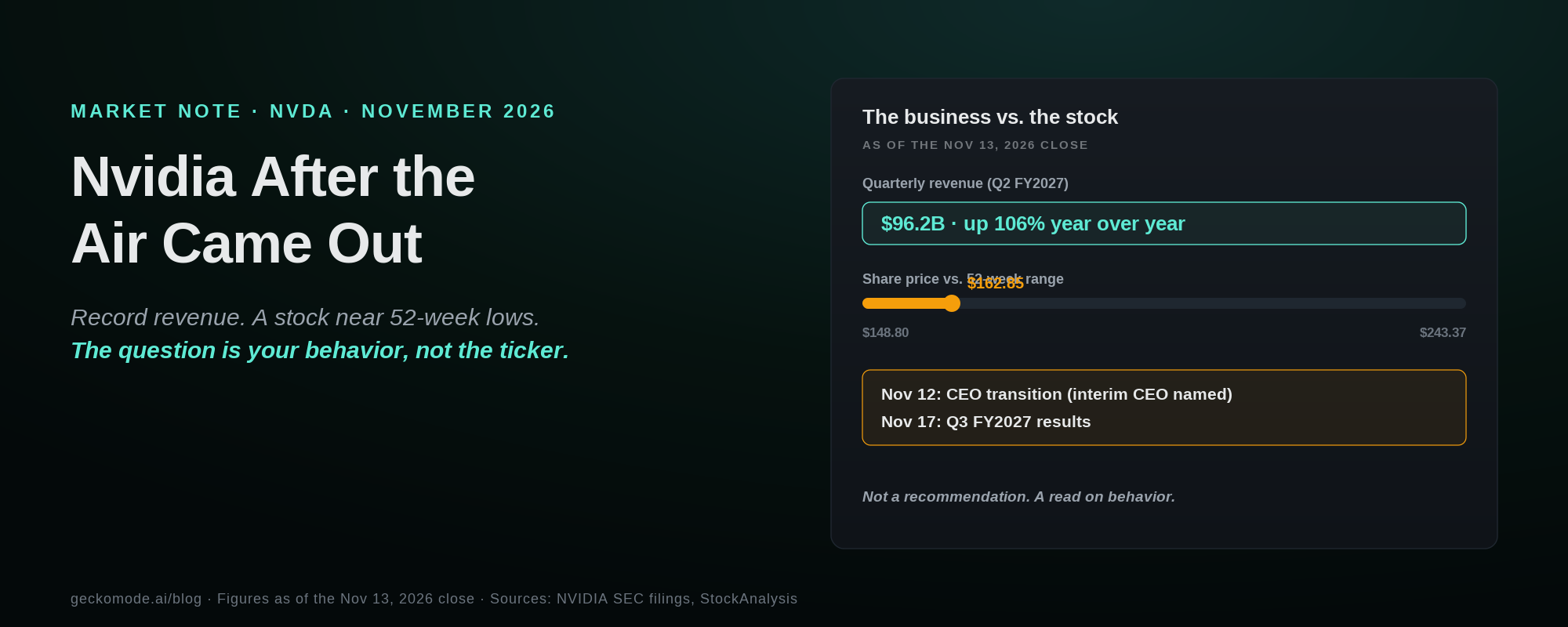
- The business is still putting up historic numbers: Q2 FY2027 revenue of $96.2B, with Data Center at $89.0B (up 117% year over year), and guidance of about $108B for Q3.
- The stock has done the opposite lately: about $162.85 at the November 13 close, near the bottom of its 52-week range ($148.80 to $243.37), with market value back under $4 trillion.
- Jensen Huang resigned as CEO on November 12; CFO Colette Kress is interim CEO. Q3 results follow on November 17.
- None of that tells you what to do. The useful question is how you will behave around a volatile, narrative-heavy position.
The business vs. the stock
It helps to separate two things that NVDA coverage constantly blends. The company is still growing at a rate with almost no precedent at this scale. In Q2 of fiscal 2027 (reported August 2026) Nvidia posted $96.2B in revenue, with Data Center alone at $89.0B, up 117% year over year, and guided the next quarter to roughly $108B while assuming no data-center compute revenue from China. A year earlier, quarterly data-center revenue was about $51B. The top line has roughly doubled in a year.
The stock, meanwhile, closed November 13 near $162.85: toward the bottom of a 52-week range of $148.80 to $243.37, below its 200-day moving average, and down sharply on the week, enough to take its market value back under $4 trillion, to about $3.9T. With a beta around 2, it tends to move about twice as hard as the index in both directions.
A leadership change in the middle of it
On November 12, Nvidia announced that Jensen Huang, its co-founder and CEO for 33 years, had resigned effective immediately. The company named CFO Colette Kress interim CEO and appointed its first independent board chair; it gave no reason in its filing, and press coverage has tied the departure to his personal conduct. Its Q3 FY2027 results are scheduled for November 17, the first report without him. A founder exit at a company this central to the market is exactly the kind of event that produces large, emotional moves regardless of the underlying numbers.
What the analyst split is really saying
Consensus is still nominally a Buy, and average price targets (roughly $248 to $277 depending on the survey) sit far above the quote. But the direction of revisions matters more than the level: Hold ratings have been rising, and several analysts have moved from Buy to Hold, HSBC among them. When targets stay high while ratings drift to Hold, the Street is quietly saying “great company, uncertain next twelve months,” which is exactly the regime in which stocks chop and gap.
Why this one is a behavioral minefield
NVDA is the poster child for the AI trade, it sits in nearly every index portfolio whether its owners chose it or not, and it is covered relentlessly. That combination triggers the exact errors that drain accounts:
- Anchoring. The gap between about $163 and an average target near $260 invites “it was $240, so it’s cheap.” See anchoring.
- Oversizing. A beta near 2 makes the moves exciting, and excitement leaks into position size. See size discipline.
- Overtrading. There is always a fresh headline to react to, this week more than most. See overtrading.
- The disposition-effect script. A slide toward 52-week lows invites averaging down on conviction, or panic-selling at the low. See the disposition effect.
We walked through why AI-era narratives are so hard on position sizing in The Technology Was Real. The Returns Weren’t. and in our AI debt machine feature. NVDA sits at the center of both.
The behavioral turn
Gecko has no view on whether Nvidia is a buy. That isn’t our job, and anyone who tells you confidently either way is selling something. What we would point out is this: a ticker like NVDA doesn’t reward you for being right about the AI thesis nearly as much as it punishes you for behaving badly around a volatile position. Two traders with the same long-term view can end the year far apart, purely on sizing, averaging, and whether they flinched at the November lows. The thesis gets argued on television. The behavior is recorded in your statement.
Upload a broker statement and Gecko shows how you behave around your most volatile positions: sizing, averaging down, and trading after big moves, priced in dollars across twelve behavioral habits. Free for your first 100 trades.
An educational tool, not financial advice.
Resources and data
- NVIDIA SEC filings: Q2 FY2027 results (8-K), Q1 FY2027 results (8-K), and the CEO transition (8-K, November 2026).
- Price and estimate data: StockAnalysis, TipRanks, Public.com. Figures move; check a live quote.
Market note in Gecko’s series. Figures as of the November 13, 2026 close from company filings and the data providers above. This is commentary, not investment advice or a recommendation to buy, sell or hold any security. Markets carry substantial risk of loss.
Drop in a single statement. Gecko produces a one-page Behavioral Diagnosis ranking your costliest habits in actual dollars. Free to start. No card. No broker connection.
Twelve checks, one per behavioral habit, that show what your own trading costs you. Then one behavioral self-check from the research, every other Friday.
No account needed. We only use your email for the newsletter, and every email has a one-click unsubscribe.
More on the blog
- Most Trading Journals Ask What You Did. Gecko Tells You What It Cost You.A trading journal is a logbook: you type in trades and feelings, then audit yourself. Gecko reads your broker statement, tests twelve behavioral habits for real patterns, and prices each one in dollars. Here's why we built it that way.
- The Behavioral Investor by Daniel Crosby: The Four Tendencies Behind Almost Every Investing MistakePsychologist and asset manager Daniel Crosby compresses the long list of investing biases into four roots: ego, conservatism, attention and emotion. His defense is process over willpower. What the book can't tell you is which tendency is costing you money.
- Our Dollar, Your Problem by Kenneth Rogoff: Is Dollar Dominance Running Out of Road?Harvard economist and former IMF chief economist Kenneth Rogoff traces seven decades of dollar dominance and argues it is real but contingent, with the gravest threats internal: debt, dysfunction and the end of ultra-low rates. For traders, the lesson is time horizon: a slow tide is not a daily signal.