Trading in the Zone by Mark Douglas: 5 Truths, 4 Fears, and What They Look Like in Your Own Data
Most trading books promise a better setup. Mark Douglas wrote one that argues your setup was probably never the problem. Trading in the Zone is about the gap between knowing what to do and actually doing it, trade after trade, when real money is moving against you.
The premise: you are not trading the market, you are trading your beliefs about it
Douglas spent years coaching traders who already knew their strategies cold and still lost money. His conclusion was uncomfortable: the edge was rarely the issue. The issue was what happened inside the trader during the moments that mattered — the flinch before an entry, the urge to move a stop, the relief of taking a small win too early.
The book’s thesis is that the consistency a trader is chasing lives in the mind, not in the charts. The market will always produce uncertainty. The only variable you control is how you meet it.
“Anything can happen.”
Mark Douglas, the first of the five fundamental truths in Trading in the Zone
Thinking in probabilities: the five fundamental truths
The heart of the book is a shift from prediction to probability. A trader who needs to be right on this trade is fragile, because the market owes them nothing. A trader who thinks in probabilities treats each trade as one sample from a much larger distribution, where the edge only has to show up over many repetitions. Douglas distills this into five truths:
- Anything can happen.
- You do not need to know what is going to happen next in order to make money.
- There is a random distribution between wins and losses for any given set of variables that define an edge.
- An edge is nothing more than an indication of a higher probability of one thing happening over another.
- Every moment in the market is unique.
The practical payoff is emotional, not analytical. If you genuinely accept truth number three, a losing trade stops feeling like a personal verdict. It is simply one of the losers you already knew the distribution contained. That acceptance is what lets a trader follow a plan without flinching, which is the behavior the next idea protects.
The four primary fears: where the money quietly leaks
Douglas argues that the overwhelming majority of trading errors trace back to four fears. They are worth naming precisely, because each one drives a different and recognizable mistake.
Fear of being wrong
This is the one Marty Schwartz pointed at when he said most traders would rather lose money than admit a mistake. It shows up as holding losers past the stop, hoping the market proves you right.
Fear of losing money
Paradoxically, the fear of losing makes traders lose. It causes hesitation on valid entries and, after a loss, a rush to make the money back. That rush has a name most traders recognize: tilt.
Fear of missing out
FOMO turns a calm plan into a chase. It produces late entries into moves that are already extended, and position sizes that are bigger than the plan allowed because this one feels obvious.
Fear of leaving money on the table
The mirror image of cutting losses late is taking winners early. The fear of giving back an open profit makes traders snatch small gains, which quietly inverts their risk-to-reward over time.
Consistency is built, not summoned: the seven principles
Douglas does not leave the reader with awareness alone. He offers a set of commitments, the seven principles of consistency, designed to make disciplined behavior automatic rather than heroic:
- I objectively identify my edges.
- I predefine the risk of every trade.
- I completely accept the risk, or I am willing to let go of the trade.
- I act on my edges without reservation or hesitation.
- I pay myself as the market makes money available to me.
- I continually monitor my susceptibility for making errors.
- I understand the absolute necessity of these principles, and I never violate them.
Notice principle six. Douglas does not assume a trader can simply decide to be disciplined and stay that way. He builds in continuous self-monitoring, because the fears never fully disappear. They just get easier to catch. That single principle is the bridge from a book about mindset to something you can actually do every week.
From belief to behavior: tracking the zone in your own data
Here is the part that often gets lost. Douglas’s ideas sound abstract, but the behaviors they describe are not. Each fear produces a pattern that is visible in the timestamps, sizes, and outcomes of trades you have already closed. Principle six, continual self-monitoring, is really a request for data.
| Concept from the book | The fingerprint it leaves in your trade history |
|---|---|
| Fear of losing, the urge to win it back | A cluster of entries placed shortly after a losing trade, often with worse outcomes than your baseline. |
| Fear of missing out | Late entries into extended moves, and position sizes above your own average on impulse trades. |
| Fear of leaving money on the table | Average winner smaller than average loser, a tell that profits are being cut short. |
| Fear of being wrong | Holds that run past the predefined stop, turning small planned losses into large ones. |
| Principle 2, predefine risk | Consistency of risk per trade, measurable as the spread in your position sizing. |
| Principle 6, monitor errors | A weekly score that moves up or down as the patterns above shrink or grow. |
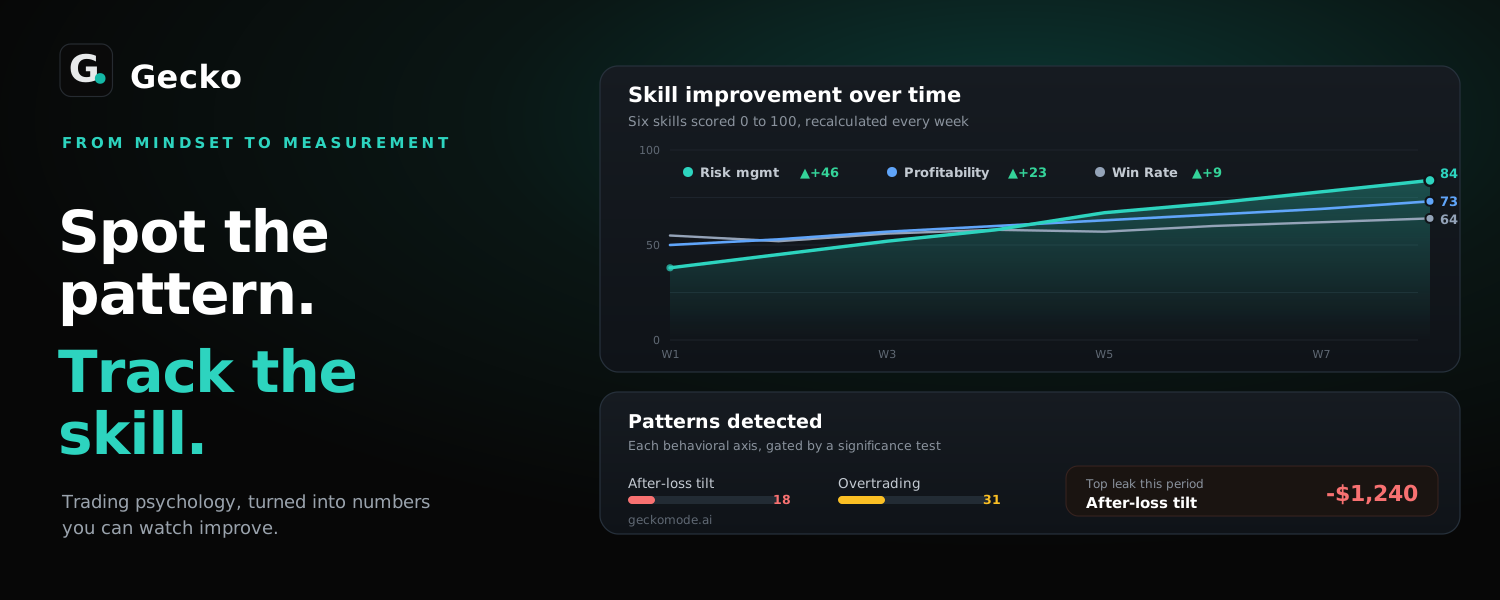
This is the whole reason a behavioral journal is more useful than a spreadsheet of entries and exits. A spreadsheet records what you did. A behavioral read tells you which of Douglas’s fears was driving the trade, and what it cost. Gecko was built around exactly this idea: it scores patterns like after-loss tilt, time-of-day skew, and the ratio of your average win to your average loss, so the concepts in Trading in the Zone stop being something you nod along to and become something you can watch improve week over week.
You do not need a tool to start. You can read your own statements and ask, for each red day, which of the four fears was in the room. But if you want the numbers attached without the manual work, that is the gap a behavioral journal closes.
See which fear is costing you the most →Free to start. No credit card. No broker connection.
Frequently asked questions
What is the main idea of Trading in the Zone?
That consistent results come from a probabilistic mindset rather than from predicting the market. Once a trader accepts that any single trade can win or lose, and that an edge only plays out across a series of trades, the emotional pressure behind most errors begins to fade.
What are the five fundamental truths of trading?
Anything can happen. You do not need to know what happens next to make money. Wins and losses are randomly distributed for any edge. An edge is only a higher probability of one outcome over another. Every market moment is unique.
What are the four primary trading fears?
The fear of being wrong, the fear of losing money, the fear of missing out, and the fear of leaving money on the table. Douglas attributes the large majority of trading errors to these four.
How do you actually track trading psychology?
By looking for the numeric fingerprints each fear leaves in your closed trades, such as entries clustered after losses, oversized impulse trades, or winners cut shorter than losers. A behavioral trading journal scores these automatically from your trade history.
This article is part of Gecko’s trading psychology series. Quotations and concepts are drawn from Mark Douglas, Trading in the Zone: Master the Market with Confidence, Discipline and a Winning Attitude. Gecko is an educational and informational tool. Nothing here is financial, investment, or trading advice. Trading carries substantial risk of loss.
Drop in a single statement. Gecko produces a one-page Behavioral Diagnosis ranking your costliest habits in actual dollars. Free to start. No card. No broker connection.
Short notes, usually once or twice a month. Unsubscribe in one click.
No account needed. We use your email only to send Gecko blog posts, and the link at the bottom of every email opts you out in one click.
More on the blog
- The AI Debt Machine: Circular Financing, Off-Balance-Sheet Data Centers, and the Ghosts of Bubbles PastThe AI build-out has quietly shifted from cash to debt: hyperscaler bonds near $194 billion in 2026, private credit's share of AI financing up from about 9% to 34%, debt parked in off-balance-sheet vehicles, and a circular loop among Nvidia, OpenAI, Oracle and CoreWeave. What telecom, Enron and the 1920s say about it, and what a trader should actually do.
- When the Consumer BreaksHousehold debt booms have a long record of ending in slowdowns that forecasters miss. What that history says about markets, and about the most overlooked balance sheet in trading: your own.
- How Banking Crises Actually StartThe run is the last chapter, not the first. What 150 years of bank failures teach traders about reading stress, and about the mistakes made when the headlines finally arrive.