How Banking Crises Actually Start
On March 9, 2023, customers pulled about $42 billion out of Silicon Valley Bank in a single day. The Federal Reserve’s Michael Barr later told the Senate that another $100 billion was scheduled to leave the next morning. Together that was about 81% of the bank’s $175 billion in deposits at the end of 2022. Regulators shut it on March 10, the largest US bank failure since 2008.
It looked like a sudden panic. It was not. Barr testified that Fed supervisors had been warning SVB’s management about interest-rate risk on its balance sheet since November 2021. The run was the moment the market’s slow recognition turned into a stampede.
Key takeaways
- Bank runs are real and can be self-fulfilling, which is why deposit insurance and central-bank lending exist. That insight won the 2022 Nobel Prize in economics.
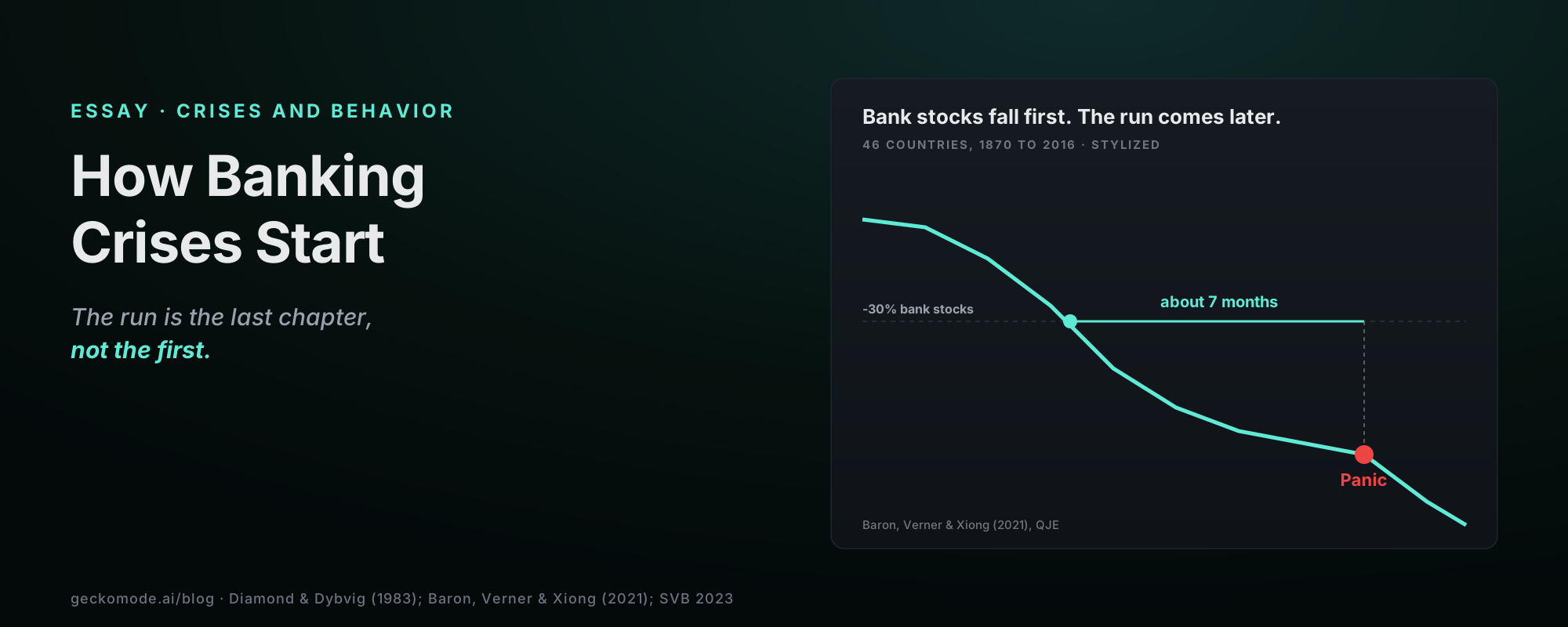
- But a study of 46 countries since 1870 finds panics usually come late: on average, they arrived about seven months after bank stocks had already fallen 30%.
- Bank equity is one of the better early-warning signals. A bank-stock fall of at least 30% predicted 3.4% lower GDP and 5.7 points less bank credit-to-GDP three years later.
- Most trading damage happens at the headline stage: panic selling of everything, or buying bank stocks because they “look cheap” after a 30% drop.
Why banks can fail overnight
In 1983 Douglas Diamond and Philip Dybvig published “Bank Runs, Deposit Insurance, and Liquidity.” Their insight, which earned them the 2022 Nobel Prize with Ben Bernanke, is that banks do something useful and fragile at once. They let savers withdraw at any time while lending long-term to borrowers. That works only while depositors trust each other not to run. If enough of them withdraw at once, the Nobel committee wrote, “the rumour may become a self-fulfilling prophecy” and even a sound bank can collapse. Deposit insurance and a central-bank lender of last resort exist to break that loop.
Bernanke’s part of the prize adds why it matters beyond the bank. Studying the Great Depression, he showed that bank failures made the downturn deeper and longer, because the knowledge banks held about their borrowers was lost and could not be quickly rebuilt.
Why the run is usually late
If runs were the whole story, crises would strike out of nowhere. The historical record says otherwise. In “Banking Crises Without Panics,” Matthew Baron, Emil Verner and Wei Xiong built a dataset of bank stock returns and panic accounts for 46 countries from 1870 to 2016. Three findings stand out:
- Losses come before panics. Across more than 100 crises, panics occurred on average seven months after the bank stock index had already fallen 30%. By the month before a panic, bank stocks were down an average of 36% from their peak.
- Panics are not required for damage. Even without any run, a bank equity decline of at least 30% predicted 3.4% lower real GDP and 5.7 percentage points lower bank credit-to-GDP three years later.
- The signal is one-sided. Falling bank stocks predicted weaker output and credit. Rising bank stocks did not predict stronger growth.
The authors conclude that panics tend to be the result of earlier bank losses rather than their cause. In plain terms, the market usually tells you something is wrong long before the queue forms outside the branch.
What traders get wrong
Knowing this does not make a trader a crisis forecaster. Most bank-stock declines do not become crises, and the bank-equity signal is about the economy over years, not the next trading day. The expensive mistakes are behavioral, and they cluster at the headline stage:
- Selling everything at the headline. The run is the loudest moment and often not the most informative one. Liquidating a whole account on a bank-failure headline locks in the worst prices of the episode.
- Catching the falling bank. A bank stock down 30% looks cheap. The Baron-Verner-Xiong data says a 30% fall is where trouble starts, not where it ends.
- Doubling down on a thesis. Adding to a losing bank position because “deposits are insured” confuses the safety of depositors with the safety of shareholders, who are usually wiped out in a failure.
- Ignoring your own counterparty. Many traders never check how their own cash is held.
Your own account is a small bank
The Diamond-Dybvig lesson applies to traders directly. Your broker holds your cash and securities. In the US, SIPC protects customers of a failed member brokerage up to $500,000, including a $250,000 limit for cash, but only for missing assets, not for falling prices, and not for many futures, foreign-exchange or unregistered crypto holdings. Knowing what is protected, and where your cash actually sits, is a five-minute check most traders never do.
From belief to behavior: check yourself
- Headline selling: in your last market scare, how many positions did you close within 24 hours of the first headline, and where were those prices a month later?
- Bottom-fishing: did you buy a sector after a 30% fall without a written exit level?
- Averaging down: how often did you add to a position that was already below your stop? See also Your Stop-Loss Is a Signal.
- Cash exposure: how much cash do you hold at a single broker, and is it within protection limits?
A free check you can run this week
Pull your trades from the most stressful week your account has seen. Mark every trade opened or closed on a day with a major negative headline. Compare those trades with your normal ones on size and outcome. If headline-day trades are larger or worse, write one rule: no new positions in the first hour after a major headline, and no full liquidation without a pre-written reason.
Full disclosure: Gecko is our product, and it flags headline-day trading patterns automatically from a broker statement. The spreadsheet version covers the core of it.
Frequently asked questions
Do bank runs cause banking crises?
They amplify them. Historical data suggests large bank losses usually come first and panics follow.
Are bank stocks a good early warning?
For the broader economy over years, yes, research finds large declines predict weaker GDP and credit. For short-term trading, they are not a timing signal.
Is my brokerage cash insured like a bank deposit?
Not in the same way. SIPC restores missing cash and securities up to its limits if a member firm fails; it does not protect against market losses.
Sources
- Royal Swedish Academy of Sciences (2022), Prize in Economic Sciences press release, on Bernanke, Diamond and Dybvig.
- Diamond, D. & Dybvig, P. (1983), “Bank Runs, Deposit Insurance, and Liquidity,” Journal of Political Economy.
- Baron, M., Verner, E. & Xiong, W. (2021), Banking Crises Without Panics, Quarterly Journal of Economics.
- CNBC (2023), SVB customers tried to withdraw nearly all the bank’s deposits over two days, Fed’s Barr testifies.
- SIPC, What SIPC Protects.
Essay in Gecko’s trading psychology and market history series. Figures come from the studies and reporting listed above and are approximate. Nothing here is a market forecast or a recommendation of any security or strategy, and SIPC rules are summarized, not legal advice. Gecko is an educational and informational tool. Educational, not financial advice. Trading carries substantial risk of loss.
Drop in a single statement. Gecko produces a one-page Behavioral Diagnosis ranking your costliest habits in actual dollars. Free to start. No card. No broker connection.
Short notes, usually once or twice a month. Unsubscribe in one click.
No account needed. We use your email only to send Gecko blog posts, and the link at the bottom of every email opts you out in one click.
More on the blog
- The Technology Was Real. The Returns Weren't.What railways, the internet and every tech boom in between teach traders about bubbles, and the habits that turn a real revolution into a personal loss.
- A Random Walk Down Wall Street by Burton Malkiel: Still Right After 50 Years, With One Modern CatchMalkiel's 1973 classic told ordinary investors to stop trying to beat the market and simply own it, cheaply, for the long run. Fifty years on the evidence has aged well: $10,000 in the first index fund at the start of 1977 grew to about $2.1 million by 2022. He's honest that markets aren't perfectly efficient. The catch he couldn't foresee: the index he told you to buy is now roughly a third seven stocks, so diversified indexing has quietly become a big-tech bet.
- Concentrated Portfolios vs Index Funds: What the Research Really Says, and Why the Index Isn't What It Used to BeBessembinder's landmark study found that since 1926 about 4% of US stocks created all of the market's net wealth above Treasury bills, and most individual stocks trailed cash. That fact makes concentration a long-odds bet and broad indexing the evidence-based default. It also explains the Magnificent Seven, now roughly a third of the S&P 500: buying the index today means a concentrated bet on a few mega-caps. A few winners driving everything is old; how concentrated the index has become is not.