The System Works. You Don't.
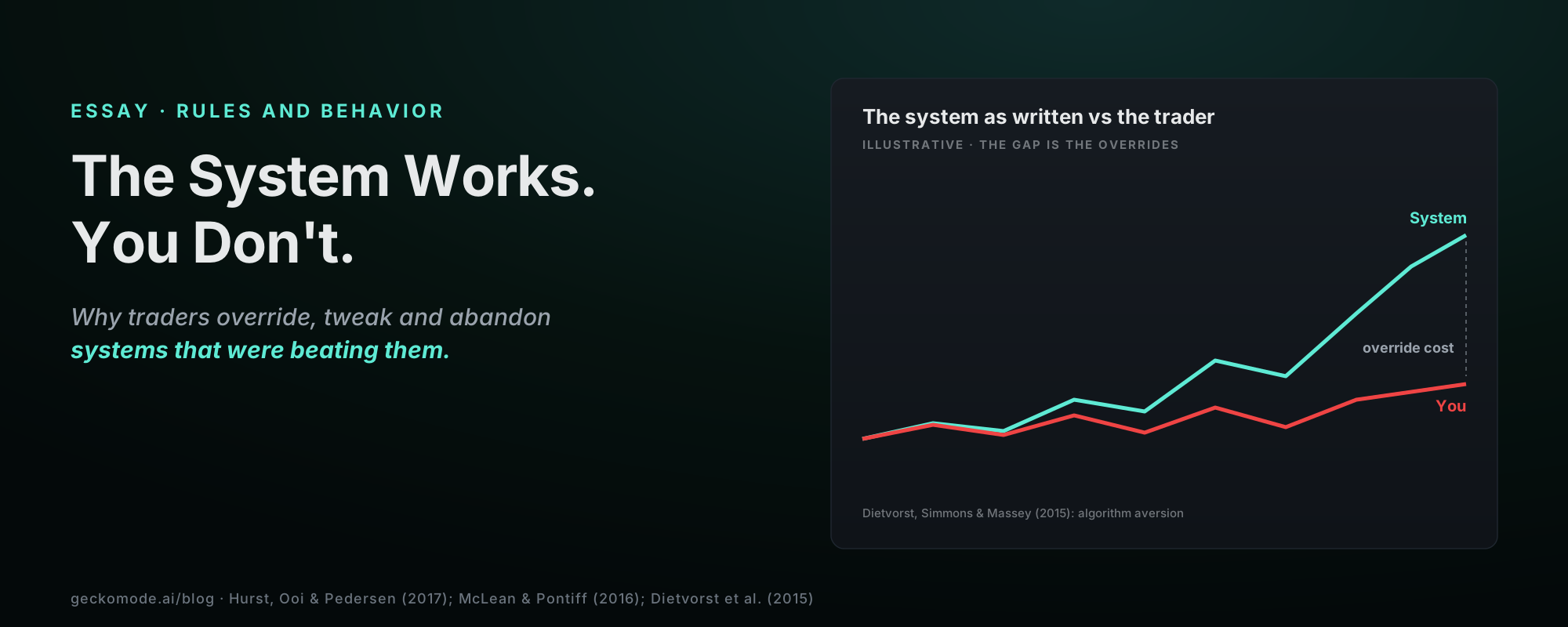
In the 1980s Richard Dennis gave a group of novice traders the same mechanical trend-following rules and real money. Their results still spread widely, because not all of them kept taking the signals. Four decades later the pattern is the same at every scale. The rules are rarely the scarce ingredient. Following them is.
Key takeaways
- Systematic trend following has a long record: AQR researchers traced a simple time-series momentum strategy back to 1880 and found it consistently profitable over the next 110 years.
- Backtests flatter. Across 97 published stock-return predictors, returns were 26% lower out of sample and 58% lower after publication.
- People abandon algorithms faster than they abandon humans after seeing the same mistake, even when the algorithm is more accurate. Psychologists call it algorithm aversion.
- The gap between a system’s results and a trader’s results is usually the overrides. That gap is measurable.
The case for rules
The most basic trend-following strategy, time-series momentum, goes long markets that have risen recently and short markets that have fallen. Moskowitz, Ooi and Pedersen (2012) found it profitable on average since 1985 for nearly all the futures and currency markets they studied. Hurst, Ooi and Pedersen then pushed the test back much further in “A Century of Evidence on Trend-Following Investing” (Journal of Portfolio Management, 2017), building the strategy back to 1880 and finding it “consistently profitable over the next 110 years.”
That is not a promise about the next year. It is evidence that a rule written in advance, applied without discretion and sized with discipline, can capture something real across very different economic eras.
The case against your backtest
The same literature carries a warning. R. David McLean and Jeffrey Pontiff (Journal of Finance, 2016) re-tested 97 variables that academic papers had shown to predict stock returns:
- Returns were 26% lower out of sample, an upper bound on how much of the original result was data mining.
- Returns were 58% lower after publication, as other investors traded on the findings.
- The best in-sample results decayed the most.
If peer-reviewed results shrink this much, a retail backtest tuned on one market and one period should be expected to shrink more. The practical lesson is to judge a system by its rules and its out-of-sample record, and to expect the live version to be smaller and bumpier than the spreadsheet.
Why traders abandon systems that work
Here is the part most system builders ignore. In “Algorithm Aversion” (Journal of Experimental Psychology: General, 2015), Berkeley Dietvorst, Joseph Simmons and Cade Massey ran five studies in which people chose whether to rely on a statistical forecast or a human. Participants who watched the algorithm perform became less confident in it and less likely to choose it, even when they had seen it outperform the human. The reason: people lose confidence in an algorithm faster than in a person after seeing both make the same mistake.
That is exactly what happens to a trader’s own system. Trend following in particular spends long stretches bleeding small losses before a few large wins. The overrides take recognizable forms:
- Skipping signals after a losing streak, often just before the trade that would have paid for the streak.
- Cutting winners early because a profit feels fragile, which removes the large wins trend systems depend on.
- Moving or widening stops on the one trade that “looks different.”
- Re-optimizing after every drawdown, swapping a tested rule for one fitted to the last three months.
- Sizing up on conviction, adding a discretionary bet on top of the system’s sizing.
A fair caveat
Rules are not automatically better than judgment. Badly designed systems lose money faithfully, markets change, and some discretionary traders have excellent records. The claim here is narrower: if you have a system you believe in, the most common way to ruin it is to stop following it at the worst moments, and that is something you can measure.
From belief to behavior: check yourself
- Signal-take rate: of the signals your system produced last quarter, what share did you actually take?
- Skipped-signal P&L: what would the trades you skipped have earned?
- Override cost: on trades where you changed the exit, did the change help or hurt on average?
- Rule changes: how many times did you change the system’s parameters this year, and were the changes made during drawdowns?
A free check you can run this week
Keep two columns for the next 30 signals: what the system said, and what you did. At the end, total the P&L of the system as written and of your actual trades. The difference is your override cost. If it is negative, the fix is not a better system. It is fewer exceptions, or a smaller size you can sit through.
Full disclosure: Gecko is our product, and it measures drift from a written plan automatically from a broker statement. Two spreadsheet columns cover the core of it.
Frequently asked questions
Does systematic trading work?
Simple trend-following rules have a long historical record, but backtests overstate live results and every system has long losing stretches.
Why do backtests disappoint?
Part of the in-sample result is usually data mining, and published edges shrink as others trade them; one study found a 58% decline after publication.
Why do traders abandon good systems?
Research on algorithm aversion finds people lose trust in rules faster than in human judgment after the same mistake, which pushes traders to override during normal losing streaks.
Sources
- Hurst, B., Ooi, Y. H. & Pedersen, L. H. (2017), A Century of Evidence on Trend-Following Investing, Journal of Portfolio Management.
- Moskowitz, T., Ooi, Y. H. & Pedersen, L. H. (2012), “Time Series Momentum,” Journal of Financial Economics.
- McLean, R. D. & Pontiff, J. (2016), Does Academic Research Destroy Stock Return Predictability?, Journal of Finance 71(1).
- Dietvorst, B., Simmons, J. & Massey, C. (2015), Algorithm Aversion: People Erroneously Avoid Algorithms after Seeing Them Err, Journal of Experimental Psychology: General.
- Gecko blog, Richard Dennis and the Turtle Traders.
Essay in Gecko’s trading psychology series. Figures come from the studies listed above and are approximate. Nothing here is a recommendation of any security, system or strategy. Gecko is an educational and informational tool. Educational, not financial advice. Trading carries substantial risk of loss.
Drop in a single statement. Gecko produces a one-page Behavioral Diagnosis ranking your costliest habits in actual dollars. Free to start. No card. No broker connection.
Short notes, usually once or twice a month. Unsubscribe in one click.
No account needed. We use your email only to send Gecko blog posts, and the link at the bottom of every email opts you out in one click.
More on the blog
- The AI Debt Machine: Circular Financing, Off-Balance-Sheet Data Centers, and the Ghosts of Bubbles PastThe AI build-out has quietly shifted from cash to debt: hyperscaler bonds near $194 billion in 2026, private credit's share of AI financing up from about 9% to 34%, debt parked in off-balance-sheet vehicles, and a circular loop among Nvidia, OpenAI, Oracle and CoreWeave. What telecom, Enron and the 1920s say about it, and what a trader should actually do.
- When the Consumer BreaksHousehold debt booms have a long record of ending in slowdowns that forecasters miss. What that history says about markets, and about the most overlooked balance sheet in trading: your own.
- How Banking Crises Actually StartThe run is the last chapter, not the first. What 150 years of bank failures teach traders about reading stress, and about the mistakes made when the headlines finally arrive.