Richard Dennis and the Turtle Traders: Why Discipline Beats a Secret Strategy
It started as a bet. Richard Dennis believed great traders are made, not born. His partner William Eckhardt disagreed. So in the early 1980s, Dennis recruited a group of novices, taught them his system, and set out to settle the argument with real money. The result became the most famous experiment in trading, and its real lesson is not the one most people take from it.
The bet that became a legend
Dennis reportedly framed it with a line that gave the group its name, saying he would grow traders the way they grow turtles in Singapore. He ran ads, interviewed applicants, and selected a mixed bag of people with little or no trading background. He taught them objective entry and exit signals, strict risk limits, and a position-sizing method built to cut losses fast and let winners run. Then he handed them real capital. Many of the Turtles produced extraordinary returns, and the story is now told as proof that method beats talent.
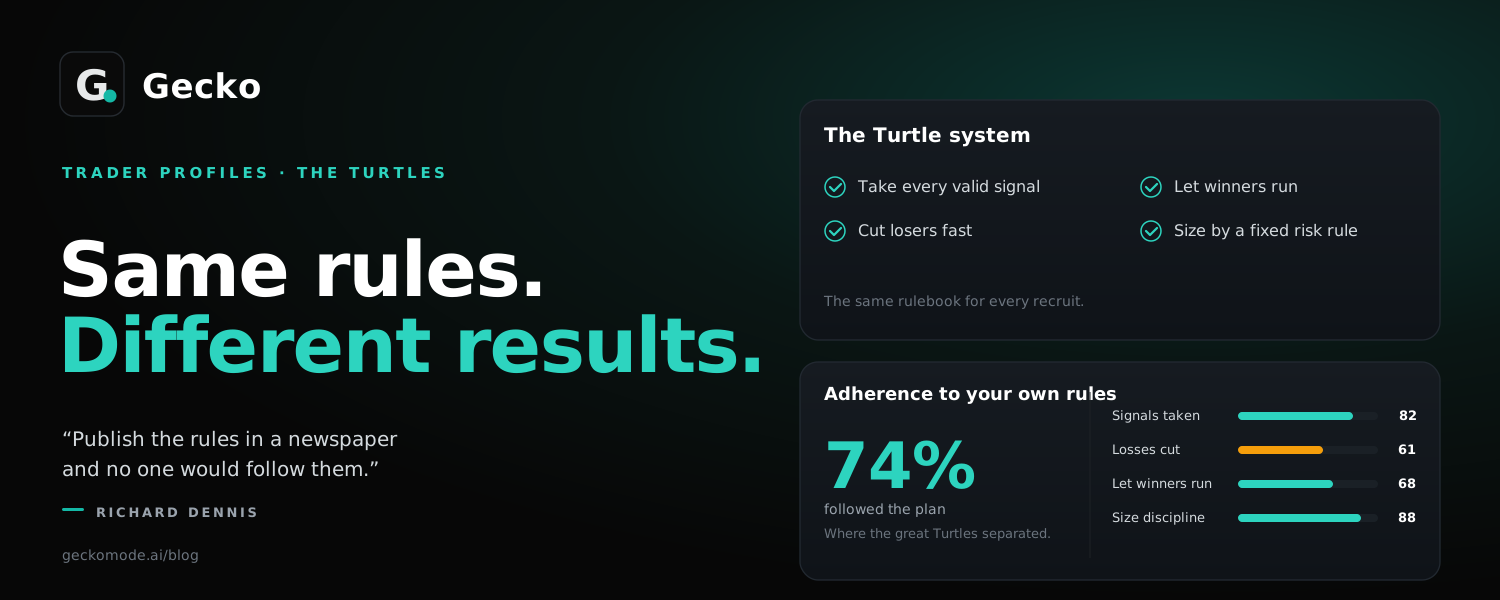
“I always say that you could publish trading rules in the newspaper and no one would follow them. The key is consistency and discipline.”
Richard Dennis, in Market Wizards by Jack Schwager
The lesson hiding inside the legend
Here is the part that gets lost. The Turtles were all handed the same rules, yet their results were not the same. Some performed brilliantly. Others lagged badly. The system was identical, so the difference came down to the human running it. The traders who followed the rules exactly, especially through losing stretches, captured the edge. The ones who second-guessed, skipped signals that felt wrong, or hesitated on entries gave a chunk of it back.
That is why Dennis could say the rules could be printed in a newspaper and still not help most people. Knowing the system was never the bottleneck. Doing it, trade after trade, when a signal felt uncomfortable or a drawdown tested your nerve, was the entire game. Curtis Faith, the most successful of the Turtles, later put the point simply: in trading, rules can beat instinct, and it is not about being right, it is about trading right.
What the system actually rewarded
Strip away the specifics and the Turtle method rewarded a handful of behaviors. Take every valid signal without cherry-picking. Cut losers quickly at a predefined level. Let winners run instead of grabbing quick profits. Size every position by a consistent risk rule rather than by conviction or mood. None of these are clever. All of them are hard, because each one asks you to act against a feeling in the moment. The experiment proved that traders who could do the boring, repeatable thing beat traders who trusted their gut.
From belief to behavior: measuring your own discipline
The Turtle story has a direct, practical edge for any trader today. If the difference between the best and worst Turtles was rule-following, then the most useful thing you can know about your own trading is how consistently you follow your plan. And that is not a feeling. It is in your trade record.
| Turtle principle | The fingerprint it leaves in your trade history |
|---|---|
| Take every valid signal | Gaps where you skipped setups, visible as inconsistency between your plan and your actual entries. |
| Cut losers quickly | Losses that run past your stop, the sign of overriding the rule in the moment. |
| Let winners run | Average winner smaller than average loser, the sign of grabbing profits early. |
| Size by a consistent rule | Wide variance in position size, the sign that conviction and emotion are setting risk. |
| Stay consistent through drawdowns | A spike in overtrading or revenge trades after losing days, the moment discipline usually breaks. |
This is the case for a behavioral journal over a plain log. A log records the trades. A behavioral read tells you how close your execution sits to your own rules, and where it drifts. Gecko scores exactly these patterns from an uploaded statement, including after-loss tilt, hold-time discipline, size discipline, and the ratio of your average win to your average loss, so the one trait that separated the great Turtles from the rest becomes a number you can track in yourself.
See how consistently you follow your own rules →Free to start. No credit card. No broker connection.
Frequently asked questions
What was the Turtle Traders experiment?
In the early 1980s Richard Dennis bet William Eckhardt that he could teach ordinary people to trade profitably. He taught a group, the Turtles, a mechanical trend-following system, and many made large profits.
Did it prove trading can be taught?
Largely yes, but with a twist. The same rules produced very different results, and the difference was discipline. The Turtles who followed the system exactly did best.
What is the main lesson?
That the edge is in execution, not secrecy. Dennis said you could publish the rules in a newspaper and almost no one would follow them, because the hard part is consistency.
How do you measure trading discipline?
By comparing what you did to what your plan said: skipped signals, losses held past the stop, winners cut early, and inconsistent sizing. A behavioral journal scores your rule-following over time.
This article is part of Gecko’s trading psychology series. The Turtle experiment and quotations are drawn from public accounts including Jack Schwager, Market Wizards, and Curtis Faith, Way of the Turtle. Gecko is an educational and informational tool, and is independent and not affiliated with the individuals named. Nothing here is financial, investment, or trading advice. Trading carries substantial risk of loss.
Drop in a single statement. Gecko produces a one-page Behavioral Diagnosis ranking your costliest habits in actual dollars. Free to start. No card. No broker connection.
Short notes, usually once or twice a month. Unsubscribe in one click.
No account needed. We use your email only to send Gecko blog posts, and the link at the bottom of every email opts you out in one click.
More on the blog
- The AI Debt Machine: Circular Financing, Off-Balance-Sheet Data Centers, and the Ghosts of Bubbles PastThe AI build-out has quietly shifted from cash to debt: hyperscaler bonds near $194 billion in 2026, private credit's share of AI financing up from about 9% to 34%, debt parked in off-balance-sheet vehicles, and a circular loop among Nvidia, OpenAI, Oracle and CoreWeave. What telecom, Enron and the 1920s say about it, and what a trader should actually do.
- When the Consumer BreaksHousehold debt booms have a long record of ending in slowdowns that forecasters miss. What that history says about markets, and about the most overlooked balance sheet in trading: your own.
- How Banking Crises Actually StartThe run is the last chapter, not the first. What 150 years of bank failures teach traders about reading stress, and about the mistakes made when the headlines finally arrive.