A Random Walk Down Wall Street by Burton Malkiel: Still Right After 50 Years, With One Modern Catch
Some books matter because they’re right; a rare few matter because they changed what millions of people do. Burton Malkiel’s A Random Walk Down Wall Street, first published in 1973 and now in its 50th-anniversary edition, is both. It took an academic idea, that stock prices move unpredictably and markets are hard to beat, and turned it into some of the most consequential practical advice in modern finance: stop trying to beat the market and simply own it, cheaply, for the long run. Half a century and trillions of indexed dollars later, it’s worth asking how the argument holds up, and where the modern market has finally handed it a real complication.
Key takeaways
- Malkiel’s 50-year-old argument is radical and durable: you can’t reliably beat the market, so buy a low-cost, broad index fund and hold for the long run.
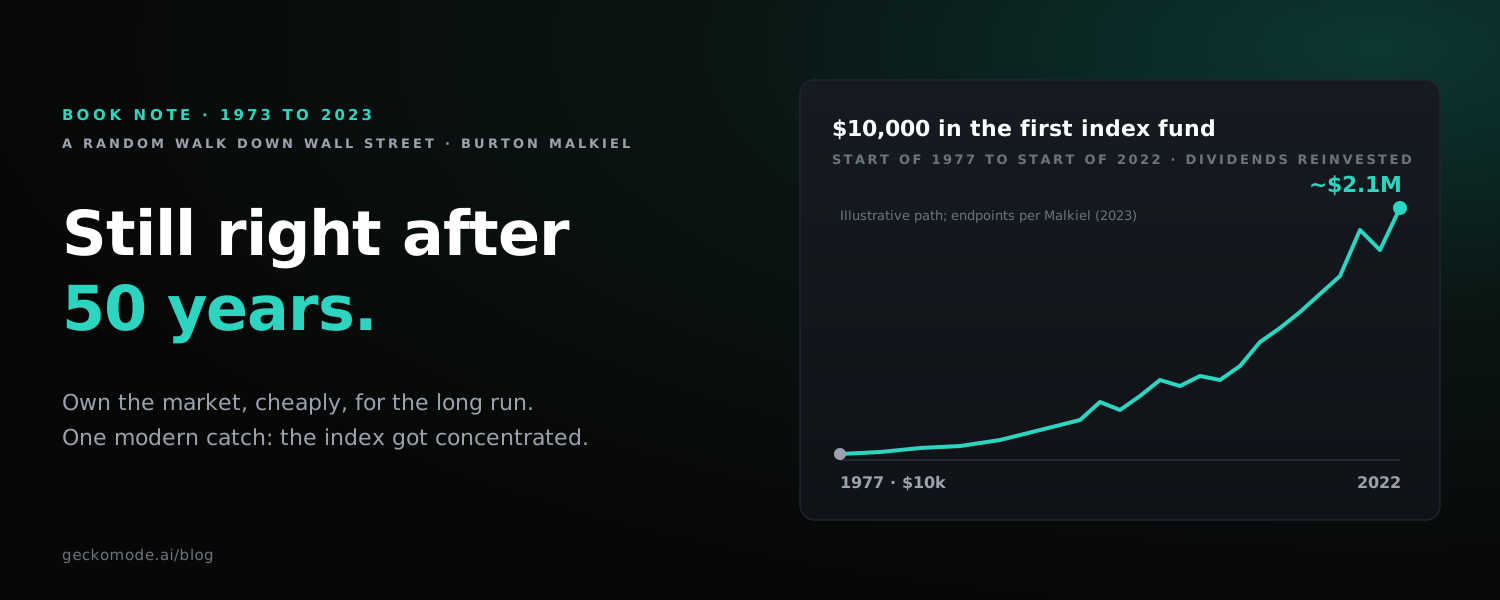
- The evidence has aged well: $10,000 in the first index fund at the start of 1977 grew to about $2.1 million by 2022, while most active managers lagged after fees.
- He’s honest about the limits: markets aren’t perfectly efficient, bubbles happen, and behavioral economists have a real counter-case.
- The one thing he couldn’t foresee: the index he told you to buy is now roughly a third seven stocks, so “diversified indexing” has quietly become a big-tech bet.
The argument that changed investing
Malkiel’s thesis rests on two linked ideas. The first is the random walk: short-term price movements are, for practical purposes, unpredictable, so the chart reading of technical analysis is, in his telling, closer to astrology than science. The second is the efficient market hypothesis: because available information is already reflected in prices, there are no easy, systematic ways to earn extraordinary returns without taking extraordinary risk. Together they produce the line that made the book famous: “a blindfolded monkey throwing darts at a newspaper’s financial pages could select a portfolio that would do just as well as one carefully selected by experts.”
The whole practical program flows from that provocation. If the experts can’t reliably beat the market, don’t pay them to try. Build wealth on low-cost, broad index funds; save consistently; hold for decades. Malkiel was writing before index funds for ordinary investors existed; a few years later John Bogle’s Vanguard launched the first one. Few authors can claim to have helped call an industry into being. Malkiel can.
Why it has aged so well
The remarkable thing about re-reading Malkiel is how little the core has needed to change. The evidence for the central claim has only strengthened: as we covered in which strategies actually work, the SPIVA data shows most active managers trail their benchmarks over time, and the studies of real millionaires find them built on exactly the boring, diversified, hold-forever approach Malkiel prescribed. His own example makes the point: $10,000 put into the first index fund at the start of 1977, with dividends reinvested, would have been worth about $2.1 million by the start of 2022, not through cleverness but through low costs, discipline and time. The 50th-anniversary edition updates the furniture (crypto, meme stocks, tax-loss harvesting, factor investing, robo-advisers) and leaves the foundation alone, because it still holds.
Crucially, Malkiel is no naïf about efficiency. He is explicit that markets are not perfectly efficient: prices aren’t always right, investors aren’t always rational, and markets make large mistakes, bubbles included. That is the honest version of the efficient-market view, and it is much harder to dismiss than the straw man critics attack. His claim was never “prices are always correct.” It was that they are correct enough, often enough, that you can’t reliably exploit the errors after costs. That weaker, truer claim is the one that has survived.
Where the critics have a point
A fair review has to give the other side its due, and there is a real one. Behavioral economists, the tradition this blog draws on, argue that Malkiel leans too heavily on near-efficiency. Recurring cognitive errors, institutional incentives and the mechanical force of fund flows can, they contend, create mispricings that are more than noise and that persist long enough for disciplined strategies to exploit. The documented value premium, momentum and the overreaction patterns of De Bondt and Thaler are evidence that markets are not quite the efficient machine the strong form of the hypothesis implies. Malkiel’s reasonable rejoinder is that these edges are small, hard to capture after costs and prone to fading once known, which is largely true. The honest middle ground, which he mostly occupies, is that markets are hard to beat, not impossible. For advising a normal investor, “hard enough that you probably won’t” is all the argument needed.
The modern catch Malkiel couldn’t foresee
Here is where a 2026 reading adds something the book doesn’t address, and it’s the most interesting tension in the whole index-investing case. “Buy the broad market index and you’re diversified” quietly depends on the index actually being broad. For most of the book’s fifty years it was. Today it increasingly isn’t. The Magnificent Seven have grown to roughly a third of the S&P 500, up from about 12% a decade earlier, and those few names have driven most of the index’s recent returns. Follow Malkiel’s advice with an S&P 500 fund today and about a third of your money goes into seven closely related mega-cap technology companies. The “diversified index” has become, substantially, a concentrated bet.
This doesn’t refute Malkiel; indexing still beats most active strategies, which was always his real point. But it complicates the comfort. It also connects to research his framework doesn’t fully grapple with: Hendrik Bessembinder’s finding that about 4% of stocks created all of the market’s net wealth since 1926, which we unpack in concentrated portfolios vs index funds. That finding is at once the best argument for Malkiel (own everything, because you can’t afford to miss the few winners) and the explanation for why the index is now so top-heavy (the winners have grown to dominate it). Malkiel told you to buy the haystack to be sure of owning the needles. He didn’t anticipate a day when a few needles would be a third of the haystack.
Why it belongs on a behavioral blog
We profile great traders and dissect behavioral edges, so why review the book that says don’t trade at all? Because Malkiel’s deepest lesson is behavioral, not analytical. His case against active management isn’t really “you aren’t smart enough”; it’s “your behavior will cost you more than your analysis can earn.” Fees, overtrading, taxes, chasing performance, panic selling: the enemies he names are the ones the behavior gap measures. Even if you reject his conclusion and invest actively, you have to clear the bar he sets: a cheap index fund held by someone who does nothing. What most often stops people from clearing it isn’t a lack of insight. It’s behavior. Malkiel, the great evangelist for doing nothing, makes the same point we make about doing something: the market is hard to beat, and you are usually the reason.
From belief to behavior: can you beat the monkey?
| Malkiel’s challenge | The fingerprint in your own record |
|---|---|
| Costs and turnover erode returns. | High trade frequency and fees quietly dragging you below a buy-and-hold benchmark; see overtrading. |
| You can’t reliably beat the market. | Your time-weighted return against your benchmark over a long enough period. Most active records trail the index they’re compared with. |
| Hold through the noise. | Exits on the worst days and re-entries near highs: the behavior gap that turns a sound plan into a poor result. |
| Know your real diversification. | A “diversified” book that is actually one correlated bet; see size discipline. |
Are you beating the index, or the monkey?
Malkiel’s bar is a cheap index fund held by someone who does nothing. Connect your accounts and Gecko shows your time-weighted return against the benchmark you choose, with deposits and withdrawals taken out, plus your real concentration across every account. Trade history uploads are scored across twelve behavioral axes, including overtrading and costs, in dollars, so you can see whether your activity is adding value or quietly subtracting it.
Measure yourself against the index →Free to start. 14-day Pro trial. An educational tool, not financial advice.
Resources and further reading
- The book: Malkiel, B. G., A Random Walk Down Wall Street (1973; 50th-anniversary edition, 2023), on the random walk, efficient markets and the case for index funds.
- The concentration complication: Bessembinder, H. (2018), “Do Stocks Outperform Treasury Bills?”, Journal of Financial Economics 129(3): 440–457; and Gecko’s concentrated vs index essay.
- The active-vs-passive evidence: S&P Dow Jones Indices, SPIVA Scorecard.
- The behavioral counter-case: Lakonishok, Shleifer & Vishny (1994) and De Bondt & Thaler (1985) on persistent, behavior-driven mispricings; see value investing is a behavioral strategy.
- The practical companion: Bogle, J., The Little Book of Common Sense Investing.
Frequently asked questions
What is A Random Walk Down Wall Street about?
First published in 1973 and now in a 50th-anniversary edition, Malkiel’s classic argues that stock prices move largely as a random walk and that markets are broadly efficient, so neither technical nor fundamental analysis reliably beats buy-and-hold after costs. Its conclusion: most investors are best served by low-cost, broad index funds held for the long run.
What is the main lesson of the book?
That beating the market is a losing game for almost everyone, so owning the whole market cheaply is the better default. Malkiel’s image is a blindfolded monkey throwing darts that picks as well as the experts. His 50th-anniversary edition reports that $10,000 in the first index fund at the start of 1977 grew to about $2.1 million by 2022.
Is the efficient market hypothesis still valid?
Its practical core, that most active managers fail to beat low-cost index funds, has held up well. Malkiel concedes markets aren’t perfectly efficient. Behavioral economists argue persistent mispricings leave room for disciplined active strategies. The fair verdict: markets are hard to beat, not impossible, and “hard” is enough to make indexing the sensible default for most people.
Does the index-fund advice still work with today’s concentration?
Yes, with a wrinkle. A cap-weighted S&P 500 fund is far less diversified than “index” implies: the Magnificent Seven are roughly a third of it, so buying the index is substantially a bet on a few mega-cap tech names. Indexing still beats most active strategies, Malkiel’s enduring point, but investors should understand that concentration rather than assume it away.
Book note in Gecko’s investing and trading psychology series. Details about A Random Walk Down Wall Street are drawn from the book (including its 50th-anniversary edition) and public summaries; concentration figures come from 2024 to 2026 market reporting and are approximate. Gecko has no commercial relationship with the author or publisher. Gecko is an educational and informational tool. Nothing here is financial, investment or trading advice, or a recommendation of any fund or strategy. Investing carries substantial risk of loss.
Drop in a single statement. Gecko produces a one-page Behavioral Diagnosis ranking your costliest habits in actual dollars. Free to start. No card. No broker connection.
Short notes, usually once or twice a month. Unsubscribe in one click.
No account needed. We use your email only to send Gecko blog posts, and the link at the bottom of every email opts you out in one click.
More on the blog
- Concentrated Portfolios vs Index Funds: What the Research Really Says, and Why the Index Isn't What It Used to BeBessembinder's landmark study found that since 1926 about 4% of US stocks created all of the market's net wealth above Treasury bills, and most individual stocks trailed cash. That fact makes concentration a long-odds bet and broad indexing the evidence-based default. It also explains the Magnificent Seven, now roughly a third of the S&P 500: buying the index today means a concentrated bet on a few mega-caps. A few winners driving everything is old; how concentrated the index has become is not.
- Risk and Reward by Ben Carlson: The 2026 Book That Takes a Wrecking Ball to Its Own AdviceBen Carlson's 2026 book stress-tests his own stay-the-course philosophy against the 1930s, Japan's 1980s bubble and the dot-com bust. Its lesson in four words: risk and reward are inseparable. You earn the return by surviving the risk, and history shows the danger is rarely the crash itself but what investors do during it. Superb on philosophy and plan; the one gap is measuring whether your own behavior matches the advice.
- Value Investing Is a Behavioral Strategy, Not an Analytical OneWhy does value investing work? If it were about analysis, the edge would have been arbitraged away decades ago. Lakonishok, Shleifer & Vishny (1994) argued the value premium comes from the crowd over-extrapolating growth, not from extra risk, and De Bondt & Thaler (1985) documented the overreaction it feeds on. The balance-sheet work is learnable and widely known; the temperament to buy what everyone hates and sit through a lost decade is rare. Your spreadsheet won't fail you. Your psychology will.