Linda Raschke: The Process Trader Who Never Enters Without a Plan
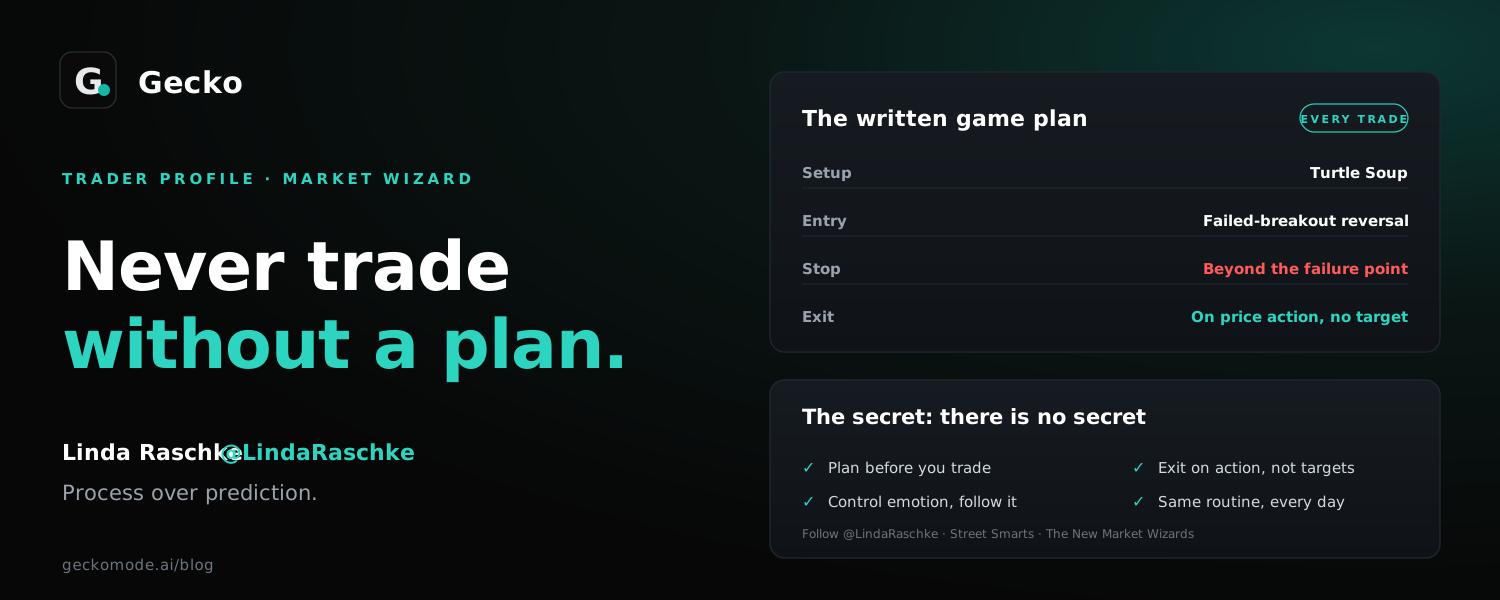
Linda Bradford Raschke has traded professionally for more than four decades, from the exchange floor to running her own fund, and she still posts her setups publicly today. Jack Schwager profiled her in The New Market Wizards alongside Druckenmiller and Lipschutz. What sets her apart in this series is not a famous trade or a headline return. It is the most boring and most transferable edge there is: process.
Key takeaways
- Raschke never enters a trade without a written game plan, which she treats as an anchor against emotional decisions.
- She predicts direction, not magnitude, sets no fixed targets, and exits on price action.
- She believes she could give away every setup and it would not matter, because most people cannot follow a system or control their emotions.
- Her process is routine and repeatable, which makes it a clean benchmark to measure your own behavior against.
Four decades of doing the work
Raschke started as a floor trader, learning to read markets in the most direct environment there is, then built LBR Group as a money manager and later ran her own commodity pool. Across that span her style stayed short-term: swing and day trades in futures, built on a library of well-defined technical setups. But ask her where the edge lives and she does not point to the setups. She points to preparation, routine, and the discipline to follow a plan when the screen is trying to talk you out of it.
“I never enter the market without a written game plan; it acts as an anchor that prevents emotional reactions during the heat of battle.”
Linda Bradford Raschke
The written game plan
This is the habit at the center of everything she does. Before the trade, the entry trigger, the stop, the exit logic, and the size are already decided, in writing. The plan is not there to predict the future. It is there to remove the in-the-moment decision making that emotion hijacks. When a position moves against you, that is precisely when judgment is worst and a pre-written plan is worth the most. Most traders improvise the exit while the money is moving, which is the single most expensive moment to be making fresh decisions.
The exit is where pros separate from amateurs
Raschke is emphatic that entries are the easy part. Anyone can get into a trade. The professional is defined by the exit, and her approach to it is revealing: she believes you can forecast direction but not magnitude, so she does not set price targets and instead lets the market’s own action tell her when to leave. That keeps her from the two classic exit errors at once, snatching a winner early because it hit an arbitrary number, and holding a loser because it has not hit her hoped-for target yet. The plan defines where she is wrong. Price action defines where she is done.
The secret is that there is no secret
The most freeing thing Raschke has said is that she could hand you all of her setups, step by step, and it would change almost nothing, because most people cannot control their emotions or follow a system, and many would not even trust her method enough to run it. This is the same truth Richard Dennis found with the Turtles and that runs through every profile in this series. The information is not the edge. The execution is. Which means the work of getting better is not collecting more setups. It is closing the gap between your plan and your behavior.
Treat it like a craft, not a thrill
Underneath her method is a temperament worth copying. Raschke approaches trading like a disciplined professional showing up to do reps: a consistent daily routine, homework done the night before, markets prepared in advance, and emotion treated as something to manage rather than obey. The drama most traders bring to the screen is itself a leak. Her calm, repeatable process is the antidote, and it is available to anyone willing to be a little bored.
From belief to behavior: measuring it in your own data
Raschke’s process is a gift to a behavioral journal because every part of it is checkable. You can compare what your plan said to what you actually did, trade by trade.
| Raschke principle | The fingerprint it leaves in your trade history |
|---|---|
| A written plan, every time | Consistency between your intended setups and your actual entries. Improvised trades stand out. |
| The exit is the edge | Average winner versus average loser, and winners cut short or losers held past the plan. |
| No targets, exit on action | Profits taken at round numbers or your entry-anchored levels rather than where the trade told you. |
| Control emotion, follow the system | After-loss tilt and overtrading, the moments the plan gets abandoned. |
| Routine and consistency | Whether your results come from repeatable behavior or swing with your mood week to week. |
This is the case for a behavioral journal over a plain log. A log records the trades. A behavioral read tells you where your execution drifts from your own plan, and what the drift costs. Gecko scores exactly these patterns from an uploaded statement, including after-loss tilt, hold-time discipline, and the ratio of your average win to your average loss, so Raschke’s process discipline becomes a number you can measure in yourself.
Resources: where to follow and what to read
- Follow Linda Raschke
- X (Twitter): @LindaRaschke, where she still posts technical setups and market notes. Beware of impostor accounts.
- Website: lindaraschke.net.
- Street Smarts with Larry Connors, the short-term trading classic, home of Turtle Soup, the Holy Grail, and other setups.
- The New Market Wizards by Jack Schwager, whose Raschke chapter is the best primer on her mindset.
Her own note worth keeping in mind: she has said traders do not need more setups, they need the tools to manage risk, state of mind, and uncertainty. That is the whole reason this series exists. See our Reminiscences breakdown for the foundation.
Do you actually follow your own plan?
Plan adherence, exit discipline, and emotional control are all measurable. Upload a broker statement and Gecko names where your execution drifts from your plan, in dollars, and scores it across twelve behavioral axes. No login or broker connection needed, and your first 100 trades are analyzed free.
Read your trades free →An educational tool, not financial advice.
Frequently asked questions
Who is Linda Raschke?
A professional trader of more than 40 years who began on the exchange floor, founded LBR Group, and ran her own hedge fund. She was profiled in The New Market Wizards and co-wrote Street Smarts.
What is her trading style?
Short-term and swing trading built on a written game plan and strict process. She predicts direction not magnitude, uses no fixed targets, and exits on price action.
What is the Turtle Soup strategy?
A short-term setup from Street Smarts that fades failed breakouts. A new high or low that quickly reverses back into range often leads to a sharp move the other way.
Where can I follow her?
On X at @LindaRaschke and at lindaraschke.net. Street Smarts and her New Market Wizards chapter are the best primers. Watch for impostor accounts.
This article is part of Gecko’s trading psychology series. Biographical details and quotations are drawn from Linda Bradford Raschke’s public writing, interviews, and Jack Schwager’s The New Market Wizards, as of June 2026. Gecko is an educational and informational tool and is independent and not affiliated with, endorsed by, or sponsored by Ms. Raschke. Nothing here is financial, investment, or trading advice. Trading carries substantial risk of loss.
Drop in a single statement. Gecko produces a one-page Behavioral Diagnosis ranking your costliest habits in actual dollars. Free to start. No card. No broker connection.
Short notes, usually once or twice a month. Unsubscribe in one click.
No account needed. We use your email only to send Gecko blog posts, and the link at the bottom of every email opts you out in one click.
More on the blog
- The AI Debt Machine: Circular Financing, Off-Balance-Sheet Data Centers, and the Ghosts of Bubbles PastThe AI build-out has quietly shifted from cash to debt: hyperscaler bonds near $194 billion in 2026, private credit's share of AI financing up from about 9% to 34%, debt parked in off-balance-sheet vehicles, and a circular loop among Nvidia, OpenAI, Oracle and CoreWeave. What telecom, Enron and the 1920s say about it, and what a trader should actually do.
- When the Consumer BreaksHousehold debt booms have a long record of ending in slowdowns that forecasters miss. What that history says about markets, and about the most overlooked balance sheet in trading: your own.
- How Banking Crises Actually StartThe run is the last chapter, not the first. What 150 years of bank failures teach traders about reading stress, and about the mistakes made when the headlines finally arrive.