Reminiscences of a Stock Operator: Livermore on Patience, Emotion, and Repeating the Same Mistake
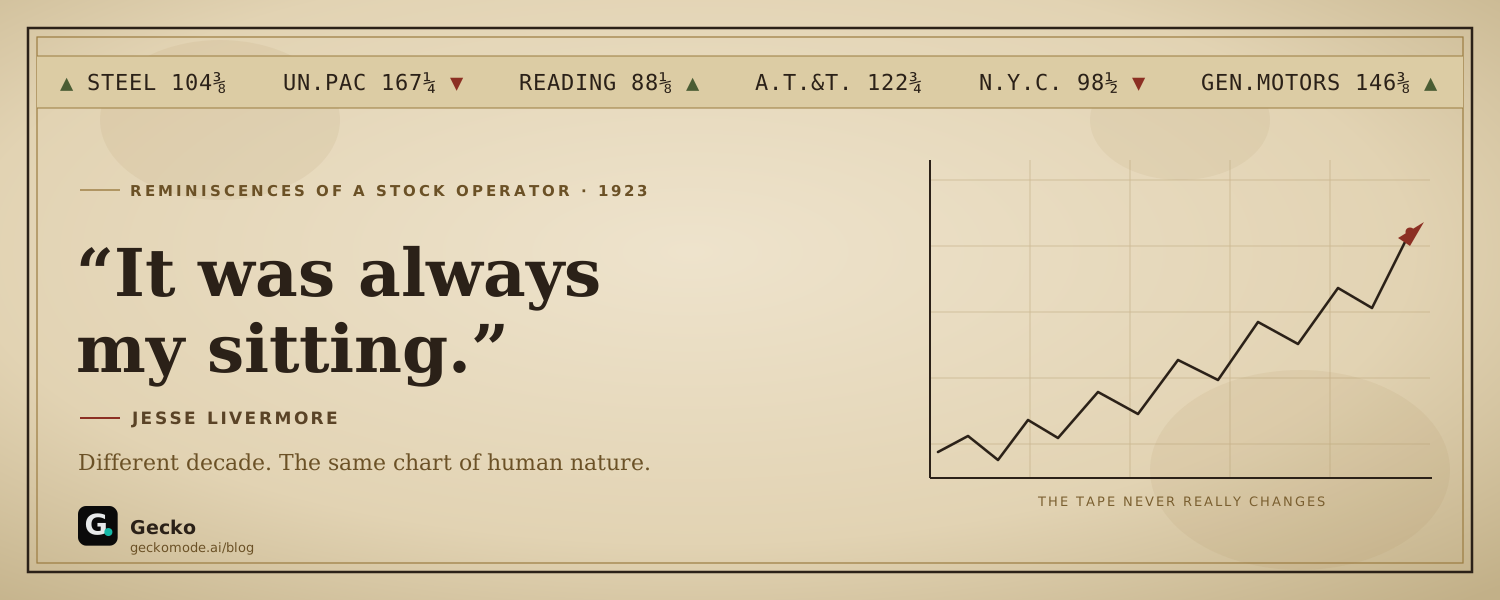
Written in 1923 about the speculator Jesse Livermore, Reminiscences of a Stock Operator is still the book traders quote most. The reason is simple. A century of new tools has changed almost everything about markets except the one thing that decides most outcomes, which is the trader.
Why a 1923 book still describes your trading
Livermore’s central claim is that markets are old and human nature is older. As he put it, there is nothing new in Wall Street, because whatever happens in the market today has happened before and will happen again. The patterns repeat because the people repeat. That is an unsettling idea, but it is also a useful one, because anything that repeats can be studied, and anything that can be studied can be improved.
“It was never my thinking that made the big money for me. It was always my sitting. Got that? My sitting tight!”
Jesse Livermore, in Reminiscences of a Stock Operator by Edwin Lefevre
Sitting tight: the discipline of doing nothing
The most famous line in the book is a confession about patience. Livermore made his fortune not by being right more often, but by staying in a correct position long enough for it to matter. The opposite habit, taking a profit the moment it appears, feels responsible but quietly caps your upside. Over a long run of trades, a trader who exits winners early can be right on direction and still lose to a trader who simply sits.
This is the same idea modern traders meet as the average win to average loss ratio. If your winners are consistently smaller than your losers, you are not sitting tight, and no amount of accuracy fully rescues the account.
The desire for action: Livermore on overtrading
Livermore was blunt about the urge that ruins most traders. He observed that the desire for constant action, regardless of underlying conditions, is responsible for many losses on Wall Street, even among professionals. The market does not pay you for activity. It pays you for being right and then waiting. Yet the screen invites a trade every minute, and boredom feels like a problem to solve.
The tell is volume of trades that rises when opportunity does not. A flurry of entries during a slow session, or right after a loss, is rarely the plan. It is the itch.
The speculator’s deadly enemies
Livermore named four: ignorance, greed, fear, and hope. Ignorance is curable with study. The other three are emotional, and they are the ones that turn a good plan into a bad month. Greed holds a winner past its logic. Hope holds a loser past its stop. Fear pushes a trader out of a sound position or into a revenge trade after a red day. He added that fear and hope do not change, which is exactly why studying the psychology of speculation is as valuable now as it ever was.
“If a man is both wise and lucky, he will not make the same mistake twice. But he will make any one of the ten thousand brothers or cousins of the original.”
Edwin Lefevre, Reminiscences of a Stock Operator
From belief to behavior: measuring Livermore in your own data
The reason traders quote Livermore for a hundred years and still repeat his mistakes is that awareness alone does not change behavior. You can agree that you should sit tight and still cut every winner short on Monday. What closes the gap is feedback, and the behaviors Livermore described are not vague. They are visible in the timestamps, sizes, and outcomes of trades you have already closed.
| Livermore’s lesson | The fingerprint it leaves in your trade history |
|---|---|
| Sitting tight, letting winners run | Average winner versus average loser. Winners smaller than losers means you are exiting early. |
| The desire for constant action | Trade frequency that climbs during quiet conditions or right after a loss, with worse outcomes on those trades. |
| Hope, holding losers | Trades held past the predefined stop, turning small planned losses into large ones. |
| Fear after a red day | Entries clustered shortly after a loss, the signature of revenge trading. |
| The ten thousand cousins of a mistake | A recurring pattern that fades on one instrument and reappears on another, visible only when you track behavior across the whole account. |
This is the case for a behavioral journal over a plain log. A log tells you what you traded. A behavioral read tells you which of Livermore’s enemies was in the room, and what it cost. Gecko scores exactly these patterns from an uploaded statement, including hold-time discipline, overtrading, and the ratio of your average win to your average loss, so a hundred-year-old warning becomes a number you can watch move week to week.
See which of Livermore’s enemies is costing you →Free to start. No credit card. No broker connection.
Frequently asked questions
What is the main lesson of Reminiscences of a Stock Operator?
That markets are driven by human emotion, which never changes, so traders keep repeating the same mistakes. Livermore’s edge was patience and emotional control more than analysis.
What did Jesse Livermore mean by sitting tight?
That he made the big money by holding a correct position rather than trading in and out. Sitting tight is the discipline of letting a winner run and not acting on every impulse.
What are the speculator’s four deadly enemies?
Ignorance, greed, fear, and hope. The last three distort judgment, causing traders to take winners too soon, hold losers too long, and chase action with no edge.
How do you stop repeating the same trading mistakes?
By making them visible. Most recurring errors leave a fingerprint in your closed trades, such as winners cut shorter than losers or a spike in frequency during quiet conditions. A behavioral journal scores these so you can watch them shrink.
This article is part of Gecko’s trading psychology series. Quotations and lessons are drawn from Edwin Lefevre, Reminiscences of a Stock Operator (1923), a fictionalised account of the trader Jesse Livermore. Gecko is an educational and informational tool. Nothing here is financial, investment, or trading advice. Trading carries substantial risk of loss.
Drop in a single statement. Gecko produces a one-page Behavioral Diagnosis ranking your costliest habits in actual dollars. Free to start. No card. No broker connection.
Short notes, usually once or twice a month. Unsubscribe in one click.
No account needed. We use your email only to send Gecko blog posts, and the link at the bottom of every email opts you out in one click.
More on the blog
- The AI Debt Machine: Circular Financing, Off-Balance-Sheet Data Centers, and the Ghosts of Bubbles PastThe AI build-out has quietly shifted from cash to debt: hyperscaler bonds near $194 billion in 2026, private credit's share of AI financing up from about 9% to 34%, debt parked in off-balance-sheet vehicles, and a circular loop among Nvidia, OpenAI, Oracle and CoreWeave. What telecom, Enron and the 1920s say about it, and what a trader should actually do.
- When the Consumer BreaksHousehold debt booms have a long record of ending in slowdowns that forecasters miss. What that history says about markets, and about the most overlooked balance sheet in trading: your own.
- How Banking Crises Actually StartThe run is the last chapter, not the first. What 150 years of bank failures teach traders about reading stress, and about the mistakes made when the headlines finally arrive.