The Madness of Crowds by Charles Mackay: Why Psychology Beats Earnings and Macro
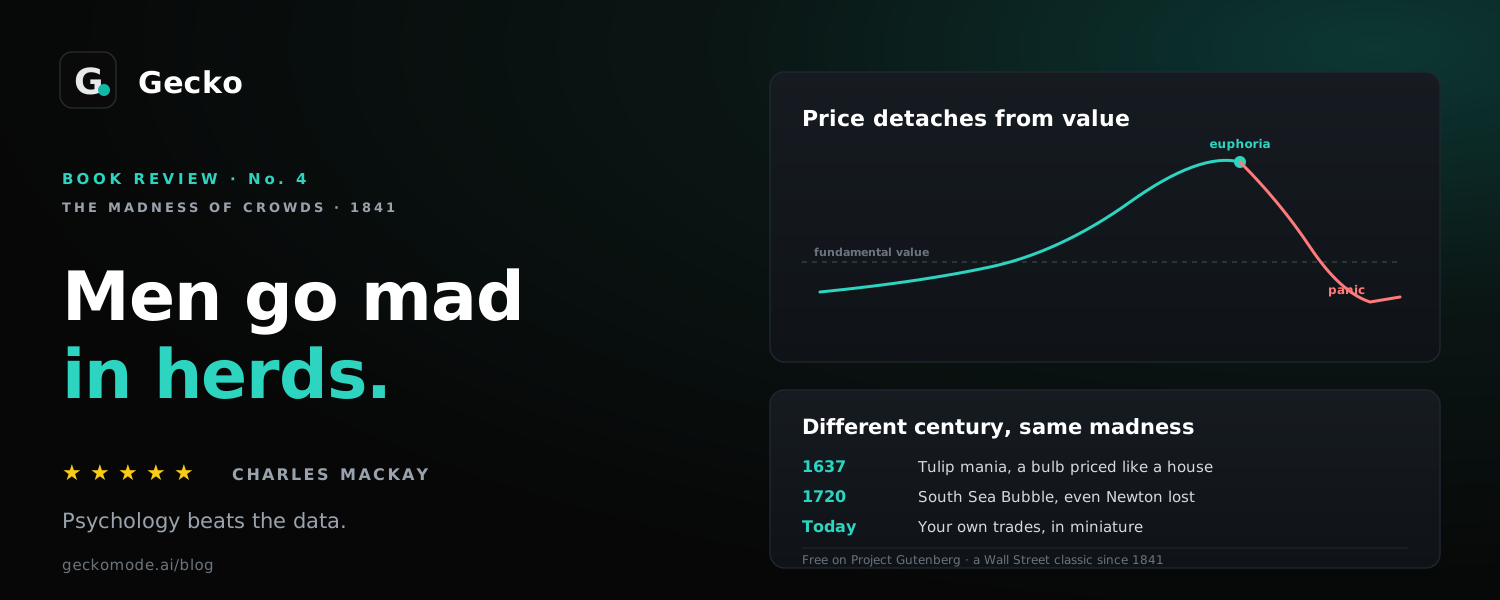
Written in 1841, Extraordinary Popular Delusions and the Madness of Crowds is the oldest book in our series and, in one specific way, the most useful. It is the original argument that markets are governed by mass psychology rather than reason, and it makes that case not with theory but with history: real episodes where price abandoned fundamentals entirely and was set, instead, by what the crowd felt. The financier Bernard Baruch is often said to have kept it close and credited it with helping him sidestep ruin. Read it once and you will never again mistake the data for the whole game.
| Rating | Best for | Reader note |
|---|---|---|
| ★★★★★ | Seeing that markets are emotion before they are math | A dense 1841 classic, but the financial chapters are timeless |
Key takeaways
- Mackay’s thesis: people think and go mad in herds, and recover their senses slowly, one by one.
- His three financial manias show price detaching completely from fundamentals under collective emotion.
- The same forces, greed, fear, and the fear of missing out, run inside every individual trader on every trade.
- Which is why your psychology often decides your results more than your earnings or macro read does.
The line that explains every bubble
Mackay’s most quoted sentence is also his whole argument compressed.
“Men, it has been well said, think in herds; it will be seen that they go mad in herds, while they only recover their senses slowly, and one by one.”
Charles Mackay, Extraordinary Popular Delusions and the Madness of Crowds
Notice the structure of it, because it is the structure of every boom and bust. The madness is collective and fast. The recovery is individual and slow. Crowds inflate a price together in a rush of shared belief, and then unwind it one frightened participant at a time. If that sounds like the tape on any hyped stock you have watched run and collapse, that is the point. The mechanism has not changed in two centuries.
The evidence: when fundamentals stopped mattering
Mackay opens with three financial manias, and each is a clean experiment in psychology overpowering value.
Tulip mania
In the Dutch Republic of the 1630s, single tulip bulbs traded for the price of a house. Nothing about the flower’s utility justified it. The price was pure social proof: people paid absurd sums because other people were paying absurd sums, and everyone assumed a greater fool waited behind them. There were no earnings to analyze, no macro data to model. There was only belief, and when belief cracked, the price did not glide back to fair value. It collapsed.
The Mississippi Scheme and the South Sea Bubble
The two great share bubbles of 1719 and 1720, John Law’s Mississippi venture in France and the South Sea Company in England, ran the same play at national scale. Paper fortunes were minted on stories of impossible riches, ordinary citizens mortgaged their lives to buy in, and the cleverest people alive were not immune. Isaac Newton, who understood the universe, reportedly lost a fortune in the South Sea Bubble and is said to have remarked that he could calculate the motions of the heavenly bodies but not the madness of people. If the man who invented calculus could be swept up, your spreadsheet will not save you either.
Why psychology beats earnings and macro
Here is the deep lesson, and it is uncomfortable for anyone who believes better analysis is the answer. In the moments that decide outcomes, price is not a measurement of value. It is a vote on what the crowd believes others will pay next. Benjamin Graham captured the same idea when he said the market is a voting machine in the short run and a weighing machine only in the long run. John Maynard Keynes sharpened it into his famous beauty-contest metaphor: successful speculation is not about picking the most beautiful face, but about guessing which face everyone else will pick, a contest of anticipating mass psychology rather than judging fundamentals. He named the engine behind it animal spirits.
This is why a correct earnings model or a sharp macro thesis so often fails to make money. You can be right about the company and the economy and still lose, because in the window you are trading, the price is being set by emotion, not by your analysis. And the inverse is the harder truth: the trader who manages their own psychology, who does not buy the euphoria or sell the panic, can outperform the one with the better data and the worse temperament. The edge is not knowing more. It is reacting less.
The madness is not only out there. It is in you.
It would be comforting to read Mackay as history, a parade of long-dead fools. It is not. You do not need a national bubble to feel the same forces, because every one of them runs inside you on an ordinary Tuesday. The urge to chase a stock that is already running is tulip mania at the scale of one trade. The refusal to sell a loser is the South Sea shareholder waiting for the price to come back. The capitulation at the exact bottom is the crowd recovering its senses one by one, and you are one of them. The crowd Mackay studied is not just the market. It is the committee of impulses in your own head during the trade.
From belief to behavior: measuring the crowd inside you
What makes Mackay a perfect bookend to a behavioral journal is that the herd emotions he describes leave fingerprints in an individual trader’s data. You cannot measure a 17th-century bubble, but you can measure your own.
| Crowd emotion | The fingerprint it leaves in your trade history |
|---|---|
| Herding and the fear of missing out | Late entries into extended moves, and oversized impulse trades on hype. |
| Euphoria and greed | Position size that swells in hot conditions, then produces worse outcomes than your baseline. |
| Fear and the refusal to admit loss | Losses held far past the stop, waiting for the price to come back. |
| Panic and capitulation | After-loss tilt and selling near the bottom, the personal version of the crowd unwinding. |
| Recovering one by one | The same costly cycle repeating, visible only when behavior is tracked over time. |
This is the case for a behavioral journal over a plain log, and over a data terminal too. A log records the trades. A feed of earnings and macro tells you about the world. Neither tells you when you joined the herd, and what it cost. Gecko scores exactly these patterns from an uploaded statement, including after-loss tilt, overtrading, and size discipline, so the madness Mackay documented in nations becomes a number you can see in yourself. It pairs naturally with our reviews of Thinking, Fast and Slow and The Intelligent Investor.
See when you trade with the crowd
FOMO, euphoria sizing, and capitulation all leave a trail. Upload a broker statement and Gecko names your costliest crowd-driven habits in dollars, and scores them across twelve behavioral axes. No login or broker connection needed, and your first 100 trades are analyzed free.
Read your trades free →An educational tool, not financial advice.
The verdict
Read it, and read it as a mirror, not a museum. The Madness of Crowds is nearly two centuries old, occasionally dry, and more right about markets than most books published this year. Its argument, that emotion sets price and reason arrives late, is the foundation every other book in this series builds on, and it reframes what a trader should actually work on. Not a better forecast. A steadier self. Skip nothing in the three financial manias, and keep Newton’s humility close: the smartest analysis in the world is no defense against your own participation in the crowd.
Resources: where to read it and what pairs with it
- The book itself: in the public domain and free to read on Project Gutenberg. The three financial chapters are the essential ones for traders.
- The Crowd by Gustave Le Bon, the other foundational text on crowd psychology.
- Manias, Panics, and Crashes by Charles Kindleberger, the modern academic companion on financial bubbles.
- Our related reviews: Thinking, Fast and Slow for the individual mind, and The Intelligent Investor for Mr. Market, the same idea in one character.
Frequently asked questions
What is the book about?
An 1841 study of crowd psychology documenting historical manias, including the Dutch tulip mania, the Mississippi Scheme, and the South Sea Bubble. Its lesson is that people go mad in herds and recover slowly, one by one.
Why does it matter for traders?
Because it shows price is driven by collective emotion at extremes, and the same herd emotions run inside every trader, which is why psychology often matters more than the data.
Is psychology more important than fundamentals?
For short-term results, often yes. A correct read on earnings or macro does not protect a trader who buys euphoria and sells panic. Behavior usually decides outcomes more than analysis does.
What bubbles does it cover?
The Dutch tulip mania of the 1630s, the Mississippi Scheme of 1719 to 1720, and the South Sea Bubble of 1711 to 1720.
Book review No. 4 in Gecko’s series. Quotations and history are drawn from Charles Mackay, Extraordinary Popular Delusions and the Madness of Crowds (1841), with corroborating ideas attributed to John Maynard Keynes and Benjamin Graham, and the Newton anecdote is widely recounted and presented as such. Gecko is an educational and informational tool. Nothing here is financial, investment, or trading advice. Trading carries substantial risk of loss.
Drop in a single statement. Gecko produces a one-page Behavioral Diagnosis ranking your costliest habits in actual dollars. Free to start. No card. No broker connection.
Short notes, usually once or twice a month. Unsubscribe in one click.
No account needed. We use your email only to send Gecko blog posts, and the link at the bottom of every email opts you out in one click.
More on the blog
- The AI Debt Machine: Circular Financing, Off-Balance-Sheet Data Centers, and the Ghosts of Bubbles PastThe AI build-out has quietly shifted from cash to debt: hyperscaler bonds near $194 billion in 2026, private credit's share of AI financing up from about 9% to 34%, debt parked in off-balance-sheet vehicles, and a circular loop among Nvidia, OpenAI, Oracle and CoreWeave. What telecom, Enron and the 1920s say about it, and what a trader should actually do.
- When the Consumer BreaksHousehold debt booms have a long record of ending in slowdowns that forecasters miss. What that history says about markets, and about the most overlooked balance sheet in trading: your own.
- How Banking Crises Actually StartThe run is the last chapter, not the first. What 150 years of bank failures teach traders about reading stress, and about the mistakes made when the headlines finally arrive.