Stop Trading the Same Lesson Twice: Why Behavioral Journaling Beats Another Indicator
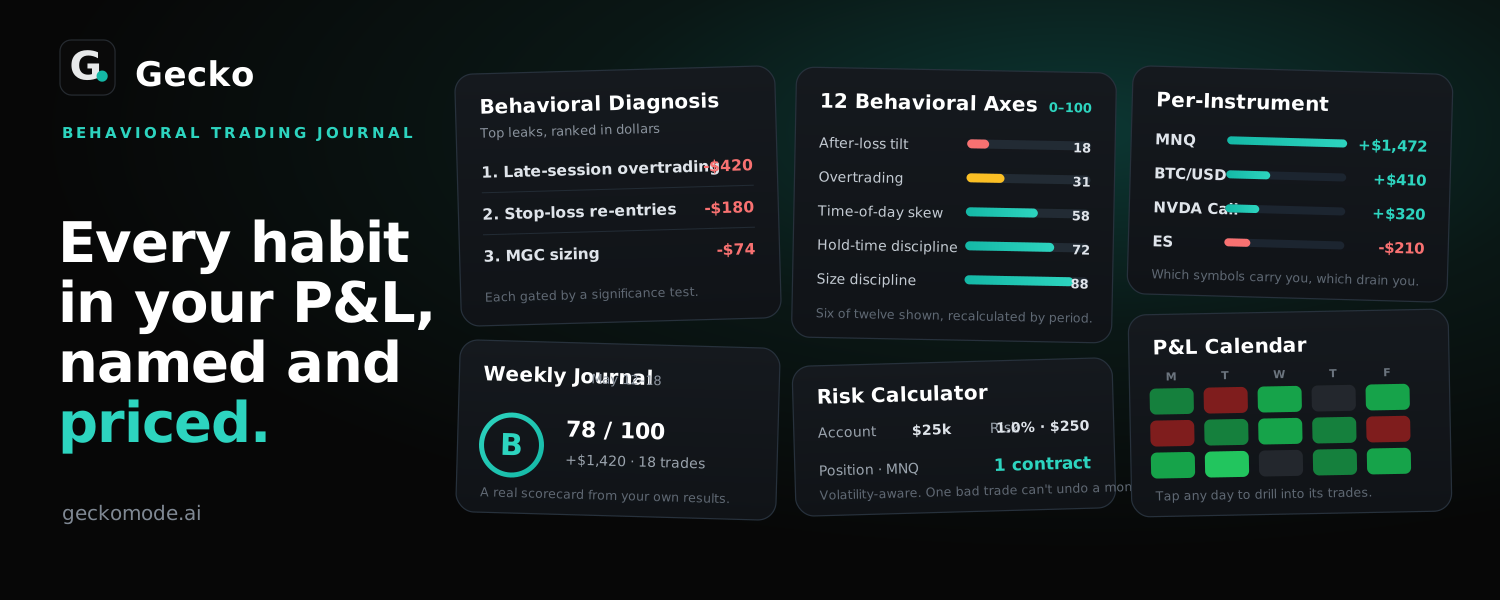
Every serious trader knows they should journal. Almost none do it consistently. The ones who try usually quit inside two weeks, and not because they lack discipline. They quit because a spreadsheet full of charts and trade notes never tells them why they keep leaking money. The journal lives. The pattern persists.
You don’t lose because your setup is bad
Walk through a year of your closed trades. Most losing days do not look random. They cluster. They share a shape. The same handful of habits show up over and over:
- After-loss tilt. The trade right after a red one is the one that breaks the day.
- Revenge re-entries. Stop hit; back in within five minutes; worse on the second try than the first.
- FOMO sizing. Size jumps on the next trade after a winner. One bad fill cancels three good ones.
- Cutting winners short. The average loss is bigger than the average win. Math says you can’t out-pick that.
These are not character flaws. They are pricing signals hiding in your own data. Most traders never see them because nobody is adding up what each habit actually costs.
The Schwartz test
In Market Wizards, Jack Schwager asked Marty Schwartz why most traders lose money. Schwartz’s answer is the entire argument for behavioral journaling in one sentence:
“Because they would rather lose money than admit they’re wrong.”
Marty Schwartz, in Jack Schwager, Market Wizards
A journal that works takes that option away. It puts the mistake in front of you, in dollars, every week. Four things stop being optional:
- Self-awareness. You can name the trigger before the next one fires.
- Accountability. Plan vs. execution, side by side, every Sunday.
- Measurement. Win rate, reward-to-risk, hold times, leaks — tracked over weeks, not vibes.
- Control. “I got tilted” turns into “this pattern cost me $X in March.” The second one is solvable.
Why manual journals die
A blank notebook on Sunday night does not survive contact with live markets on Monday. The reasons are mechanical, not moral:
- It’s vague. “Felt rushed today” is not measurable.
- No dollar impact. Without a number, there’s nothing to optimize.
- No grade. Nothing is being measured against anything, so nothing is improving.
- No reason to come back. An empty Sunday template never earned anyone a return on time.
That is the problem Gecko exists to solve.
Drop in a statement. Read a diagnosis.
Gecko reads what your broker already gives you. A daily statement PDF, an Activity Statement CSV, a trade-history export — whatever your platform produces. No login required to get started. Pro and Unlimited traders can also connect their broker via SnapTrade for read-only auto-sync; that path uses OAuth so your broker password never crosses Gecko, and the statement-upload path stays available on every plan.
Within a minute of upload, it has paired your fills into closed round-trip trades, journaled every one, and produced a one-page Behavioral Diagnosis that ranks your most expensive habits in real dollars from your real history:
- Late-session overtrading−$420
- Stop-loss re-entries−$180
- MGC sizing−$74
Scored across 12 behavioral axes
The Diagnosis ranks the worst leaks. The 12 Axes page tells you where you stand on every behavior, scored 0–100, recalculated by period:
- After-loss tilt
- Revenge re-entry
- Overtrading
- Hold-time discipline
- Size discipline
- Time-of-day skew
- Day-of-week pattern
- Long vs. short asymmetry
- Weekend gap risk
- Max loss vs. typical gain
- Per-instrument bleed
- First trade of the day
Each axis is gated by a sample-size and significance check, so it only reads a score when you have enough trades for the result to mean something. Climbing scores over eight weeks is the visible thing you’re actually optimizing.
A weekly journal that grades itself
Thirty seconds of writing on Sunday plus your real trading week equals a real A/B/C scorecard: profitability, win rate, profit factor, reward-to-risk, risk management, hold discipline. A short, plain-English note explains where the grade went. Not “do better.” Something like “your average loss was 1.6x your average win this week. Letting winners run earns the most points back.”
Eight weeks of grades and the trend line becomes obvious. So does the work.
The rest of the surface
The behavioral side does the heavy lifting. The mechanical side is all there too, doing the boring work that any decent journal owes you:
- Per-instrument P&L — which symbols pay you, which quietly drain the account.
- P&L calendar — net by day, click any cell to see the trades behind it.
- Volatility-aware risk calculator — position size that respects the current vol, futures or stocks or crypto.
- Commissions and fees tracker — the silent tax most journals ignore.
- Notebook — rules, lessons, mindset notes. Pinned notes greet you next session.
All in a clean dark UI that gets out of your way and lets the data do the talking.
Built for the trader who closes trades
Day traders, swing traders, futures traders, options traders — anyone whose statements show closed round-trips on a regular cadence. Long-only investors who never sell? Not your tool: there aren’t enough closed trades to read a behavioral pattern out of.
The free plan analyzes your last 100 trades, every feature on. Pro is $12 a month — coffee money — for unlimited history.
Stop trading the same lesson twice
The market doesn’t change. You have to. Most traders skip the journal and wonder why nothing improves. Gecko removes the excuse. Drop in your first statement and see what your habits have been costing you.
Upload my first statement →Free to start. No credit card. Upload a statement, or connect your broker read-only on Pro.
Drop in a single statement. Gecko produces a one-page Behavioral Diagnosis ranking your costliest habits in actual dollars. Free to start. No card. No broker connection.
Short notes, usually once or twice a month. Unsubscribe in one click.
No account needed. We use your email only to send Gecko blog posts, and the link at the bottom of every email opts you out in one click.
More on the blog
- The AI Debt Machine: Circular Financing, Off-Balance-Sheet Data Centers, and the Ghosts of Bubbles PastThe AI build-out has quietly shifted from cash to debt: hyperscaler bonds near $194 billion in 2026, private credit's share of AI financing up from about 9% to 34%, debt parked in off-balance-sheet vehicles, and a circular loop among Nvidia, OpenAI, Oracle and CoreWeave. What telecom, Enron and the 1920s say about it, and what a trader should actually do.
- When the Consumer BreaksHousehold debt booms have a long record of ending in slowdowns that forecasters miss. What that history says about markets, and about the most overlooked balance sheet in trading: your own.
- How Banking Crises Actually StartThe run is the last chapter, not the first. What 150 years of bank failures teach traders about reading stress, and about the mistakes made when the headlines finally arrive.