Trading the Headline Presidency: What Policy-by-Announcement Does to Volatility
This is a piece about market mechanics and trader behavior, not politics. Gecko takes no position on any administration, party, or policy. Everything below describes how markets have moved and what that means for volatility and risk — nothing here is an endorsement or a criticism of any political figure or decision.
Set aside, entirely, what you think about the policies. As a trader, the defining market feature of this era is not any single decision but a style of decision: consequential, market-moving policy delivered by announcement, often abruptly, sometimes reversed within days. Whatever its merits as governance — which is not our subject — this style has a specific and measurable signature on a price chart. It manufactures volatility on a schedule nobody controls, and it does so in a way that is almost perfectly designed to separate reactive traders from their money.
The clearest case study arrived in the spring of 2025, and it is worth walking through purely as market history, because the numbers are extraordinary.
Key takeaways
- The April 2025 “Liberation Day” tariffs triggered the largest two-day loss in market history — roughly $6.6 trillion — with the S&P down about 10% in two sessions.
- The VIX spiked above 50, near its 2020 and 2008 extremes — then fell from over 50 to under 20 in less than 100 days, one of only four such rapid collapses on record.
- The market recovered fully and finished 2025 higher. The crash and the round trip both happened at headline speed.
- For a trader, the lesson isn’t a market call. It’s a regime: policy-by-announcement means headline risk, and the panic-sell-then-FOMO-buy round trip is the costliest response to it.
What actually happened in April 2025
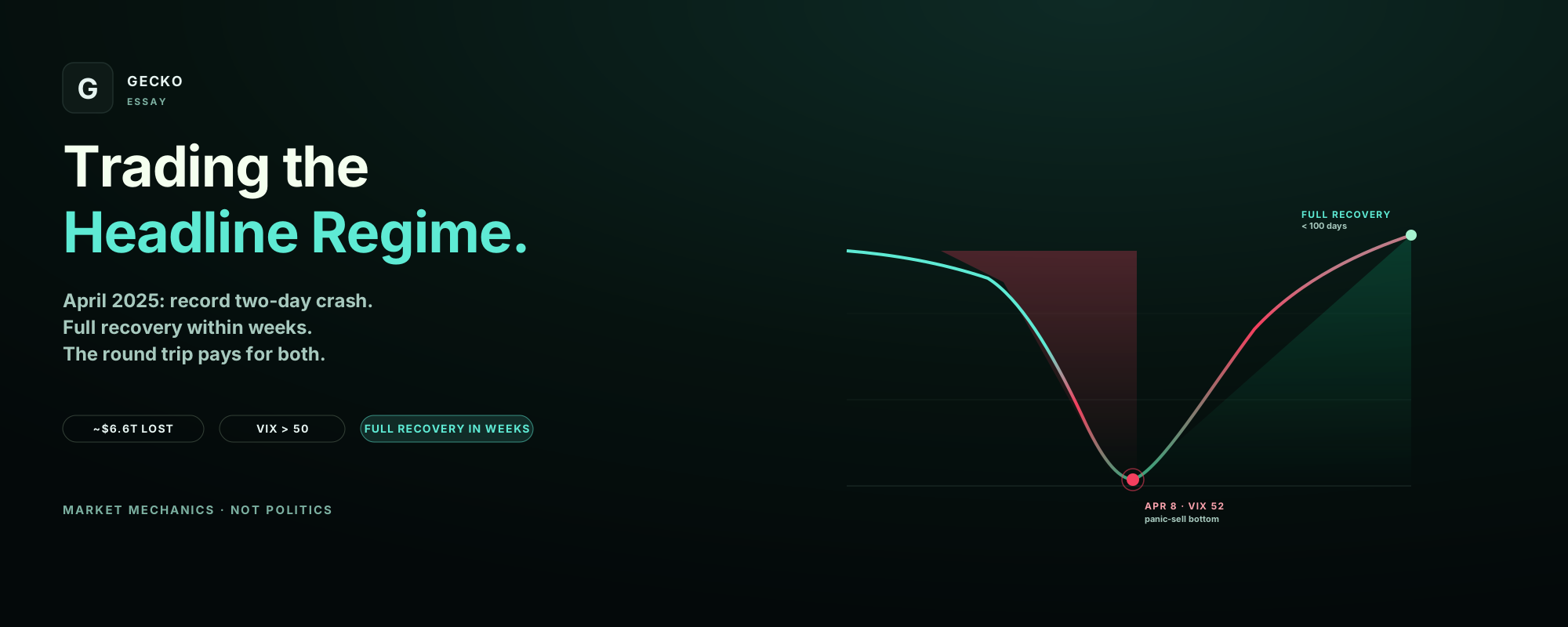
On April 2, 2025, the administration announced sweeping tariffs: a baseline 10% duty on effectively all imports, with steeper country-specific rates on roughly 60 nations. The market’s response was immediate and historic. Over the next two sessions the S&P 500 fell about 10%, the Nasdaq about 11%, and the Dow roughly 9.5% — a combined loss of around $6.6 trillion, the largest two-day dollar decline ever recorded. The VIX, Wall Street’s “fear gauge,” spiked to an intraday 52 on April 8 and closed above 45, a level not seen since the 2020 pandemic crash.
Then came the reversal that makes this a behavioral story rather than a market-crash story. On April 9, a 90-day pause on many of the tariffs was announced. The market responded with one of its largest single-day rallies in modern history. Volatility drained away almost as fast as it had arrived: the VIX fell from above 50 to below 20 in under 100 days, one of only four such rapid declines on record. The S&P 500 clawed back to positive on the year by mid-May and went on to finish 2025 up more than 18%, at record highs.
The entire episode — record crash to full recovery — resolved in weeks. The move that felt most urgent, selling into the bottom, was the single most expensive thing a trader could have done.
Academic work has already begun cataloguing the shock. Event studies published in Studies in Economics and Finance and Applied Economics Letters examined the tariff announcements across dozens of countries, documenting sharp and differentiated reactions — and, notably, that markets with intermediate trade exposure sometimes reacted more negatively than those directly targeted, a reminder that second-order effects are hard to price in real time and even harder to trade on a hunch.
The signature: this is a headline-risk regime
Strip the episode to its mechanics and you can see the pattern a trader actually has to live with. A policy-by- announcement environment produces three things, and none of them is direction.
First, it produces gaps. When market-moving news can land at any hour — a social post at night, a statement before the open, a walk-back over a weekend — price adjusts in jumps rather than in tradeable, continuous moves. A stop-loss does not protect you across a gap; you get filled on the other side of it. Second, it produces violent two-way volatility: the same week can contain a record decline and a record rally, so a position sized for a normal tape can be stopped out in both directions in the space of days. Third, it compresses the time to react to near zero, which is precisely the condition under which human decision-making is worst.
This is the same structural problem we described for FOMC days and geopolitical shocks, and it rhymes for the same reason. The information is loud, it is emotional, and by the time you can act, the market has usually already moved. The difference with policy-by- announcement is that, unlike a Fed meeting, it isn’t on the calendar. The headline regime removes even the courtesy of a known date.
Why the reactive trader loses this game specifically
Put the crash and the recovery together and you get a near- perfect behavioral trap. The record two-day plunge triggers the loss-aversion alarm at maximum volume; the trader sells to make the pain stop, typically near the bottom, because that is when the pain is worst. Then the relief rally arrives just as fast, and the same trader — now watching the market rocket without them — buys back in near the top, on the urge not to miss it. Sell the fear, buy the relief: the exact inversion of what works, executed in the correct-feeling order, and paid for twice.
The people who came through the 2025 tariff whipsaw intact were not the ones with the best read on trade policy. Forecasting the pause was essentially impossible — it was a discretionary decision made by a handful of people on a timeline they did not announce. The survivors were the ones whose position sizing was small enough that they were never forced to sell, and whose rules told them not to open new discretionary trades into the first hours of a shock. In a headline regime, survival is a risk-management outcome, not a forecasting one.
What “regime awareness” actually looks like
None of this argues for sitting in cash or for any particular market view — direction is genuinely hard to call here, and that is rather the point. It argues for calibrating to the environment. In a high-policy-uncertainty regime, implied and realized volatility can spike and collapse far faster than usual, which changes the correct size of a position much more than it changes its direction. Practically, that means smaller positions and wider mental stops in exchange for staying solvent through the gaps; a written rule against reacting to a headline in the first minutes; and an honest acknowledgment that leverage, which is merely uncomfortable in a calm tape, is genuinely dangerous when a single post can gap the market several percent overnight. The goal is not to predict the next announcement. It is to still be trading after it.
From belief to behavior: what a headline regime does to your record
You don’t have to guess whether the news cycle is trading you. If you held an account through the 2025 tariff swings, your statement already knows.
| The headline-regime hook | The fingerprint it leaves in your trade history |
|---|---|
Panic-selling the shock | A cluster of exits on the worst day of the drop, followed by no re-entry before the recovery — the round trip that pays twice. |
FOMO-buying the relief | Entries bunched into the sharpest up-day, near the top of the rebound, right after a capitulation. |
Oversizing into a gap | Leverage or size unchanged from the calm regime, then an outsized loss on a single overnight gap; a broken size discipline ladder. |
Trading the tweet | Frequency spikes on announcement days while per-trade expectancy falls; see after-loss tilt. |
Upload a broker statement and Gecko scores your overtrading, tilt, and sizing in dollars across twelve behavioral axes — and can isolate how you traded around the volatility spikes. No login or broker connection needed, and your first 100 trades are analyzed free.
An educational tool, not financial advice.
Resources and further reading
- Academic event studies: “Trump Liberation Day tariffs and stock market reactions: new insights from global analysis,” Studies in Economics and Finance (2026), and the related event study in Applied Economics Letters (2025) across 77 markets.
- Policy-uncertainty framework: Baker, Bloom & Davis, “Measuring Economic Policy Uncertainty” (Quarterly Journal of Economics, 2016) — the standard index linking policy uncertainty to market volatility.
- The market data: contemporaneous reporting on the April 2025 selloff and recovery (Fortune on the VIX spike; PBS NewsHour and Reuters year-end summaries) and Cboe VIX history.
- The behavioral counterpart: Trading Through Geopolitical Turmoil and Trading the Fed — the same “don’t trade the loud shock” logic in two other regimes.
- The cost of missing the rebound: J.P. Morgan Asset Management, Guide to Retirement, on the effect of missing the market’s best days — many of which follow the worst days.
Frequently asked questions
Sweeping tariffs announced April 2, 2025 sent the S&P down about 10% and the Nasdaq about 11% over two sessions — roughly $6.6 trillion erased, the largest two-day loss in history — with the VIX spiking above 50. After a 90-day pause was announced on April 9, the market staged one of its largest one-day rallies in years and recovered fully within months, ending 2025 higher. This describes market behavior, not politics.
The danger that an unscheduled announcement moves the market violently at a moment you can’t predict. A policy-by-announcement regime raises headline risk because market-moving news can arrive at any hour, producing gaps and sharp reversals that punish tight stops and leverage.
History suggests caution over aggression. The 2025 tariff episode was a record crash and a near-complete recovery within weeks, so traders who panic-sold and bought back after the relief paid for both moves. As with FOMC days, the disciplined response is to reduce size and avoid new discretionary positions in the first volatile hours.
Research links economic and trade-policy uncertainty to higher equity volatility, and event studies of the April 2025 tariffs documented sharp, differentiated reactions across dozens of countries. For a trader, the takeaway is regime awareness: volatility can spike and collapse far faster than usual, which changes appropriate position sizing more than it changes direction.
Essay in Gecko’s trading psychology series, and explicitly party-neutral: it describes market behavior and trader risk, not the merits of any policy or politician. Market figures are drawn from contemporaneous reporting and Cboe data, and academic findings from event studies in Studies in Economics and Finance (2026) and Applied Economics Letters (2025), as of July 2026; figures are approximate and may be revised — verify at the source. Gecko is an educational and informational tool. Nothing here is financial, investment, or trading advice, a market forecast, or a political statement. Trading carries substantial risk of loss.
Drop in a single statement. Gecko produces a one-page Behavioral Diagnosis ranking your costliest habits in actual dollars. Free to start. No card. No broker connection.
Short notes, usually once or twice a month. Unsubscribe in one click.
No account needed. We use your email only to send Gecko blog posts, and the link at the bottom of every email opts you out in one click.
More on the blog
- The AI Debt Machine: Circular Financing, Off-Balance-Sheet Data Centers, and the Ghosts of Bubbles PastThe AI build-out has quietly shifted from cash to debt: hyperscaler bonds near $194 billion in 2026, private credit's share of AI financing up from about 9% to 34%, debt parked in off-balance-sheet vehicles, and a circular loop among Nvidia, OpenAI, Oracle and CoreWeave. What telecom, Enron and the 1920s say about it, and what a trader should actually do.
- When the Consumer BreaksHousehold debt booms have a long record of ending in slowdowns that forecasters miss. What that history says about markets, and about the most overlooked balance sheet in trading: your own.
- How Banking Crises Actually StartThe run is the last chapter, not the first. What 150 years of bank failures teach traders about reading stress, and about the mistakes made when the headlines finally arrive.