Trading the Fed: What the Research Says About FOMC Days — and Why Warsh's Debut Proved It
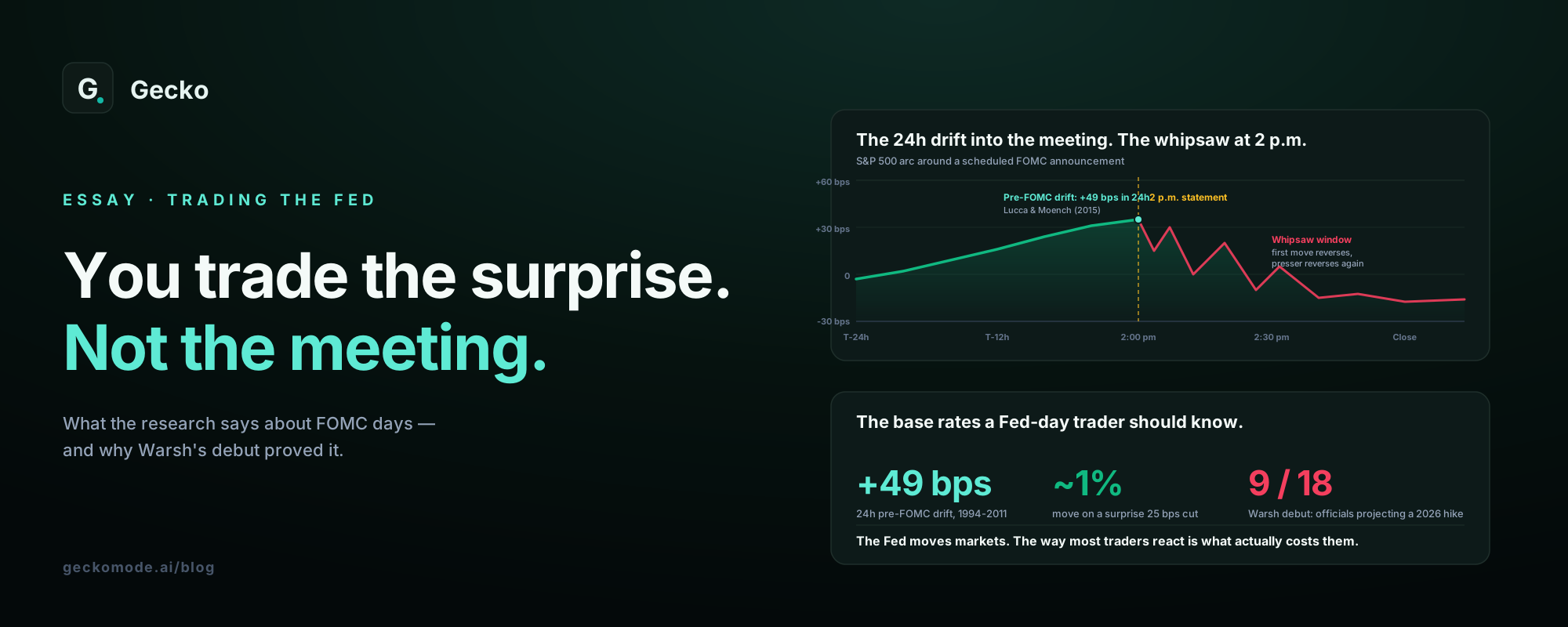
Ask a room of traders which day of the year they most want a position on, and a lot of them will say the same thing: Fed day. The 2 p.m. Eastern statement and the 2:30 press conference that follows are the closest thing markets have to a scheduled earthquake — guaranteed volatility, on a date circled months in advance. The appeal is obvious. The problem is that "I know exactly when the volatility is coming" and "I can profit from it" are two completely different claims, and decades of research say the gap between them is where retail accounts go to die.
This piece does something narrower than predict the Fed. It asks what the academic literature actually shows about how the central bank moves markets, whether that creates a tradable edge for an individual, and what a trader should do on FOMC days. Then it looks at the most current possible test of the whole framework: the arrival of a new Fed chair, Kevin Warsh, and the market's reaction to him.
Key takeaways
- The Fed's influence on stocks is large and well documented — but it works through surprises, the gap between the decision and what was already priced in.
- The famous tradable edges (the pre-FOMC drift, the FOMC-cycle pattern) are captured by positioning and holding, not by day-trading the 2 p.m. announcement.
- The announcement window itself is a whipsaw: the literature and the tape both say it's where retail behavioral errors are punished hardest.
- Kevin Warsh's hawkish debut in 2026 — after markets priced cuts — is a live case study that you trade the surprise, not the political narrative.
How much does the Fed actually move markets? A lot — through surprises
Start with the seminal result, because it reframes the whole question. In "What Explains the Stock Market's Reaction to Federal Reserve Policy?", Ben Bernanke and Kenneth Kuttner (2005, Journal of Finance) used fed funds futures to separate the expected part of a rate decision from the surprise. Their finding is the sentence every FOMC trader should tattoo somewhere visible: an unanticipated 25-basis-point cut raises stock prices by about 1 percent on average, and almost all of that move comes through a change in the risk premium — the compensation investors demand to hold stocks — not through the rate number itself.
The word doing the work is unanticipated. The expected part of a decision is, by definition, already in the price. If the Fed cuts 25 bps and the market was certain it would cut 25 bps, the reaction can be nothing, or even the opposite of what a beginner expects. You are never trading the decision. You are trading the distance between the decision and the consensus that preceded it — and that distance is precisely the thing you cannot see in advance.
The two famous "Fed edges" — and the catch in each
If the Fed moves markets so reliably, surely there's a way to trade it. The literature has found patterns; the catch is that none of them is the day-trade most people attempt.
The pre-FOMC announcement drift
The most striking result belongs to David Lucca and Emanuel Moench (2015, Journal of Finance). Studying scheduled FOMC meetings from 1994 to 2011, they found the S&P 500 earned about 49 basis points on average in the 24 hours before the announcement — a stretch that accounted for roughly 80 percent of the entire annual equity premium over that period. There was no matching move in Treasuries or money markets, and no other macro release produced the effect. It is one of the cleanest anomalies in finance.
Two catches. First, capturing it meant simply owning equities into the announcement and sitting still — a passive position, not a trade you actively work. Second, and more soberingly, subsequent research documented that the drift largely weakened or disappeared after about 2015, once it was famous. That is the recurring fate of a published anomaly: the edge gets crowded out by the very people reading about it. A pattern you learned from an article is a pattern the market has already met.
The FOMC cycle
The second pattern is even broader. Anna Cieslak, Adair Morse, and Annette Vissing-Jorgensen (2019, Journal of Finance) showed that since 1994 the U.S. equity premium has been earned entirely in "even weeks" of the FOMC cycle — weeks 0, 2, 4, and 6 counting from the last meeting — and they tie it causally to the Fed, likely via unexpectedly accommodating policy and informal communication reaching the market. It's a remarkable finding. But notice, again, what it implies for a trader: it's a calendar tilt for a position held over weeks, not a signal for what to do at 2:01 p.m. on announcement day. The research that most convincingly proves the Fed drives returns is research about being invested, not about trading the meeting.
Every documented way to profit from the Fed is a reason to hold a position through the event. Almost none of them is a reason to trade the event itself.
So should you trade FOMC days, or stay away?
Put the strands together and the answer the literature suggests is uncomfortable for the adrenaline seeker. The edges that exist are passive and fading; the announcement itself is the single most treacherous window on the calendar. In the seconds after 2 p.m., algorithms parse the statement, the first move frequently reverses as the nuance sinks in, spreads gap wider, and the 2:30 press conference routinely reverses the reversal as the chair speaks. This is not a market inefficiency you exploit; it is a volatility machine that exploits you, because it triggers every reflex that ruins traders — the urge to chase the first candle, to oversize a "sure" directional read, and to overtrade the chop.
This is the same lesson as trading a war headline, and for the same reason: the information is loud, scheduled, and emotional, and the market has usually priced the expectation before you can act. We made the fuller version of that argument in Trading Through Geopolitical Turmoil. "Stay away or engage" is slightly the wrong frame. The disciplined move is to decide your FOMC-day rules in advance — usually reduce size, avoid new discretionary entries in the first volatile minutes, and let the position you already sized calmly do its job — rather than to show up at 1:55 p.m. hunting for action.
The arrival of Kevin Warsh: a live test of the whole idea
The best evidence for all of this arrived in 2026, in the person of a new Fed chair. Kevin Warsh was confirmed in a sharply divided 54-45 Senate vote and sworn in on May 22, 2026, succeeding Jerome Powell for a term running to 2030. The political narrative was tidy and, it turned out, misleading. Warsh had been nominated by a president who spent years demanding lower rates, and while campaigning for the job he had struck a notably dovish tone. The obvious trade wrote itself: Trump's chair means cuts, cuts mean higher stocks, position accordingly.
Then Warsh actually ran a meeting. At his debut, the committee held rates steady, stripped the easing bias out of the statement, and — in the detail that stunned the desk — nine of the eighteen officials projected at least one rate hike in 2026. Warsh's press conference leaned hard into fighting inflation. Stocks dropped and Treasury yields spiked as traders who had positioned for the dovish narrative were run over. A former governor once seen as hawkish, then dovish as a candidate, turned out to be hard to caricature as chair — and the people who had traded the caricature paid for it.
That is the entire thesis of this piece compressed into one meeting. The identity of the chair, the politics of his appointment, the tone of his campaign — none of it was tradable, because all of it was known and priced. What moved the market was the surprise relative to that expectation, exactly as Bernanke and Kuttner described twenty years earlier. Warsh's influence on markets will be real and lasting; the day-one lesson is that it will express itself the same way the Fed always does, through the gap between what he does and what the market already believed he would do.
A note on the "political" Fed
It is worth naming the backdrop, because it tempts traders into a particular error. The Fed of 2026 sits under open political pressure — a president publicly demanding cuts, a bruising confirmation fight, a former chair lingering on the board to signal independence. It is genuinely a more political central bank than the one in the textbooks. But a more politicized Fed is not a more predictable one for a trader. If anything, the tension between political pressure and a committee's own read on inflation widens the range of possible surprises, which widens the whipsaw. The macro-and-politics story is fascinating to read. It is a terrible thing to bet an oversized, emotional position on.
From belief to behavior: what FOMC days do to your record
You don't have to theorize about whether the Fed trades you. If you've held an account through a few FOMC meetings, the answer is already written in your statement, and it usually reads the same way.
What do FOMC days actually cost you?
Upload a broker statement and Gecko scores your overtrading, tilt, and sizing in dollars, across twelve behavioral axes — and can isolate how you trade around scheduled events like Fed days. No login or broker connection needed, and your first 100 trades are analyzed free.
An educational tool, not financial advice.
Resources and further reading
- The surprise reaction: Bernanke, B. & Kuttner, K. (2005), "What Explains the Stock Market's Reaction to Federal Reserve Policy?", Journal of Finance 60(3): 1221-1257 — a surprise 25 bps cut lifts stocks ~1%, mostly via the risk premium.
- The pre-FOMC drift: Lucca, D. & Moench, E. (2015), "The Pre-FOMC Announcement Drift," Journal of Finance 70(1): 329-371 (also NY Fed Staff Report 512) — ~49 bps of excess return in the 24h before announcements.
- The drift fades: follow-up work on "the disappearing pre-FOMC announcement drift," documenting the weakening of the effect after roughly 2015.
- The FOMC cycle: Cieslak, A., Morse, A. & Vissing-Jorgensen, A. (2019), "Stock Returns over the FOMC Cycle," Journal of Finance 74(5): 2201-2248 — the equity premium is earned in even weeks of the cycle.
- On the new chair: broker and market commentary on Kevin Warsh's confirmation and first meeting (e.g. CNBC, PIMCO's "Warsh's First Fed Meeting," Invesco's takeaways, and J.P. Morgan Chase's investor notes) for the hawkish-surprise reaction.
Frequently asked questions
Does the Fed really move the stock market?
Yes, substantially — but through surprises. Bernanke & Kuttner (2005) found a surprise 25 bps cut lifts stocks about 1% on average, mostly by lowering the risk premium, and Cieslak et al. (2019) tied the entire post-1994 equity premium to even weeks of the FOMC cycle. Markets move on the gap between the decision and what was already expected, not on the decision itself.
Should traders trade FOMC announcement days?
The research points away from day-trading the 2 p.m. announcement. The documented edges are captured by being positioned ahead of time and holding, while the announcement window is a whipsaw where the first move often reverses and behavioral errors are punished hardest. For most retail traders, FOMC days test discipline rather than provide edge.
What is the pre-FOMC announcement drift?
Lucca & Moench (2015) found U.S. equities earned about 49 bps in the 24 hours before scheduled FOMC announcements from 1994 to 2011 — roughly 80% of the annual equity premium — with no matching Treasury move. Later research found the effect largely faded after about 2015, once it was widely known.
How will Kevin Warsh as Fed chair affect markets?
Warsh was sworn in on May 22, 2026. Despite a dovish campaign tone and a president demanding cuts, his debut delivered a hawkish surprise — rates held, easing bias dropped, and nine of eighteen officials projected a 2026 hike — sending stocks down and yields up. It's a live reminder that markets trade the surprise versus expectations, not the political story about the chair.
Essay in Gecko's trading psychology series. Academic findings are drawn from Bernanke & Kuttner (2005), Lucca & Moench (2015), and Cieslak, Morse & Vissing-Jorgensen (2019); details on Kevin Warsh's confirmation and first meeting are from contemporaneous reporting and broker commentary as of July 2026. Figures are approximate and anomalies described here may have changed or faded; verify current data at the source. Gecko is an educational and informational tool. Nothing here is financial, investment, or trading advice, and nothing here is a recommendation for or against any security or strategy, or a forecast of Federal Reserve policy. Trading carries substantial risk of loss.
Drop in a single statement. Gecko produces a one-page Behavioral Diagnosis ranking your costliest habits in actual dollars. Free to start. No card. No broker connection.
Short notes, usually once or twice a month. Unsubscribe in one click.
No account needed. We use your email only to send Gecko blog posts, and the link at the bottom of every email opts you out in one click.
More on the blog
- The AI Debt Machine: Circular Financing, Off-Balance-Sheet Data Centers, and the Ghosts of Bubbles PastThe AI build-out has quietly shifted from cash to debt: hyperscaler bonds near $194 billion in 2026, private credit's share of AI financing up from about 9% to 34%, debt parked in off-balance-sheet vehicles, and a circular loop among Nvidia, OpenAI, Oracle and CoreWeave. What telecom, Enron and the 1920s say about it, and what a trader should actually do.
- When the Consumer BreaksHousehold debt booms have a long record of ending in slowdowns that forecasters miss. What that history says about markets, and about the most overlooked balance sheet in trading: your own.
- How Banking Crises Actually StartThe run is the last chapter, not the first. What 150 years of bank failures teach traders about reading stress, and about the mistakes made when the headlines finally arrive.