AI Trading Journal Coaches in 2026: How They Work, What They Cost, and How to Pick One
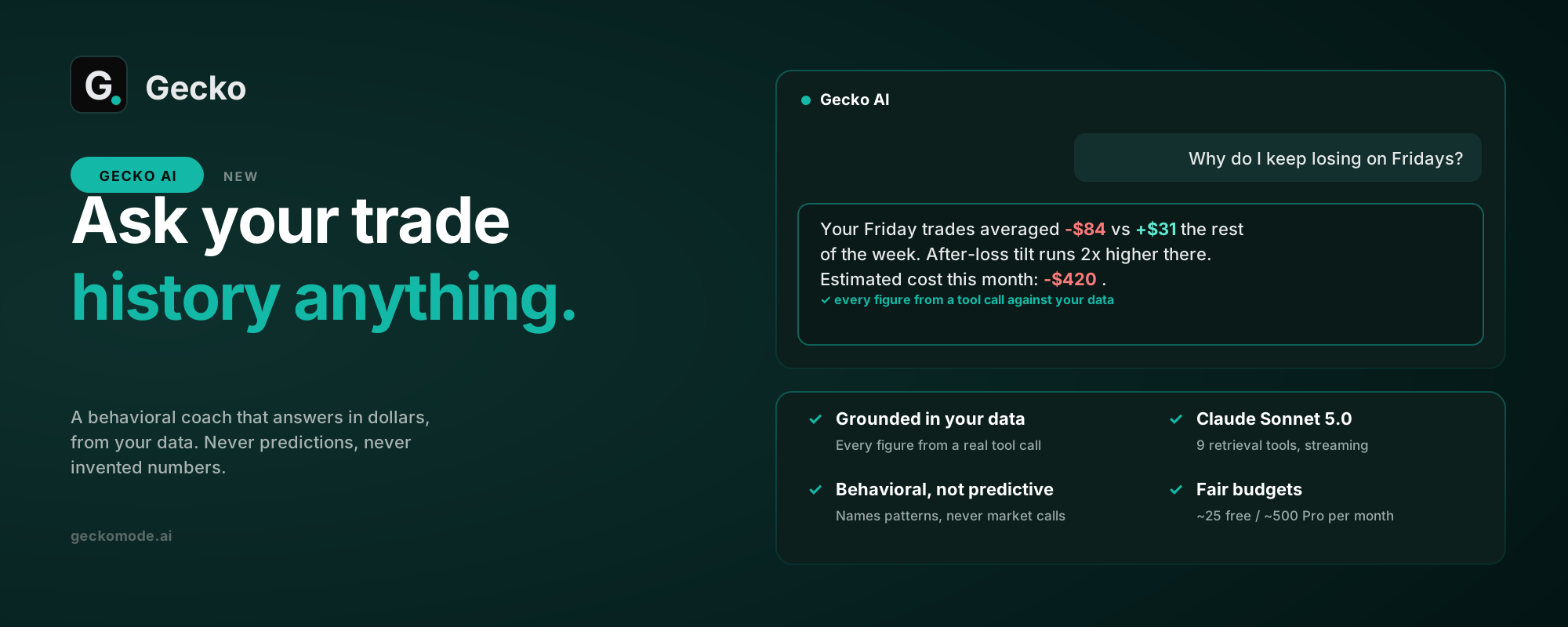
Almost every trading journal now has an AI feature stapled to it. The labels look identical, the marketing all promises insight, and underneath the hood they work in very different ways. This is a fair guide to how AI trading coaches actually function, what separates a useful one from a risky one, and where the main tools, including our own, land. We make Gecko, so weigh the favorable bits accordingly, but the facts below are checkable.
Key takeaways
- AI trading coaches do one or more of three jobs: automate logging, summarize sessions, and answer questions or coach you on your behavior.
- The biggest hidden difference is grounding: whether every number comes from your real data or is an AI estimate that can be wrong.
- The second is intent: behavioral feedback on what you did, versus predictions about what the market will do.
- Price ranges widely, from AI gated behind roughly $80 per month to AI included on a free tier.
How AI trading coaches actually work
Strip away the branding and these tools fall into three overlapping jobs. The first is automation: an AI tags your trades, classifies setups, and removes the tedium of manual logging. The second is summarization: it writes a recap of your session or week so you do not have to. The third, and the one people mean when they say coach, is analysis and conversation: it looks at your history and tells you, ideally in plain English, what you are doing well and what is costing you.
Underneath, there is a design choice that matters more than any feature list. Does the AI actually read your data, or does it generate plausible-sounding commentary on top of a summary? A grounded system answers every question by querying your real trades, so a figure it quotes is a figure that exists. An ungrounded one can produce a confident paragraph with numbers that were never in your account. In finance, that difference is not cosmetic.
How they improve performance
The mechanism is a faster feedback loop. Left alone, a trader repeats a costly habit for months because the damage is spread thin across many trades and never adds up in the moment. An AI coach compresses that. It surfaces the pattern now, names it, and ideally attaches a dollar figure, so the lesson arrives while you can still act on it. The performance gain does not come from the AI predicting anything. It comes from you seeing your own behavior sooner and correcting it. That is why the behavioral, grounded coaches tend to help more than the ones offering market opinions, which add another voice to the noise a trader already drowns in.
How they are powered
Most tools run on large language models, but the architecture around the model is what counts. A credit-based system runs AI agents in the background and meters usage in monthly credits. A conversational system lets you chat, and the best ones connect the chat to your actual records rather than a generic prompt. Gecko AI is built on Claude Sonnet 5.5 with nine retrieval tools that read your trade history, diagnosis, weekly journal, notes, and the goals you set for yourself, so every answer is a tool call against your data rather than a guess. Whatever tool you choose, the question worth asking the vendor is simple: when your coach quotes a number, did it look that number up, or did it write it?
Ask any AI coach one question: when it quotes a figure from your trades, did it look it up, or make it up?
Coach versus chatbot: what the difference actually looks like
Most tools that call themselves AI coaches are really chat interfaces over a trade log: you ask, they answer, end of thread. A coach — the way the word is used in any other domain — does three more things. They know what you said you were going to work on. They suggest one concrete action. And they check in to see if you did it.
Gecko AI is designed around that loop. Because it reads your weekly journal and your stated goals alongside your trades, it can say something a chatbot can’t: “You wrote on Monday that you wanted to stop cutting winners early. You cut seven of ten last week. Try hiding live P&L for the first 30 minutes of each trade this week. I’ll check your hold times on Friday and tell you what changed.” That is the difference between an analytics surface and a performance agent, and it is what we mean when we describe Gecko AI as personalized.
The main tools, fairly
Zella AI (TradeZella)
TradeZella’s Zella AI is the most automation-forward of the group. It runs a set of background agents that tag trades, review sessions, and build next-day plans, and it is included across plans priced from roughly $29 to $49 per month with a monthly pool of AI credits. If you want the journal to quietly do the post-session admin and you value backtesting and trade replay alongside it, TradeZella is a strong, mature all-in-one. One thing to note for the behavioral purist: part of its AI leans into market sentiment briefings, which is closer to outlook than pure self-review.
Cypher AI (TraderSync)
TraderSync’s Cypher AI takes a coaching-first, conversational approach and learns your patterns once you have logged enough trades. It is genuinely interactive, which many traders like. The catch is access. The limited version starts around $29.95 per month with a small daily message allowance, and the full Cypher experience sits on the Elite plan at roughly $79.95 per month, the most expensive AI tier in the category. It also leans on manual tagging to feed the analysis.
Gecko AI
Gecko AI is a personal trading performance agent. It has read-only access to your trades, diagnosis, weekly journal, notes, broker fees, and the goals you have written down for yourself, and it uses that full picture to close a real coaching loop: name the pattern, propose one concrete action for the week, and follow up the next week to tell you whether it moved. Two firm rules: never predictions, and never invented numbers. Every figure comes from a real tool call against your trade history, so the coach will not guess which brokers or instruments you use, and it will not tell you what to buy or where the market is going.
Three concrete examples of what that looks like in practice, each of which a chatbot over a trade log cannot reproduce:
- Goal-aware feedback. Your journal says this week you want to stop cutting winners early. Gecko AI reads that goal alongside last week’s trades and reports whether your hold times actually changed, with a number.
- One concrete action. Not “be more disciplined.” A specific suggestion grounded in the pattern it found in your data — “hide live P&L for 30 minutes after entry on your next five trades” — tied to the goal you set.
- Cross-month drift detection. A trade history analyst that catches the slow leaks a single session would miss: a hit rate that quietly slipped four points across a quarter, an after-loss tilt that has gotten worse since you flagged it. Named, in dollars, before they compound.
It is built on Claude Sonnet 5.5 with nine retrieval tools, supports streaming multi-turn conversations with persistent history, and is included on the free tier at about 25 messages a month, with Pro at about 500 a month — enough for a question every session. The honest limitation is the flip side of the design: if you want market calls or backtesting, Gecko is not that, on purpose.
Side by side
| Feature | Gecko AI | Zella AI | Cypher AI |
|---|---|---|---|
| Core approach | Personal performance agent with goal + check-in loop | Background automation agents | Conversational coaching |
| Reads your journal & goals | Yes — explicit tools for journal, notes, and account profile | Connects to trade data primarily | Trade-history focused |
| Suggests one concrete action | Yes — tied to the goal you wrote down | Plan summaries and tags | Pattern-driven advice |
| Follows up next week | Yes — proposes a check-in on the action it suggested | No | No |
| Catches cross-month drift | Yes — surfaces slow leaks across your full history | Session and weekly summaries | Pattern reports |
| Grounded in your data | Every figure from a real tool call | Connects to trade data | Analyzes logged trades |
| Invented numbers | By design, never | Varies by feature | Varies by feature |
| Predictive or behavioral | Behavioral only | Includes market sentiment | Behavioral coaching |
| Auto trade tagging | Not the focus | Yes, automatic | Manual tagging |
| How it is powered | Claude Sonnet 5.5 + 9 retrieval tools | AI agents, credit-metered | Proprietary AI |
| AI on free tier | Yes, ~25 messages/month | No free plan | No free plan |
| Price for full AI | $12/month | $29 to $49/month | ~$79.95/month (Elite) |
How to pick
Choose TradeZella if you want a mature all-in-one platform where AI quietly handles tagging and session admin, and you value backtesting and replay. Choose TraderSync if conversational coaching is your priority and the Elite price fits. Choose Gecko if you want a personal performance agent that reads your goals and journal alongside your trades, suggests one action a week, follows up to tell you if it worked, and is cheap enough to use every session. And whatever you pick, ask the grounding question first, because an AI that confidently quotes a number it never looked up is worse than no AI at all.
Get a coach, not a chatbot
Gecko AI is your personal trading performance agent. It reads your trades, diagnosis, weekly journal, notes, and the goals you set for yourself, then closes the loop a journal alone can’t: one action a week, a follow-up the next week, and the slow-moving leaks you would never spot on your own. Every figure comes from your real data. Included free, about 25 messages a month.
Try Gecko AI Free →An educational tool, not financial advice.
Frequently asked questions
What is an AI trading coach?
An AI feature in a trading journal that analyzes your trade history and gives feedback in plain language, by tagging trades, summarizing sessions, or coaching you on your behavior.
Can an AI trading coach predict the market?
It should not, and the well-designed ones do not. A coach reviews your past behavior. Gecko AI is deliberately behavioral, not predictive, and will not tell you what to trade.
Do AI trading coaches make up numbers?
They can, if they are not grounded. The safeguard is requiring every figure to come from a real query against your data. Gecko AI works this way by design.
How much do they cost in 2026?
Zella AI is included on TradeZella plans from about $29 to $49 per month. Cypher AI is limited from about $29.95 and full on TraderSync Elite at about $79.95. Gecko includes AI free and full on Pro at $12 per month.
Competitor features and pricing referenced from TradeZella and TraderSync public materials and reviews as of June 2026 and may change; verify current details on their sites. TradeZella, Zella AI, TraderSync, and Cypher AI are trademarks of their respective owners. Gecko is independent and not affiliated with them. Gecko is an educational and informational tool. Nothing here is financial, investment, or trading advice.
Drop in a single statement. Gecko produces a one-page Behavioral Diagnosis ranking your costliest habits in actual dollars. Free to start. No card. No broker connection.
Short notes, usually once or twice a month. Unsubscribe in one click.
No account needed. We use your email only to send Gecko blog posts, and the link at the bottom of every email opts you out in one click.
More on the blog
- The AI Debt Machine: Circular Financing, Off-Balance-Sheet Data Centers, and the Ghosts of Bubbles PastThe AI build-out has quietly shifted from cash to debt: hyperscaler bonds near $194 billion in 2026, private credit's share of AI financing up from about 9% to 34%, debt parked in off-balance-sheet vehicles, and a circular loop among Nvidia, OpenAI, Oracle and CoreWeave. What telecom, Enron and the 1920s say about it, and what a trader should actually do.
- When the Consumer BreaksHousehold debt booms have a long record of ending in slowdowns that forecasters miss. What that history says about markets, and about the most overlooked balance sheet in trading: your own.
- How Banking Crises Actually StartThe run is the last chapter, not the first. What 150 years of bank failures teach traders about reading stress, and about the mistakes made when the headlines finally arrive.