The Intelligent Investor by Benjamin Graham: A Trader's Review and Key Takeaways
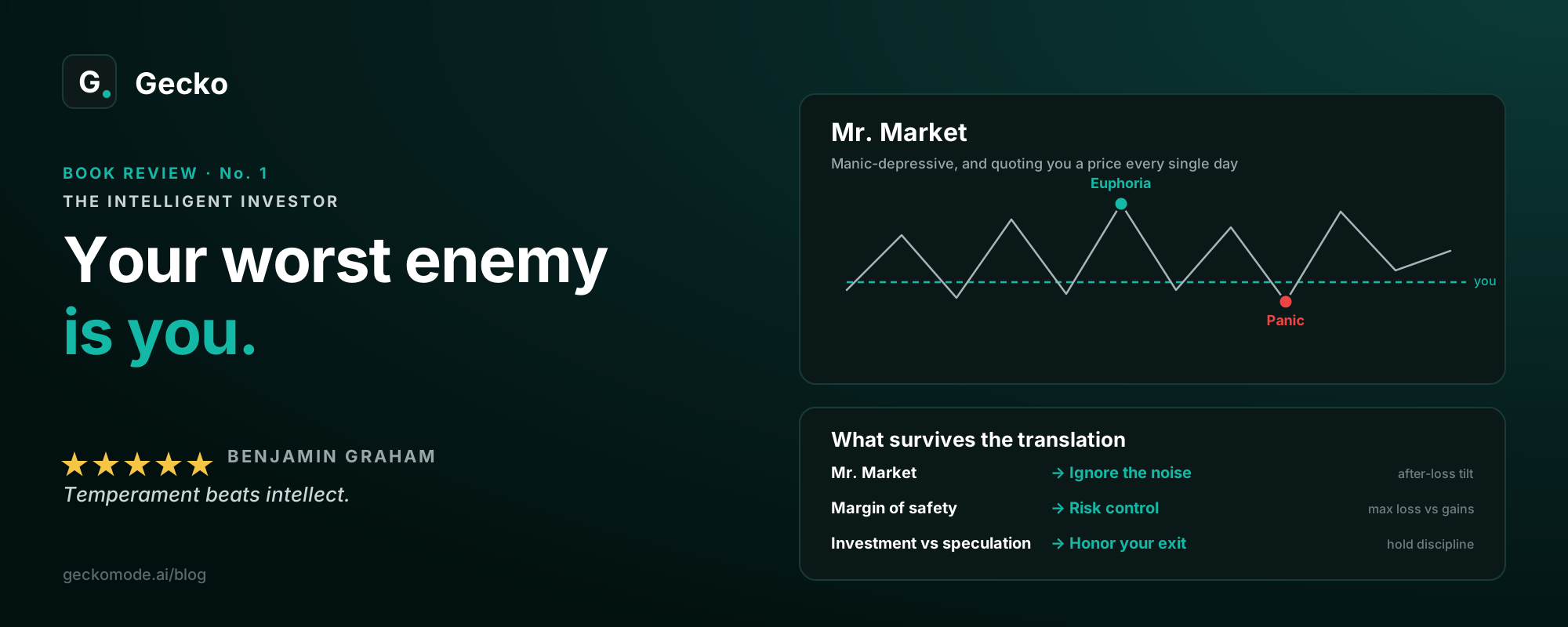
We are starting a book-review series, and there is only one honest place to begin. Ask academics and professional investors to name the most important book ever written about the stock market, and the answer comes back the same: The Intelligent Investor by Benjamin Graham. Warren Buffett, Graham’s most famous student, calls it by far the best book on investing ever written. So we read it the way a trader would, and pulled out what survives the translation.
Why a trading journal is reviewing a value-investing bible
Let us be upfront. Graham would not endorse day trading. He draws a hard line between investing and speculating, and most active trading falls on the speculative side of it. If you came for chart patterns or entry signals, this is not that book, and we will not pretend otherwise.
What makes The Intelligent Investor essential anyway is that its most important lessons are not about investing at all. They are about you, the human operating the account, and that problem does not change whether you hold for ten years or ten minutes.
“The investor’s chief problem, and even his worst enemy, is likely to be himself.”
Benjamin Graham, The Intelligent Investor
That sentence could be the epigraph for every trading psychology book written since. Graham put the enemy inside the trader decades before behavioral finance gave it academic names. The whole discipline of a behavioral trading journal is built on the same premise: the costly variable is rarely the market, it is the person reacting to it.
Mr. Market: the most useful metaphor in finance
Graham’s greatest gift to traders is a character. Imagine a business partner named Mr. Market who shows up every day and quotes you a price to buy or sell. Some days he is euphoric and names a silly high price. Other days he is despairing and offers to sell for almost nothing. He is manic, unreliable, and emotional, and here is the key: you are under no obligation to trade with him. You can let his mood pass and act only when his price genuinely suits you.
The lesson is not about valuation. It is about emotional independence. The losing trader lets Mr. Market set the mood, chasing his euphoria into late entries and catching his panic as revenge trades. The disciplined one treats those mood swings as noise to be used, not feelings to be caught. Every trader who has ever revenge traded a red candle has, for a moment, let Mr. Market run their account.
Investment versus speculation, honestly
Graham defines an investment as an operation that, on thorough analysis, promises safety of principal and an adequate return, and says everything else is speculation. He is not sneering. He simply insists you know which one you are doing, because the danger is the trader who speculates while telling himself he is investing, refusing to cut a loss because he has quietly converted a bad trade into a long-term hold.
The honest version of this discipline for an active trader is simple: define the trade and its exit before you enter, and do not let a losing position get promoted to an investment to avoid the pain of being wrong.
Margin of safety: risk control by another name
Graham called the margin of safety the central concept of investment, the three words that matter most. For him it meant buying well below intrinsic value so that errors and bad luck do not ruin you. Strip away the valuation specifics and the principle is pure risk control: leave yourself enough room that being wrong is survivable.
For a trader, the parallel is exact. Risk little enough per trade that no single loss, and no bad streak, can do lasting damage. The math that lets you keep trading is the same math Graham was teaching, dressed in different clothes.
From belief to behavior: Graham in your own data
The remarkable thing about Graham’s lessons is how measurable they become once you stop treating them as philosophy. Temperament is not a vibe. It leaves a trail in your trades.
| Graham’s idea | The fingerprint it leaves in your trade history |
|---|---|
| Do not let Mr. Market set your mood | Entries clustered after a loss or a sharp move, the signature of reacting to the market’s emotion instead of your plan. |
| Know investment from speculation | Losses held far past the stop, the tell of a trade quietly reclassified as a hold to avoid being wrong. |
| Keep a margin of safety | Max loss versus typical gain, and whether one position is ever allowed to do real damage. |
| Your worst enemy is yourself | The same costly pattern repeating across instruments and weeks, which only shows up when behavior is tracked. |
This is the case for a behavioral journal over a plain log, and it is the case Graham was making in 1949 without the data to prove it. A log records the trades. A behavioral read tells you when you let Mr. Market run the account, and what it cost. Gecko scores exactly these patterns from an uploaded statement, including after-loss tilt, max loss versus gains, and hold-time discipline, so the most respected idea in markets becomes a number you can watch in yourself.
Find out when you let Mr. Market run your account →Free to start. No credit card. No broker connection.
The verdict
Read it. Not for a trading system, because it does not contain one, but because it is the clearest statement ever written of the one problem every trader and investor shares. Skip the dated stock examples, read the chapters on Mr. Market and the margin of safety twice, and treat it as a book about temperament that happens to use markets as its subject. On that basis it earns its reputation completely, and it is the right place to begin a series about what the great market minds actually teach.
Frequently asked questions
Is The Intelligent Investor worth reading for traders?
Yes, with a caveat. Graham writes for long-term investors and is skeptical of active trading, so the techniques are not aimed at traders. But the lessons on temperament and emotional discipline apply to anyone in markets.
What is the main lesson?
That temperament beats intellect. Graham wrote that the investor’s chief problem, and even his worst enemy, is likely to be himself.
What is Mr. Market?
A metaphor for the market as a manic-depressive partner who quotes a price every day. You are free to ignore his moods and act only when his price suits you.
What is a margin of safety?
The gap between price and value that protects you from errors and bad luck. For a trader, the parallel is risking little enough per trade that being wrong is survivable.
Book review No. 1 in Gecko’s series. Quotations are drawn from Benjamin Graham, The Intelligent Investor, including the revised editions with commentary by Jason Zweig and the preface by Warren Buffett. Gecko is an educational and informational tool and is independent and not affiliated with the author, publisher, or estate. Nothing here is financial, investment, or trading advice. Trading and investing carry substantial risk of loss.
Drop in a single statement. Gecko produces a one-page Behavioral Diagnosis ranking your costliest habits in actual dollars. Free to start. No card. No broker connection.
Short notes, usually once or twice a month. Unsubscribe in one click.
No account needed. We use your email only to send Gecko blog posts, and the link at the bottom of every email opts you out in one click.
More on the blog
- The AI Debt Machine: Circular Financing, Off-Balance-Sheet Data Centers, and the Ghosts of Bubbles PastThe AI build-out has quietly shifted from cash to debt: hyperscaler bonds near $194 billion in 2026, private credit's share of AI financing up from about 9% to 34%, debt parked in off-balance-sheet vehicles, and a circular loop among Nvidia, OpenAI, Oracle and CoreWeave. What telecom, Enron and the 1920s say about it, and what a trader should actually do.
- When the Consumer BreaksHousehold debt booms have a long record of ending in slowdowns that forecasters miss. What that history says about markets, and about the most overlooked balance sheet in trading: your own.
- How Banking Crises Actually StartThe run is the last chapter, not the first. What 150 years of bank failures teach traders about reading stress, and about the mistakes made when the headlines finally arrive.