Qullamaggie (Kristjan Kullamägi): What This Modern Breakout Trader Can Teach You
Most of the legends we study traded decades ago. Kristjan Kullamägi, who trades as Qullamaggie, is doing it now, in the same markets you are, and he has given away almost the entire method for free. That combination — a current and verifiable modern record plus an open playbook — makes him one of the most useful traders alive to learn from. The lessons underneath the charts are the same ones the old masters preached, which is exactly why they are worth your time.
Key takeaways
- Qullamaggie reportedly grew a small account, by his own account a few thousand dollars, into more than $100 million in roughly a decade, after blowing up several times early on.
- He swing trades momentum breakouts in the strongest stocks, favoring episodic pivots, high tight flags, and continuation patterns.
- The edge is not the pattern, it is the behavior around it: patience, tiny risk per trade, fast exits, and trailing winners.
- His style is built on a clear lineage of trading literature, from O’Neil and Darvas to Minervini and Weinstein, all linked below.
From blowing up to a nine-figure record
Kullamägi started day trading around 2011 in his early twenties, chasing alerts and other people’s calls with, in his own telling, no real idea what he was doing. He blew up his account several times in the first couple of years. His first profitable year was reportedly 2013, and he has described being consistently profitable since. Over the following decade he grew the account into what he and widely shared accounts put at more than $100 million, primarily by swing trading momentum breakouts in US stocks.
Treat the headline number with the skepticism any self-reported return deserves, and remember it spans some of the most favorable momentum conditions in market history. The lesson worth taking is not the figure. It is the shape of the journey: a trader who failed repeatedly, then became consistent only after he narrowed his method and tightened his discipline. The turning point was behavioral, not a secret indicator.
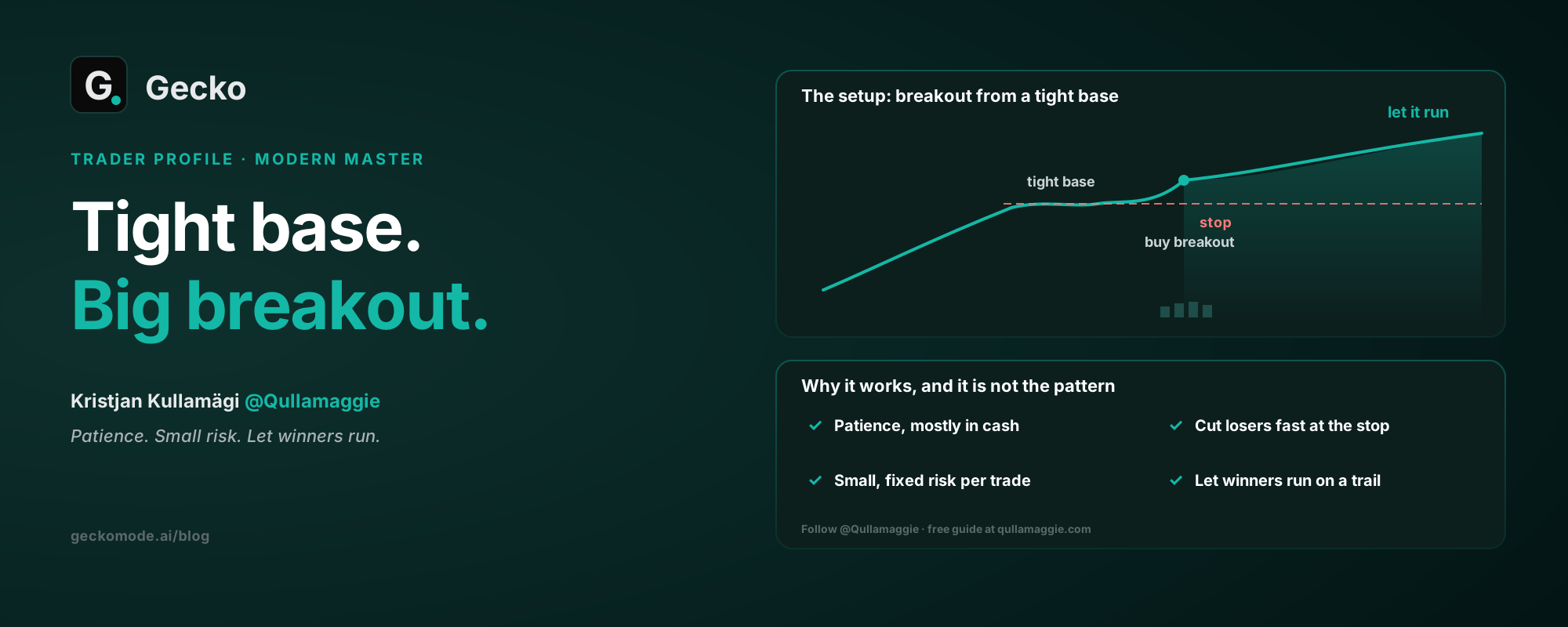
The strategy is simple. Buy strong stocks breaking out of tight ranges, risk a little, cut losers fast, and let the winners run. Simple is not the same as easy.
A summary of Qullamaggie’s repeatedly stated approach, from his interviews and public material.
The method: breakouts and episodic pivots
Qullamaggie is a swing trader, holding positions for days to weeks, and he concentrates on a small set of momentum setups rather than trying to trade everything. Three show up most often.
Episodic pivots
An episodic pivot is a stock launched by a fresh catalyst — an earnings surprise, an upgrade, or major news — that gaps up hard, often 10% or more, on heavy volume. The catalyst marks a change in the company’s story, and Qullamaggie trades the continuation of that move rather than predicting it in advance. He has said in recent years that episodic pivots are the setup he leans on most, because the edge is clear and the entry is defined. The idea traces back to Pradeep Bonde, known as Stockbee, whom Kullamägi credits as an influence.
High tight flags and continuation patterns
After a powerful run, a strong stock often pauses and consolidates in a tight, shallow range. That contraction is supply drying up. When price breaks out of the range on volume, the move can resume with force. Qullamaggie enters on the breakout from the tight base, which gives him a precise level to be wrong against, and that precise risk point is the whole game.
The behavioral engine underneath
Strip away the chart vocabulary and Qullamaggie’s edge is a set of behaviors that would sound familiar to Livermore, Seykota, or Paul Tudor Jones. The patterns are just the delivery mechanism.
Patience, and a lot of cash
He has been blunt that most of the time the right move is to do nothing. He waits for his specific setups in the strongest names and sits in cash when they are not there. For a retail trader wired to be in the market constantly, this is the hardest habit on the list, and it is the one that protects the account during chop.
Tiny risk per trade
Qullamaggie sizes positions off a small, fixed risk, placing his stop just below the breakout level and sizing so that being wrong costs a modest, survivable amount. This is the same defense-first principle Paul Tudor Jones preaches, applied with a mechanical stop. It is why blowing up stopped happening once he adopted it. Our free risk calculator does the math in seconds.
Cut losers fast, trail winners
If a breakout fails, he is out quickly at his predefined level, no negotiating. If it works, he does the opposite of most traders: he holds, trailing the position with moving averages and letting a winner run far beyond where the urge to take profit appears. Small losses, occasional large gains. That is the positive asymmetry every great trader chases, and it is the exact opposite of the loss-aversion trap that makes most traders cut winners and hold losers.
Relentless review
He is known for studying charts for hours, going back through the biggest winners in market history to internalize what they looked like before they ran. The work is the edge. The setups are simple to describe and hard to execute, and the only way to execute them is to have seen thousands of them.
Trade like Qullamaggie? Read this first
Two honest cautions. First, survivorship: for every trader who compounded a small account into a fortune with aggressive breakouts, many more blew up trying, and you mostly hear about the one who made it. Second, conditions: his biggest gains came in strong momentum and bull phases, and breakout strategies struggle in choppy, mean-reverting markets. The transferable part is not the promise of his returns. It is his risk discipline and patience, which protect you in any regime.
From belief to behavior: measuring it in your own data
What makes Qullamaggie a perfect case study for a behavioral journal is that his entire edge is behavioral, and behavior leaves a trail. You can hold your own trading up against his principles with numbers, not vibes.
| Qullamaggie principle | The fingerprint it leaves in your trade history |
|---|---|
| Patience, mostly in cash | Trade frequency, and whether you trade when your setup is absent. Overtrading in dead conditions is the tell. |
| Tiny, fixed risk per trade | The spread in your position sizing and your largest losses versus your typical one. |
| Cut losers fast | Losses that run past your planned stop, the sign of negotiating with a losing trade. |
| Let winners run | Average winner versus average loser. Winners cut short means you are not trailing. |
| Trade only the best setups | Outcome differences between your A-grade setups and your impulse trades, visible only when tagged and tracked. |
This is the case for a behavioral journal over a plain log. A log records the trades. A behavioral read tells you where your execution drifts from the discipline that makes a method like this work, and what the drift costs. Gecko scores exactly these patterns from an uploaded statement — including overtrading, after-loss tilt, size discipline, and the ratio of your average win to your average loss — so the habits behind a modern master become numbers you can hold yourself to.
The literature behind his style
Qullamaggie did not invent breakout trading. He stands on a well-documented lineage, and he points to it openly. If you want to understand the why beneath his setups, this is the reading that supports the style, roughly in order of how foundational it is.
How to Make Money in Stocks — William J. O’Neil
The CAN SLIM method and the founding text of modern momentum and breakout trading. Why it matters: defines the high-quality, high-growth leaders and the base-breakout entries Qullamaggie hunts.
How I Made $2,000,000 in the Stock Market — Nicolas Darvas
The original box theory, written by a dancer who traded by mail in the 1950s. Why it matters: the box is a tight consolidation, and the breakout from it is the same structural idea, decades early.
Secrets for Profiting in Bull and Bear Markets — Stan Weinstein
Stage analysis: the four phases a stock cycles through. Why it matters: it teaches you to buy only in the advancing stage, which is where Qullamaggie’s breakouts live.
Trade Like a Stock Market Wizard and Think & Trade Like a Champion — Mark Minervini
The SEPA method and the discipline of a two-time US Investing Champion. Why it matters: modern, precise rules for entries, risk, and the psychology of following them.
Momentum Masters — Minervini, Ryan, Zanger & Ritchie II
A roundtable of elite momentum traders answering the same questions. Why it matters: shows how top breakout traders handle risk, exits, and drawdowns in their own words.
Trade Like an O’Neil Disciple — Gil Morales & Chris Kacher
A practitioner’s deep dive into applying O’Neil’s system. Why it matters: the nuts and bolts of pivot points and selling rules that underpin the approach.
Reminiscences of a Stock Operator — Edwin Lefevre
The timeless account of Jesse Livermore, and the patience and discipline at the root of all of this. Why it matters: read our full breakdown of Reminiscences for the behavioral foundation.
One more source worth naming is not a book. The episodic pivot itself comes from Pradeep Bonde, who writes as Stockbee, whose work on momentum bursts Qullamaggie credits directly.
Additional resources: where to follow him
Follow and learn from Qullamaggie
- X (Twitter): @Qullamaggie, his main account, where he posts ideas and commentary. Beware of lookalike impostor handles.
- Website: qullamaggie.com, which hosts his free written guide to the setups, entries, and risk rules.
- YouTube and past streams: his channel and archived Twitch sessions walk through real trades and screening.
- His own reading list: the must-read list he publishes, which informed the literature section above.
- Interviews: his appearances on trading podcasts such as Chat With Traders are a strong primer, and he has been noted as featuring in a forthcoming Market Wizards book.
Find out if you trade with his discipline
Patience, small risk, fast exits, and running winners are measurable. Upload a broker statement and Gecko names where your execution drifts, in dollars, and scores it across twelve behavioral axes. No login or broker connection needed, and your first 100 trades are analyzed free.
Read your trades free →An educational tool, not financial advice.
Frequently asked questions
Who is Qullamaggie?
The online name of Kristjan Kullamägi, a Swedish momentum swing trader who began in 2011 and reportedly grew a small account into more than $100 million, known for trading breakouts and episodic pivots and sharing his method publicly.
What is his trading strategy?
Swing trading momentum breakouts in the strongest stocks, using episodic pivots, high tight flags, and continuation patterns, with small fixed risk, fast exits, and moving-average trailing on winners.
What is an episodic pivot?
A large move driven by a fresh catalyst like earnings or news, often a gap of 10% or more on heavy volume. He trades the continuation and has said it is his most-used setup.
What books influenced him?
O’Neil’s How to Make Money in Stocks, Darvas, Weinstein’s stage analysis, Minervini’s work, and the episodic pivot from Pradeep Bonde (Stockbee), among the titles in the reading list above.
Where can I follow Qullamaggie?
On X at @Qullamaggie and on his website qullamaggie.com, which hosts his free guide. Watch for impostor accounts.
This article is part of Gecko’s trading psychology series. Biographical details, return figures, and method descriptions are drawn from Kristjan Kullamägi’s public interviews, streams, website, and widely shared accounts as of June 2026, and self-reported figures should be treated with appropriate skepticism. Gecko is an educational and informational tool and is independent and not affiliated with, endorsed by, or sponsored by Mr. Kullamägi. Nothing here is financial, investment, or trading advice. Trading carries substantial risk of loss.
Drop in a single statement. Gecko produces a one-page Behavioral Diagnosis ranking your costliest habits in actual dollars. Free to start. No card. No broker connection.
Short notes, usually once or twice a month. Unsubscribe in one click.
No account needed. We use your email only to send Gecko blog posts, and the link at the bottom of every email opts you out in one click.
More on the blog
- The AI Debt Machine: Circular Financing, Off-Balance-Sheet Data Centers, and the Ghosts of Bubbles PastThe AI build-out has quietly shifted from cash to debt: hyperscaler bonds near $194 billion in 2026, private credit's share of AI financing up from about 9% to 34%, debt parked in off-balance-sheet vehicles, and a circular loop among Nvidia, OpenAI, Oracle and CoreWeave. What telecom, Enron and the 1920s say about it, and what a trader should actually do.
- When the Consumer BreaksHousehold debt booms have a long record of ending in slowdowns that forecasters miss. What that history says about markets, and about the most overlooked balance sheet in trading: your own.
- How Banking Crises Actually StartThe run is the last chapter, not the first. What 150 years of bank failures teach traders about reading stress, and about the mistakes made when the headlines finally arrive.