Fooled by Randomness by Nassim Nicholas Taleb: How to Tell Skill From Luck in Your Own Trading
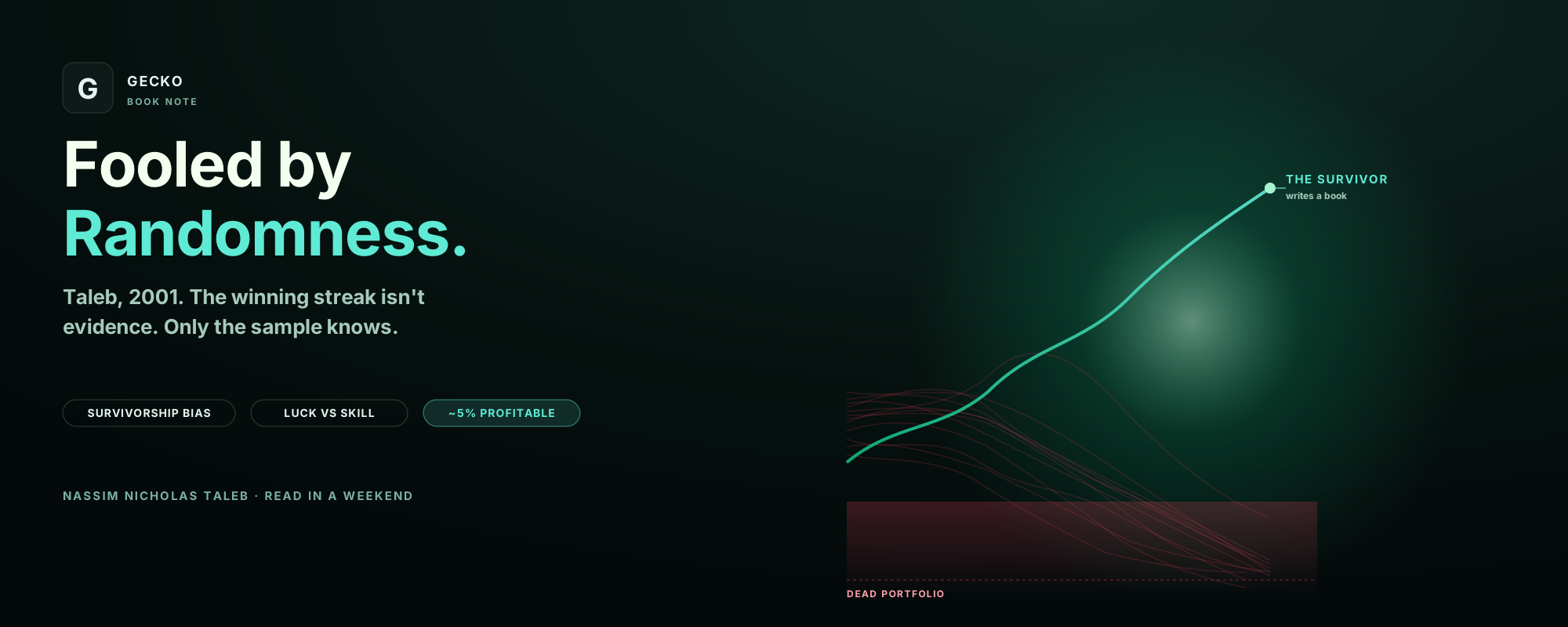
There is a thought experiment near the heart of Fooled by Randomness that ought to be printed on the login screen of every brokerage. Take a large population of traders. Give them no skill whatsoever — none, zero, coin flips. Let them trade. After a few years, some of them will have run of five, six, seven straight winning periods. They will appear on podcasts. They will be described as having a philosophy. They will believe it themselves, and they will explain, articulately and sincerely, exactly what they do differently.
They will be wrong. And the terrible thing — the thing that makes Taleb’s 2001 classic still the most uncomfortable book on any trader’s shelf — is that from the inside, a lucky streak and an edge feel precisely the same.
Key takeaways
- Taleb’s core claim: a population of entirely unskilled traders will still produce a few dazzling track records, purely through volatility and survivorship.
- Which means your own winning streak is not evidence of anything. Mild success can be skill; spectacular success is usually variance.
- The account-level data agrees. In Taiwan, only about 5% of day traders were consistently profitable — and losers came back the next year at nearly the same rate as winners.
- The trap in the book is the lazy reading: “it’s all luck, so why bother measuring?” The right conclusion is the opposite — randomness is exactly why you need a bigger sample and honest records.
The argument: survivorship is not evidence
Taleb’s book is not really about markets. It’s about the human inability to reason under uncertainty, with markets as the cruellest available laboratory. Its central mechanism is survivorship bias: we admire the winners because the winners are the only ones we can see. The thousands who used the same method, took the same risks, and were quietly wiped out do not write books, do not get interviewed, and do not appear in your feed. The graveyard is silent, so the sample you learn from is rigged before you open your eyes.
From this follows the line that should genuinely alarm anyone with a good year behind them: even if the expected return across an entire population of managers is negative, volatility alone guarantees that some of them will post magnificent records. Not “might.” Will. The existence of a great track record is therefore weak evidence of skill until you know how many people were playing and for how long.
Taleb’s second blade is asymmetry. He is merciless about strategies that produce small, steady, comforting gains while quietly accumulating a catastrophic tail — the trader picking up pennies in front of a steamroller, who looks like a genius for four years and then ceases to exist in an afternoon. A smooth equity curve is not proof of safety. Sometimes it is the symptom of a risk you haven’t been paid to take yet.
Mild success can be explained by skill and hard work. Wild success is usually explained by variance. The trader’s problem is that both feel like insight from the inside.
The data Taleb didn’t have
When Fooled by Randomness appeared in 2001, its argument was mostly philosophical — a probabilist’s intuition, argued with anecdote and a certain amount of Mediterranean contempt. What has happened since is that the empirical literature has gone and proved him right with account-level records.
The most devastating evidence comes from Brad Barber, Yi-Tsung Lee, Yu-Jane Liu and Terrance Odean, who obtained comprehensive Taiwan Stock Exchange data covering the entire day-trading population across more than a decade. Their findings read like an appendix Taleb forgot to write. Consistently profitable day traders were roughly 5 percent of the active population. More than eight in ten lost money in a typical semiannual period. The average day trader lost about 23.9 basis points per day net of fees. Survival rates collapsed with time: around 44 percent were still trading after a year, 24 percent after two, 15 percent after three.
But the single most Talebian statistic in the whole study is this one. Profitable day traders returned to trade in the following twelve months about 96 percent of the time. Unprofitable day traders returned about 95 percent of the time. The losers came back at essentially the same rate as the winners — which means that, in aggregate, traders cannot tell which group they are in. That is not a moral failing. It is exactly the epistemological blindness Taleb spent a whole book describing. The noise is loud enough to hide the signal from the person generating it.
Where the book fails you
An honest review has to say that Fooled by Randomness is a better diagnosis than it is a book. Taleb is repetitive, digressive, and enormously pleased with himself; his imaginary foils are strawmen; and the tone that reads as bracing at thirty pages reads as smug at three hundred. If you want a method, this is not where you will find one. He tells you the water is full of sharks and declines to teach you to swim.
More dangerous is the lazy reading the book invites, and which you will find all over trading forums: it’s all randomness, so measurement is pointless, so I may as well trust my gut. This is precisely backwards, and it is worth being blunt about. Randomness is not an argument against keeping records. Randomness is the entire reason records are necessary. If outcomes were deterministic, you could learn from three trades. Because outcomes are noisy, you need many, sorted carefully, before any signal appears. Taleb’s own conclusion is not “stop trying to know things.” It is “stop believing you know things on a sample of five.”
What a serious trader does with this
The practical inheritance from Taleb is a set of habits that feel unnatural and are worth adopting anyway.
Judge the process, not the outcome. A profitable trade taken outside your rules is a bad trade that happened to pay, and treating it as validation is how a discipline dies. Demand a sample before you believe anything: a setup that has worked six times has told you almost nothing, and the confidence you feel after those six is the exact feeling the Taiwanese losers had. Distrust your smoothest strategy most, because the absence of visible pain may simply mean the tail hasn’t arrived. And separate luck from skill the only way anyone can — by measuring specific, repeatable categories of trade over enough occurrences that chance starts to wash out.
This is also the deep link to Daljit Dhaliwal’s method. He didn’t decide his edge was event-driven trading because it felt right; he decided it because he categorized his own trades and the record said so. That is the Taleb-proof way to find out what you’re good at: not by asking how you feel about your trading, but by asking your trading what it has actually done, across a sample large enough to mean something.
From belief to behavior: is it edge, or is it noise?
Every idea in the book converts into a question you can put to your own trade history — and each one has a fingerprint.
| Taleb’s idea | The fingerprint it leaves in your trade history |
|---|---|
Luck mistaken for skill | Size rising after a hot streak, then reverting — the classic size discipline break that turns a run of luck into a real loss. |
Sample too small to know anything | Strategy hopping: a method abandoned after five losers, adopted after five winners. No category ever accumulates enough trades to be judged. |
The hidden tail | A smooth curve punctuated by one enormous loss — a worst-loss-to-typical-win ratio that quietly undoes a quarter. |
Outcome bias | Rule-breaking trades that made money and were therefore never reviewed; the leak that hides inside a green day. |
Taleb’s whole point is that you can’t tell from the inside. Upload a broker statement and Gecko sorts your trades by category and scores your overtrading, tilt, and sizing in dollars across twelve behavioral axes — so you can see which setups actually carry the account and which just got lucky. No login or broker connection needed, first 100 trades free.
An educational tool, not financial advice.
Resources and further reading
- The book: Taleb, N. N. (2001), Fooled by Randomness: The Hidden Role of Chance in Life and in the Markets — survivorship bias, the luck/skill confusion, and asymmetric tails.
- The day-trading evidence: Barber, B., Lee, Y.-T., Liu, Y.-J. & Odean, T., “The Cross-Section of Speculator Skill: Evidence from Day Trading” and the related Taiwan studies — approximately 5% consistently profitable, average net daily loss of ~23.9 bps, and near-identical return rates for winners and losers.
- The turnover evidence: Barber & Odean (2000), “Trading Is Hazardous to Your Wealth,” Journal of Finance — the most active traders underperformed by roughly 6.5 points a year.
- The companion volume: Taleb’s The Black Swan (2007), for the fuller treatment of rare, high-impact events.
- The counter-practice: Gecko, Daljit Dhaliwal — a Market Wizard who found his edge by categorizing his own record rather than trusting a streak.
Frequently asked questions
Taleb’s 2001 classic argues we systematically mistake luck for skill, survivorship for evidence, and random outcomes for patterns. Its central claim for traders: a population of entirely unskilled traders will still produce a few spectacular track records by chance alone — and those survivors will be celebrated as geniuses, including by themselves.
Drawing conclusions from the winners you can see while the losers stay invisible. You read interviews with traders who made it and never meet the thousands who used similar methods and blew up. With enough participants and enough volatility, impressive records appear by chance even when the population’s expected return is negative.
Not from a winning streak, which proves almost nothing. It takes a large sample, a consistent process, and measurement across categories of trade rather than a glance at the P&L. The test is whether a specific, repeatable setup shows positive expectancy over many occurrences — and whether your risk stays stable instead of escalating after wins.
No. Barber, Lee, Liu and Odean’s Taiwan research found roughly 5% of day traders were consistently profitable, more than eight in ten lost money in a typical semiannual period, and the average day trader lost about 23.9 bps per day net of fees. Tellingly, unprofitable traders returned the next year at nearly the same rate as profitable ones — they couldn’t tell the difference.
Book note in Gecko’s trading psychology series. Ideas and arguments are drawn from Nassim Nicholas Taleb’s Fooled by Randomness (2001); empirical figures are from the Taiwan day-trading research of Barber, Lee, Liu and Odean and from Barber & Odean (2000), and are approximate and specific to the periods and markets studied. Gecko has no affiliation with the author or publisher. Gecko is an educational and informational tool. Nothing here is financial, investment, or trading advice. Trading carries substantial risk of loss.
Drop in a single statement. Gecko produces a one-page Behavioral Diagnosis ranking your costliest habits in actual dollars. Free to start. No card. No broker connection.
Short notes, usually once or twice a month. Unsubscribe in one click.
No account needed. We use your email only to send Gecko blog posts, and the link at the bottom of every email opts you out in one click.
More on the blog
- The AI Debt Machine: Circular Financing, Off-Balance-Sheet Data Centers, and the Ghosts of Bubbles PastThe AI build-out has quietly shifted from cash to debt: hyperscaler bonds near $194 billion in 2026, private credit's share of AI financing up from about 9% to 34%, debt parked in off-balance-sheet vehicles, and a circular loop among Nvidia, OpenAI, Oracle and CoreWeave. What telecom, Enron and the 1920s say about it, and what a trader should actually do.
- When the Consumer BreaksHousehold debt booms have a long record of ending in slowdowns that forecasters miss. What that history says about markets, and about the most overlooked balance sheet in trading: your own.
- How Banking Crises Actually StartThe run is the last chapter, not the first. What 150 years of bank failures teach traders about reading stress, and about the mistakes made when the headlines finally arrive.