Can AI Make You a Profitable Trader? The One Thing It Can't Fix
There is a version of the AI trading pitch that is genuinely true, and it is the reason the pitch works. Machines really are better than humans at parts of this. They can read a thousand filings before you finish your coffee, backtest a rule across forty years in a second, and never get bored, never get scared, never fall in love with a position. If trading were a knowledge test, the machines would already have won it.
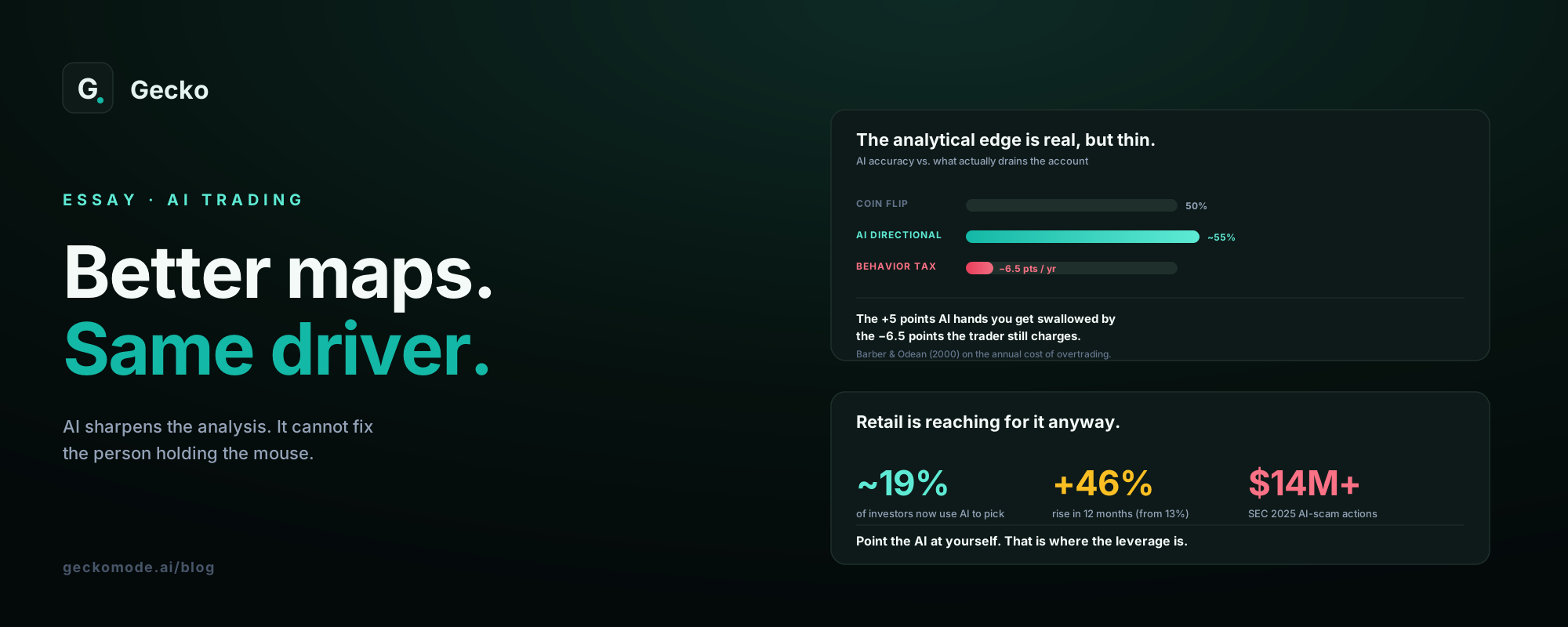
So retail traders are doing the rational thing and reaching for the tool. In a 2025 survey of 11,000 investors across thirteen countries, the share using AI tools like ChatGPT or Gemini to pick or alter their holdings jumped to roughly 19 percent, up from 13 percent a year before — a 46 percent rise in twelve months, and higher still in the United States. The instinct is understandable. It is also aimed at the wrong problem.
Key takeaways
- AI adoption among retail investors rose to about 19 percent globally in 2025 (roughly 30 percent in the US), driven mostly by millennials.
- The analytical edge AI provides is real but thin: mid-50s percent directional accuracy, and no reliable market-beating returns from general chatbots.
- The edge retail traders were actually missing is behavioral, and decades of research — from Barber and Odean onward — say behavior, not analysis, is what drains most accounts.
- Outsourcing decisions to AI tends to increase turnover and overconfidence, the two behaviors most reliably linked to lower net returns.
- The one thing AI cannot fix is the person holding the mouse — and that person was the problem all along.
What AI is genuinely good at (and it's a lot)
Start with the honest case, because it is strong. Modern models are extraordinary at the mechanical layer of trading. They summarize earnings calls, tag sentiment across a newswire, surface correlations, and run a defined backtest without the fatigue or wishful thinking that corrupts a human doing the same work at 11 p.m. For a disciplined professional with clean data and real execution, machine learning is not hype; it is the job. This is the world of the quant funds, where an operation like Virtu Financial famously reported something close to a single losing day across more than a thousand trading sessions. That is what a real algorithmic edge looks like.
But notice what that edge is built on: proprietary data, co-located servers, execution measured in microseconds, risk limits enforced by code, and teams of PhDs whose entire job is to stop the system from doing anything stupid. The retail trader typing "should I buy NVDA today" into a chatbot is not buying a slice of that. They are buying the confidence of it without any of the machinery underneath.
The analytical edge is real but thin
Strip away the marketing and look at what the models actually deliver on price. Academic research puts the best AI next-day direction calls somewhere in the mid-50s percent — better than a coin flip, and genuinely profitable, but only in the hands of someone with strict risk control and position sizing. Studies of ChatGPT as a stock picker reach a blunter conclusion: it can be a serviceable research assistant, but it does not reliably generate abnormal returns, and it will cheerfully hallucinate data inside a backtest if you let it. The mid-50s number is not a licence to print money. It is a razor-thin statistical edge that survives only if the person applying it behaves perfectly — which is precisely the thing retail traders do not do.
The market never charged retail traders much for bad analysis. It charged them for bad behavior — and AI doesn't discount that bill.
The edge you were missing was never analysis
Here is the uncomfortable part. For the vast majority of retail traders who lose, the cause of death was never a bad view of the market. It was what they did around the view. They sized too big on conviction and blew a month in a day. They held losers past the stop hoping to get back to even. They cut winners early to lock in the feeling of a win. They revenge-traded after a loss and overtraded out of boredom. None of that is an analysis problem, and so none of it is a problem AI solves by giving you a better analysis.
The research on this is old and unusually settled. In their landmark study of tens of thousands of brokerage accounts, Barber and Odean found that the most active traders underperformed the market by roughly 6.5 percentage points a year — not because their stock picks were worse, but because they traded, driven by overconfidence. Their follow-up work showed the effect was strongest exactly where overconfidence runs highest. The number that should stop an AI-curious trader cold is that one: the cost of behavior, measured in points per year, dwarfs the mid-50s directional edge any model is going to hand them. You can bolt a state-of-the-art analytical engine onto a trader who oversizes and tilts, and you will get a slightly better-informed version of the same losing account.
Buying AI is itself a new behavioral trap
It gets worse than "AI doesn't help." For a lot of traders, reaching for AI actively makes the behavioral problem larger, because the tool is shaped to exploit the same wiring that already costs them money.
It outsources conviction
When the trade idea comes from a confident-sounding model instead of your own process, you lose the one thing that lets you manage a position sanely: a reason. A trade you cannot explain in your own words is a trade you cannot hold through noise or exit on a plan. "The AI said so" is not a thesis; it is a way to enter positions you have no framework to manage.
It multiplies action
An AI screen or signal service never runs out of ideas. There is always another setup, another alert, another ticker lighting up. That is a feature the vendor sells and a bug your account pays for, because it feeds straight into overtrading — the exact behavior Barber and Odean priced at 6.5 points a year. More signals do not mean more edge. They mean more trades, and for most people more trades mean lower returns.
It flatters overconfidence
Pairing your own hunch with a machine's blessing produces a feeling of near-certainty that neither had alone. Psychologists call this the illusion of validity, and it is rocket fuel for overconfidence bias. The trader sizes up on the "high-confidence" AI call, the black box is right often enough to reinforce the habit, and the eventual large loss on a confident call erases a long run of small correct ones.
It opens a brand-new door for fraud
The gap between what AI can do and what people believe it can do is a fraud engine. In a joint alert, the SEC, FINRA, and NASAA warned that bad actors are exploiting the AI boom, and that any pitch promising large or guaranteed returns from a proprietary AI algorithm is a classic red flag. This is not theoretical: in 2025 the SEC charged operators of purported crypto platforms and "investment clubs" that lured victims with AI-generated trading tips and took more than $14 million. The more mysterious and impressive the AI sounds, the less you can verify it, which is exactly the environment a scam wants.
An honest caveat, because this is not a claim that AI is useless or that everyone selling it is a fraud. Genuine quant strategies work, disciplined traders use models well, and AI is a superb research and journaling assistant. The trap is specific and it is retail-shaped: the trader who reaches for AI hoping it will supply the discipline they don't have, and instead gets a faster, more confident, more expensive version of the behavior that was already the problem.
The one thing AI can't fix
Every capability in the honest case above lives on the strategy side of the ledger: better analysis, faster backtests, cheaper research. But the account was rarely lost on the strategy side. It was lost in the two seconds between the plan and the click — the moment the trader sized up because they felt sure, or re-entered because they were angry, or held the loser because selling would make it real. AI can hand you a better map. It cannot make you stop trading against it. The gap between knowing and doing is the whole game, and it sits inside the trader, where no model reaches.
From belief to behavior: point the AI at yourself
There is a place where machine analysis genuinely helps a retail trader, and it is the mirror, not the crystal ball. Every habit that actually drains the account leaves a clean, measurable fingerprint in your own trade history. Instead of asking AI what to buy, ask it what you keep doing.
Is the AI helping you, or just helping you trade more?
Upload a broker statement and Gecko scores your overtrading, tilt, and sizing in dollars, across twelve behavioral axes — so you can see whether any tool is actually improving your account or just adding action. No login or broker connection needed, and your first 100 trades are analyzed free.
An educational tool, not financial advice.
Resources and further reading
- Adoption: eToro / Opinium 2025 Retail Investor Beat survey (11,000 investors across 13 countries) on the rise in AI-tool usage for stock selection.
- The behavioral cost: Barber & Odean (2000), "Trading Is Hazardous to Your Wealth," and Barber & Odean (2001), "Boys Will Be Boys," on overconfidence and overtrading.
- AI stock-picking limits: research on ChatGPT and abnormal returns, and on the mid-50s directional accuracy of machine-learning next-day predictions.
- Fraud warning: the joint SEC / FINRA / NASAA investor alert on AI and investment fraud, and the SEC's 2025 enforcement actions against AI-branded crypto schemes.
- What a real algo edge requires: background on high-frequency operations such as Virtu Financial's near-perfect trading record and the infrastructure behind it.
Frequently asked questions
Can AI make you a profitable trader?
It can improve the analysis, but research shows AI models call next-day direction only in the mid-50s percent and general chatbots do not reliably beat the market. For most retail traders the binding constraint was behavior — sizing, tilt, overtrading, cutting winners short — which AI does not fix, so it rarely turns a losing trader into a profitable one on its own.
Do AI trading bots actually work?
Genuine quant systems work, but they rely on data, execution, and discipline retail buyers don't have, and many "AI bots" are simple scripts with a label. Regulators warn that promises of guaranteed AI returns are a common fraud red flag. A bot is only as disciplined as the person who lets it run.
Is it safe to use ChatGPT to pick stocks?
It's a useful research assistant, but it does not reliably produce market-beating returns and can hallucinate data in backtests. The bigger risk is behavioral: outsourcing conviction tends to raise your trading frequency and overconfidence, both linked to lower net returns. Use it to support a written process, not to generate signals.
What can AI actually help a trader with?
The mechanical, repeatable parts: summarizing filings and news, scanning for setups, backtesting a defined rule, and — most usefully — measuring your own behavior in your trade history so you can see which habits cost the most. The leverage is in diagnosing the trader, not generating the next tip.
Essay in Gecko's trading psychology series. Adoption figures, research findings, and enforcement examples are drawn from the eToro/Opinium 2025 survey, academic and industry research, and SEC/FINRA/NASAA materials as of July 2026, and may change; verify current figures at the source. Gecko is an educational and informational tool. Nothing here is financial, investment, or trading advice, and nothing here is a recommendation for or against using any AI tool, bot, or trading strategy. Trading carries substantial risk of loss.
Drop in a single statement. Gecko produces a one-page Behavioral Diagnosis ranking your costliest habits in actual dollars. Free to start. No card. No broker connection.
Short notes, usually once or twice a month. Unsubscribe in one click.
No account needed. We use your email only to send Gecko blog posts, and the link at the bottom of every email opts you out in one click.
More on the blog
- The AI Debt Machine: Circular Financing, Off-Balance-Sheet Data Centers, and the Ghosts of Bubbles PastThe AI build-out has quietly shifted from cash to debt: hyperscaler bonds near $194 billion in 2026, private credit's share of AI financing up from about 9% to 34%, debt parked in off-balance-sheet vehicles, and a circular loop among Nvidia, OpenAI, Oracle and CoreWeave. What telecom, Enron and the 1920s say about it, and what a trader should actually do.
- When the Consumer BreaksHousehold debt booms have a long record of ending in slowdowns that forecasters miss. What that history says about markets, and about the most overlooked balance sheet in trading: your own.
- How Banking Crises Actually StartThe run is the last chapter, not the first. What 150 years of bank failures teach traders about reading stress, and about the mistakes made when the headlines finally arrive.