0DTE Options: The Most Popular Trade in the Market Is a Behavioral Trap
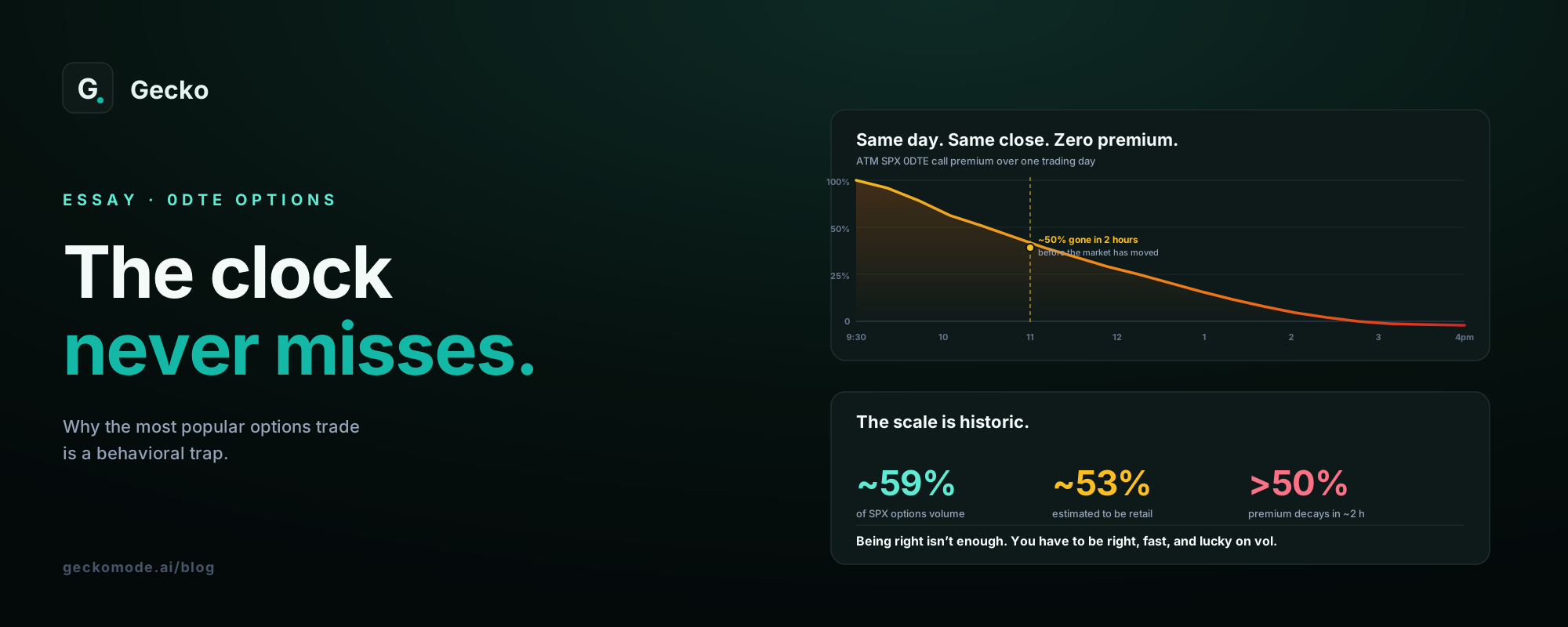
Something remarkable happened in the options market. The single most traded contract type is now an option that expires the same day it is bought. Zero days to expiration, 0DTE, has gone from a niche to the majority of all S&P 500 options volume in about three years, and retail traders are more than half of it. The instrument is real, liquid, and useful for some. It is also, for most of the people flooding into it, a nearly perfect behavioral trap, and understanding why is a masterclass in how markets separate people from their money.
Key takeaways
- 0DTE options are now roughly 59 percent of SPX options volume, a record above 62 percent in August 2025, with retail estimated at more than half.
- Research indicates retail buyers lose money on average, even before costs, because theta decay is a relentless headwind.
- The deeper problem is behavioral: 0DTE is engineered like a lottery and a slot machine, rewarding the exact impulses that ruin traders.
- You can be completely right on direction and still lose, which is what makes it a trap rather than merely a risky trade.
What a 0DTE option actually is
An option gives you the right to buy or sell at a set price by a set date. A 0DTE option is one where that date is today. On the S&P 500 and other major indexes, exchanges now list expirations every single trading day, so you can buy a call at 10 a.m. that is worthless or golden by the 4 p.m. close. Because there is almost no time left, these options are cheap, extremely sensitive to small moves, and completely binary by the end of the session. That combination, cheap and explosive, is exactly what makes them so attractive and so dangerous.
The scale is genuinely historic
This is not a fringe corner of the market. By 2025, Cboe data put 0DTE at roughly 59 percent of total SPX options volume, averaging around 2.3 million contracts a day, and August 2025 set a record above 62 percent. Retail traders were estimated at more than half of that flow. In roughly three years since daily index expirations became widespread, the same-day option went from novelty to the dominant instrument in the most important options market in the world. Whatever else you think of it, the demand is real and it is overwhelmingly a retail phenomenon.
The math is quietly against the buyer
Here is the mechanic that makes 0DTE a trap rather than just a gamble. When you buy an option, time decay, called theta, works against you every minute you hold it, and on a 0DTE option that decay is brutal. An at-the-money SPX 0DTE option can shed more than half of its premium in the first couple of hours purely from time passing, before the market has moved at all. This is why research finds that retail traders lose money on average buying long 0DTE options, even before trading costs. You can predict the direction of the market correctly and still watch your position evaporate, because the clock took your money before the move arrived, or because implied volatility fell faster than the index moved. Being right is not enough. You have to be right, and fast, and lucky on volatility, all at once.
In most trades, the market is your opponent. In a 0DTE option you buy, the clock is your opponent too, and it never misses.
Why it is a behavioral trap, not just a bad trade
Plenty of trades have poor odds. What makes 0DTE special is that it packages every known behavioral weakness into one product. It is not that traders are dumb. It is that the instrument is shaped to exploit exactly how the human mind misfires around risk.
It is a lottery ticket, and we are wired for lotteries
Behavioral research has long shown that investors overpay for lottery-like payoffs, a small chance of a huge win, and systematically lose money doing it. A cheap 0DTE call that could go up ten times by the close is the purest lottery ticket the market has ever offered, priced in dollars and delivered in hours. The same preference that makes people buy lottery tickets with negative expected value makes them buy 0DTE options, and the outcome is mathematically similar.
It is a slot machine, and speed is the addiction
Slot machines are engineered around fast, variable rewards, because rapid feedback and intermittent wins are what make a behavior compulsive. A 0DTE option resolves in hours, sometimes minutes, delivering exactly that loop: quick action, a jolt of hope, a fast result, and the immediate chance to do it again. This is the mechanism behind action bias and overtrading, and the research that active trading lowers returns applies with special force to an instrument built for constant action.
It supercharges tilt and chasing
Because each ticket is cheap and each round is fast, a loss can be avenged within minutes by simply buying the next one. The speed and low cost that make 0DTE feel harmless are precisely what turn a single bad trade into a spiral. After-loss tilt, the urge to win it back immediately, normally plays out over a session. In 0DTE it plays out over a coffee break, and you can take twenty shots at it in an afternoon.
It flatters overconfidence
When a 0DTE bet hits, the payoff is enormous and immediate, and the mind records it as skill. The illusion of control and the recency of a big win convince the trader that they have found an edge, right up until the far more numerous losses quietly outweigh the occasional jackpot. See overconfidence bias for the underlying research. The wins are loud and memorable. The steady bleed is silent.
An honest caveat: 0DTE options are not inherently evil, and this is not a claim that everyone loses. Institutions use them to hedge precisely dated risk, defined-risk spreads cap the downside, and disciplined premium sellers can profit from the very decay that punishes buyers, though selling carries its own tail risk of a sudden move wiping out many small gains at once. The trap is specific: the retail trader buying cheap same-day options for the thrill and the lottery payoff. That is who the instrument is quietly built to harvest.
The real danger: it compresses a career of mistakes into an afternoon
A normal trader might take years to learn their behavioral lessons, one painful drawdown at a time. 0DTE removes the mercy of time. The overtrading, the chasing, the lottery preference, the overconfidence after a win, all of it that would normally unfold slowly enough to notice and correct, now happens in a single session, at high speed, with real money. The instrument does not create new mistakes. It just lets you make all of your old ones, faster than you can see them.
From belief to behavior: if you trade them, measure yourself
The only real defense against an instrument designed to exploit behavior is to measure your behavior. Every leak 0DTE amplifies leaves a clear trail in your trade record.
| The 0DTE hook | The fingerprint it leaves in your trade history |
|---|---|
| Lottery preference | Many cheap, low-probability bets and a negative average expectancy per trade. |
| Action bias and overtrading | High trade frequency, especially clustered in volatile windows; see overtrading. |
| Tilt and chasing | After-loss tilt: a burst of entries right after a loser. |
| Overconfidence after a win | Size that jumps following a jackpot, then worse outcomes; see size discipline. |
This is the case for a behavioral journal over the dopamine of the P&L ticker. A log records the trades. A behavioral read tells you whether the instrument is trading you, and what it is costing. Gecko scores exactly these patterns from an uploaded statement, including overtrading, after-loss tilt, size discipline, and the ratio of your average win to your average loss, so the trap becomes a number you can see before it empties the account. It pairs with our review of Thinking, Fast and Slow, the science of the biases 0DTE exploits.
Is 0DTE trading you, or the other way around?
Upload a broker statement and Gecko scores your overtrading, tilt, and sizing in dollars, across twelve behavioral axes, so you can see whether the instrument is running your account. No login or broker connection needed, and your first 100 trades are analyzed free.
Read your trades free →An educational tool, not financial advice.
Resources and further reading
The data and the science
- Volume and share: Cboe’s market-structure posts on 0DTE, including the record 62 percent SPX share in August 2025 and the retail participation estimates.
- Retail performance: academic and industry research finding retail buyers lose on average on long 0DTE strategies, driven by theta.
- Lottery preference: Kumar (2009), “Who Gambles in the Stock Market?”, on the overpayment for lottery-like payoffs.
- Overtrading: Barber and Odean (2000), “Trading Is Hazardous to Your Wealth.”
- The mechanics: broker and exchange primers on theta decay in same-day options, e.g. Charles Schwab and Cboe education.
Frequently asked questions
What are 0DTE options?
Options that expire the same day they are traded. On major indexes, expirations are now listed every trading day, so a contract can live and die within hours.
Do retail traders lose money on 0DTE options?
Research indicates retail buyers lose on average even before costs, because theta decay can erase more than half of an at-the-money premium in a couple of hours, so you can be right on direction and still lose.
Why are 0DTE options a behavioral trap?
They combine a cheap lottery payoff, instant feedback, constant action, and violent swings, rewarding the impulses (chasing, overtrading, lottery preference) that research shows destroy returns.
How much of SPX volume is 0DTE?
By 2025, roughly 59 percent of total SPX options volume, a record above 62 percent in August 2025, with retail estimated at more than half.
Essay in Gecko’s trading psychology series. Volume figures, retail estimates, and research findings are drawn from Cboe market-structure data and academic and industry research as of June 2026, and may change; verify current figures at the source. Gecko is an educational and informational tool. Nothing here is financial, investment, or trading advice, and nothing here is a recommendation for or against trading options. Options and trading carry substantial risk of loss.
Drop in a single statement. Gecko produces a one-page Behavioral Diagnosis ranking your costliest habits in actual dollars. Free to start. No card. No broker connection.
Short notes, usually once or twice a month. Unsubscribe in one click.
No account needed. We use your email only to send Gecko blog posts, and the link at the bottom of every email opts you out in one click.
More on the blog
- The AI Debt Machine: Circular Financing, Off-Balance-Sheet Data Centers, and the Ghosts of Bubbles PastThe AI build-out has quietly shifted from cash to debt: hyperscaler bonds near $194 billion in 2026, private credit's share of AI financing up from about 9% to 34%, debt parked in off-balance-sheet vehicles, and a circular loop among Nvidia, OpenAI, Oracle and CoreWeave. What telecom, Enron and the 1920s say about it, and what a trader should actually do.
- When the Consumer BreaksHousehold debt booms have a long record of ending in slowdowns that forecasters miss. What that history says about markets, and about the most overlooked balance sheet in trading: your own.
- How Banking Crises Actually StartThe run is the last chapter, not the first. What 150 years of bank failures teach traders about reading stress, and about the mistakes made when the headlines finally arrive.