How to Actually Pass a Prop Firm Combine (Without Losing the Next One)
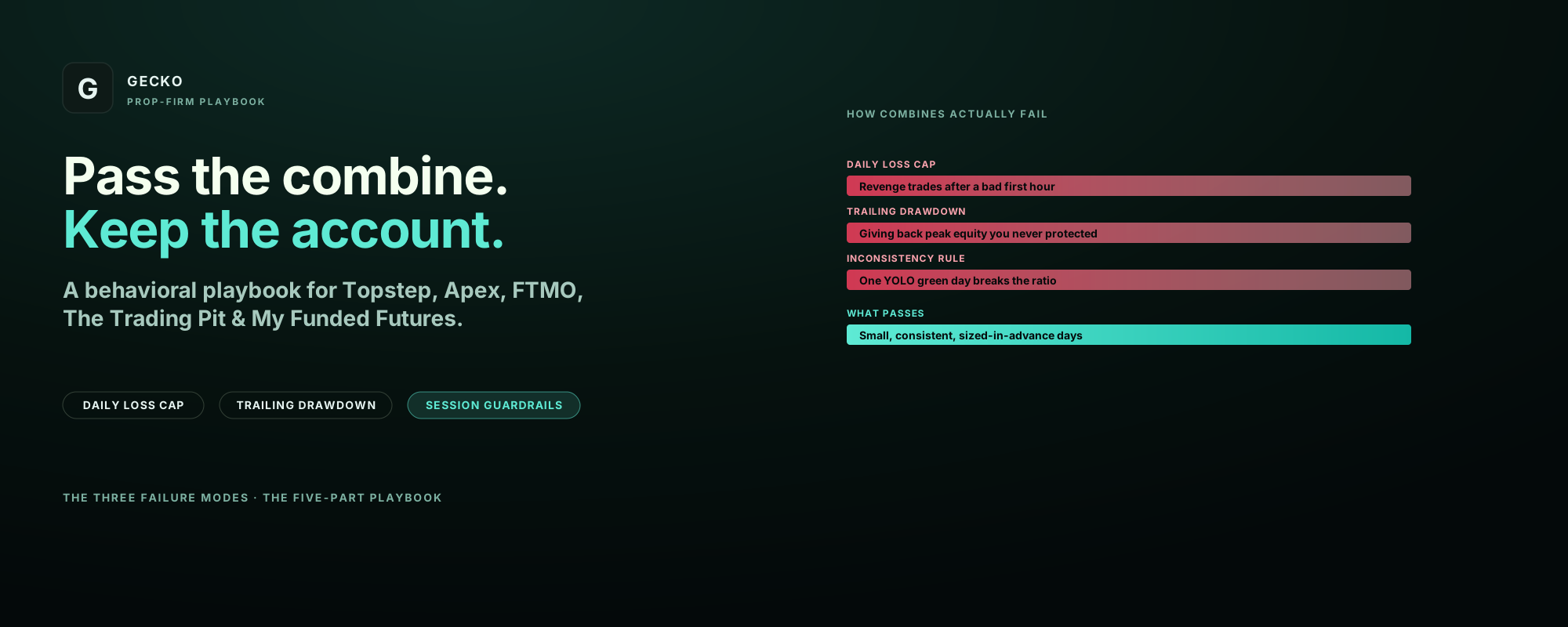
The uncomfortable truth about prop firm combines is that most traders don’t fail because their strategy was wrong. They fail on a single afternoon when a good week turns into a red day, they trade back through the daily loss cap trying to fix it, and the firm’s dashboard shows the account as breached before the session even ends. The strategy could have worked. The sizing couldn’t survive the moment.
This is a behavioral playbook for passing a Topstep, Apex, FTMO, The Trading Pit, or My Funded Futures combine — and, harder, holding onto the funded account once you’re there. It won’t hand you an edge. It will help you not detonate the one you have.
The three ways combines actually fail
Every prop firm ships slightly different rules, but the failure surface is remarkably consistent. You can fail for other reasons (rule violations around news trading, prohibited strategies, sitting on a losing position at the daily cutoff), but the three below account for the overwhelming majority of blown accounts. Getting each one out of your calendar is what “passing” actually looks like.
1. Blowing the daily loss cap
The most common cause of a failed combine is a single red day where you kept trading past your firm’s daily loss limit. Not because the market was unbeatable — usually because you were already down two-thirds of the cap by 10:30 AM and decided to trade back to green. The rule violation is the loss cap. The behavioral cause is after-loss tilt and revenge re-entry. The firm’s dashboard doesn’t care why; it just calls the account.
2. Giving back your trailing drawdown
Most futures firms (Topstep, Apex, MFFU) use a trailing drawdown — the account’s max-loss threshold moves up with your intraday high, so every dollar of unrealized gain that you don’t lock in raises the bar under you. Which means the classic combine death isn’t losing on a bad day — it’s going up +$800 in the morning, trading it back to breakeven by noon, then continuing to trade and eventually printing a small loss the trailing bar can’t survive. You were up. You gave it back. The firm calls it.
3. Tripping the consistency rule
Apex, MFFU, and increasingly the other firms enforce some form of consistency rule — the biggest single day can’t be more than a set percentage of your total profit. It exists to weed out traders who pass a combine on one lucky YOLO day and would blow the funded account the same way. If you go from +$200 days for three weeks to a +$1,500 day because you sized up on “conviction,” the ratio breaks and the combine is invalidated. Passing on a spike is failing on a spike.
Notice the pattern. None of these are analytical failures about the market. All three are execution failures about you. Which is why the playbook that solves them isn’t about picking better setups.
The five-part playbook
1. Set limits below what the firm allows, not equal to it
The first mistake most combine traders make is treating the firm’s max daily loss as their daily loss budget. If Topstep’s $50K Combine caps you at $1,000 daily loss, don’t trade to a $1,000 daily loss — trade to $600 or $700. Give yourself a buffer for the day when a stop slips or a fill is worse than the mid.
The math is boring but binding. If you consistently risk your full cap, you’re one bad execution or one gapping fill away from a breach every day. Trading to 60–70% of the cap means normal-day noise can’t take you out. It’s the same principle as risking a small fixed fraction per trade, applied one level up.
2. Have a written pre-market plan the loss doesn’t override
Write down, before the open: max trades today, max risk per trade, the ONE setup you’re trading, and the loss number at which you stop for the day. This isn’t a wish list. It’s the version of your decision-making that was still sober. When you’re down 60% of your cap at 10:30 AM, you will want to change every number on that list. That desire is exactly why you wrote them down. The plan exists to survive being ignored by your future self.
3. Set live session guardrails so the plan enforces itself
This is where most retail combine traders leave real edge on the table. Willpower is not a strategy — especially not in the middle of a session where the position is bleeding and the plan you wrote at 8am feels like it was written by someone who didn’t understand the setup. Structure enforces what willpower can’t.
Concretely: something — a broker rule, a script, an app, a spreadsheet with alarms — needs to be watching your realized P&L and pinging you at 80% and 100% of your daily loss budget, your trailing drawdown, and your max trade count. Gecko’s Session Monitor does exactly this — you set your daily loss cap, trailing drawdown, profit target, and max trades once in Settings, and it pushes to your phone the moment you cross a threshold during your declared session hours. There’s a one-click preset for each of the firms above so the limits match the actual eval rules. Suggest-only, never touches your broker. But the principle matters more than the tool: some outside voice needs to break through your session-brain before you make the trade that ends the account.
4. Codify your walk-away rules
Two walk-aways worth writing down: the loss walk-away (which you already have from step 2) and the win walk-away. Passing traders will often tell you the day they truly understood the game was the day they closed the platform after hitting their profit target instead of “pressing while it’s working.” The firm’s consistency rule is a mechanical version of this insight: your best day can’t be too much bigger than your typical day. If you’re running a combine, closing out at +$500 six times is a better path to a funded account than one +$3,000 day followed by five +$300 days, because the ratio breaks. Small, boring, repeatable is what actually passes.
5. Review the day honestly, in numbers, before you touch the platform again
Combines are lost in the fog between sessions. You had a red day, you tell yourself it was “just a bad setup,” and you show up the next morning without having interrogated what actually happened. A five-minute honest review — how many trades did I take past my max, what was my average size vs my plan’s max, did I add to losers, did the P&L drop track a plan violation or a market surprise — is what turns a lost day into a paid-for lesson. This is the whole point of a journal that scores your behavior, not just your P&L.
What the firm specifically enforces (and where the limits live)
Every firm publishes their rules but the language varies enough to be confusing. Below are the five firms Gecko ships a preset for and where their specifics land. The preset numbers on /for/prop-firms reflect the published rules as of the noted date and the firm’s dashboard is always the source of truth — but the mechanical shape is stable enough to plan around.
| Firm | Instruments | Drawdown type | Watch out for |
|---|---|---|---|
| Topstep | CME futures | Trailing (intraday) | Trail moves with your high; giving back peak equity is the classic combine death. |
| Apex Trader Funding | CME futures | Trailing (intraday) + consistency rule | Consistency ratio kicks in on the funded side; one big day can invalidate weeks of small wins. |
| The Trading Pit | Futures + stocks | Trailing, tier-dependent | Multi-step eval; Stage 2 is where most traders drift into overtrading. |
| FTMO | Forex, futures, stocks, crypto (CFDs) | Static (not trailing) | 5% daily / 10% overall of starting balance; static means peaks don’t re-arm the trail against you. |
| My Funded Futures | CME futures | Trailing intraday OR EOD (plan-dependent) | Read the plan carefully; intraday and EOD drawdowns behave very differently on a spike day. |
The behavioral fingerprint of a passer vs a failer
If you’ve run a combine before — passed or failed — the answer to whether you’re on track is already in your trade history, not in the firm’s dashboard. Passing traders look boring on paper. Failing traders look erratic before the firm calls it. The table below is what separates them mechanically:
| Passer | Failer |
|---|---|
| Position size stable across trades, changes only by rule. | Size spikes on “conviction,” then again on the trade that’s trying to recover the last loss. |
| Daily loss ends at ~50–70% of firm cap on worst days. | Daily loss regularly finishes within 10% of the cap; occasional breach. |
| Trade count per day inside a narrow band (3–8 for most). | Trade count doubles on losing days — the overtrading signature of tilt. |
| Best day is a small multiple of typical day (e.g. 2–3x). | Best day is a huge multiple (e.g. 8–15x); consistency rule risk. |
| Cuts losers at the pre-defined stop, honors the exit. | Averages down on losers “because I’m right” — the classic LTCM behavior at 1/1000th the scale. |
Notice how much of this is measurable from a trade history, not from a story. Which is why the tightest feedback loop a combine trader has isn’t their firm’s dashboard — it’s their own journal, honestly maintained, that scores whether they looked like a passer or a failer this week.
Why we built the Session Monitor + Prop Firm Presets
This is the point where a lot of blog posts would swerve into a hard pitch. Here’s the honest version. We talked to enough funded traders (and enough about-to-be- funded traders) to notice that the tool that would actually help them wasn’t another dashboard, or another AI coach that told them what went wrong at end-of-day. It was something that would ping their phone at 80% of their daily loss cap and at 80% of their trailing drawdown — before the next click that would breach it. So we built it. It’s called the Live Session Monitor, the prop-firm presets ship for the five firms above, and the whole thing is free on every tier.
You don’t need our tool to run this playbook. But you do need a tool — some outside voice that reaches into your session and gets past session-brain when it counts. If it’s us, great. If it’s a broker alert, a spouse texting you at 11 AM to check in, or a physical index card taped to your monitor that says “WALK AWAY AT $600 LOSS,” that’s fine too. The category matters more than the brand.
From belief to behavior: is your combine trending pass or fail?
This is one of the few questions in trading with a clean answer. Your last 20 trading days can be scored against every one of the passer / failer signatures above — average size, worst-day-vs-cap ratio, trade count on losing days, best-day-vs-typical-day ratio, average-down behavior. If the answer looks like the left column, you’re on track. If it looks like the right column, no amount of trying harder is going to fix a combine you keep entering with the same behavior.
Resources and further reading
- The base rate: Gecko, Why Most Funded Traders Blow the Challenge — why the number of traders who take a funded account and hold it is so much smaller than the number who pass the eval.
- The survival companion: Gecko, How Successful Traders Manage Risk — risk a small fixed fraction, demand asymmetry, de-risk in drawdowns.
- What leverage removes: Gecko, When Genius Failed — being right doesn’t matter if leverage denies you the time to be proven right; the same mechanism at prop-firm scale.
- The academic base rate on day trading: Barber, Lee, Liu & Odean, Taiwan day-trading studies — roughly 1% reliably profitable net of fees; a humbling prior when deciding whether your “strategy” is what’s failing the combine, or your behavior around it.
- The tool + preset library: Gecko, /for/prop-firms — per-firm preset limits for Topstep, Apex, The Trading Pit, FTMO, and My Funded Futures.
Frequently asked questions
An evaluation program run by a proprietary trading firm (Topstep, Apex, FTMO, and similar) where a trader pays a fee to prove they can hit a profit target while staying inside strict daily-loss and drawdown limits. Passing moves them onto a funded account where the firm supplies the capital and the trader keeps a share of profits.
The failure surface is remarkably consistent across firms: breaching the daily loss cap on a revenge- trading spiral, giving back a trailing drawdown by not protecting peak equity, or tripping a consistency rule with a single outsized day. All three are execution-and-behavior problems, not strategy problems.
A trailing drawdown moves up as your account grows — every dollar of unrealized profit you don’t lock in raises the max-loss threshold under you. A static drawdown is fixed at a percentage of the starting balance and doesn’t chase your equity. FTMO uses static; most futures firms (Topstep, Apex, MFFU) use trailing. Trailing is the trickier of the two because giving back your morning peak can end the account.
No. The Session Monitor is suggest-only. When you approach or breach a self-set limit, it pushes a heads-up to your phone and shows an alert on your Dashboard. It never sends orders or cancels positions on your broker or prop account. The firm’s dashboard remains the source of truth for pass / fail.
Playbook in Gecko’s trading psychology series. Firm-specific rule descriptions reflect each firm’s stated public rules as of the dates noted per firm on /for/prop-firms; rules change occasionally and the firm’s own dashboard is always the source of truth. Gecko is not affiliated with, sponsored by, or endorsed by Topstep, Apex Trader Funding, The Trading Pit, FTMO, My Funded Futures, or any other prop firm mentioned. Trading futures, forex, and other leveraged products carries substantial risk of loss. Nothing here is financial or trading advice, or a recommendation for or against any particular firm, strategy, or evaluation program.
Drop in a single statement. Gecko produces a one-page Behavioral Diagnosis ranking your costliest habits in actual dollars. Free to start. No card. No broker connection.
Short notes, usually once or twice a month. Unsubscribe in one click.
No account needed. We use your email only to send Gecko blog posts, and the link at the bottom of every email opts you out in one click.
More on the blog
- Which Strategies Actually Make Millionaires? The Boring Answer, Backed by 10,000 of ThemIf you learned about wealth from social media, you'd think millionaires are minted by 0DTE options, ten-baggers, leveraged crypto, and Lamborghini day-trading. The largest study of US millionaires (Ramsey, 10,000 people) tells a very different story: 8 in 10 named their 401(k) as their #1 wealth-builder, none credited single-stock picking, 89% didn't inherit. Fidelity now counts ~645,000 401(k) millionaires; the average one is nearly 59 and has been in the same account ~25 years. The strategy that mints millionaires isn't a strategy — it's a habit repeated for decades. And it's the same trait every disciplined trader we've profiled shares.
- Jim Simons: The Mathematician Who Beat the Market — and Why You Can't Copy HimRenaissance Technologies' Medallion Fund averaged ~66% gross (~39% net) a year from 1988 to 2018, never had a losing year, and turned $1 into more than $27,000. It is the greatest track record ever recorded — and the definitive counterexample to the efficient-market hypothesis (Cornell, 2020, JPM). Simons wasn't a market natural. He was a world-class mathematician and former NSA codebreaker who turned pattern-detection on prices with an army of PhDs. The honest lesson: his edge is unrepeatable at retail scale — his RELATIONSHIP to evidence and risk (edge measured not felt, process over outcome, never blow up) is what's transferable.
- Midterm Elections Won't Move the Market the Way You Think They WillThe 2026 midterms land on November 3. Political uncertainty carries a real, measurable premium — Pastor & Veronesi's 'political risk premium' shows up in options data across 20 elections in 20 countries. S&P 500 midterm-year returns average ~4.6% since 1950 (below the long-run ~10%), with the deepest intra-year drawdowns of the four-year cycle. But the twelve months AFTER a midterm have never been negative since 1950 — ~15% avg. The real risk for most traders isn't the drawdown; it's headline-driven behavior at the account level. Party-neutral. Historical patterns, not forecasts.